When to Replace a Boiler in the UK: A Practical Guide
Learn when it’s cost-effective to replace a boiler in the UK. This practical guide outlines signs, costs, boiler types, and a step-by-step plan to replace safely and efficiently.


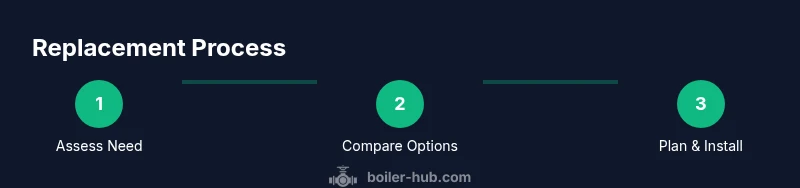
According to Boiler Hub, you should begin by assessing your boiler’s age, reliability, and the cost of frequent repairs. Replace when the unit is old (typically over 10–15 years in UK service), or when running costs dominate repairs. A professional assessment helps compare replacement options and anticipated savings before decisions.
What Triggers Replacement in the UK
In the UK, the decision to replace a boiler often hinges on a combination of age, reliability and ongoing running costs. Most modern condensing boilers deliver much higher efficiency than older non-condensing units, which means substantial savings on fuel bills over time. The Boiler Hub team emphasizes that the calculus is not only about upfront price, but also about long-term value: when repairs become frequent, and energy costs rise, replacement can be the more economical option. Safety matters too: deteriorating seals, heat exchangers, or flue components can increase carbon monoxide risk, so any persistent fault or warning light requires prompt professional attention. If a gas safety engineer detects a fault that could worsen, they will usually advise on next steps, including whether a replacement is appropriate. In addition to safety, consider your home’s heating needs. A newer boiler paired with smart controls or zoning can improve comfort and reduce fuel usage. This is particularly relevant in older homes with uneven heat distribution. According to Boiler Hub, an initial, impartial assessment helps homeowners weigh repair costs against replacement value and plan for future energy savings.
When planning, remember that equipment ages differently depending on usage, maintenance, and installation quality. For many UK households, upgrading a boiler becomes attractive once a unit passes its mid-life phase and reliability declines, or when the cost of ongoing repairs approaches or exceeds the cost of a newer, more efficient model. This is a decision that benefits from a structured comparison of options, rather than a single repair job that prolongs a marginally functioning system.
note":"100-300 words"},{
Tools & Materials
- Boiler service history records(Recent service paperwork, fault history, and last audit date)
- CO detector(Battery-operable, calibrated; place near boiler area)
- Notebook and pen(For logging faults, dates, and costs during assessment)
- Measuring tape(Useful for checking space for replacement unit)
- Budget planning worksheet (digital or paper)(Helps compare upfront installation vs ongoing running costs)
- Manufacturer’s boiler manual or spec sheet(Reference for installation clearances and compatibility)
Steps
Estimated time: 1-2 hours for a thorough self-assessment, plus professional quotes over 1-2 weeks
- 1
Gather boiler history
Collect the boiler’s age, model, and service history. Note any recurring faults, unusual noises, or pressure changes. This baseline helps determine whether repair or replacement is more economical.
Tip: Keep a single file or log to track every fault and service date. - 2
Assess age and可靠性
Estimate the unit’s useful life based on type and usage. Condensing boilers typically last longer when well maintained. If the boiler is approaching or past mid-life and requires frequent repairs, replacement becomes more sensible.
Tip: If you’re unsure, have a Gas Safe engineer perform a quick health check. - 3
Estimate running costs vs repair costs
Calculate annual energy use and compare it with the cost of regular repairs. If annual repairs are frequent, replacement can offer predictable energy costs and better efficiency.
Tip: Ask your installer to provide an energy-savings estimate for a new unit. - 4
Explore replacement options
Choose between combi, system, or heat-only boilers based on your hot-water needs and household size. Newer models often pair with smart controls for zoned heating.
Tip: A knowledgeable installer can tailor a plan to your home’s layout. - 5
Budget and financing planning
Factor in upfront costs, installation, and potential backup heating during install. Check for warranties and available government or manufacturer incentives for energy-efficient models.
Tip: Get at least 3 quotes to compare total installed costs. - 6
Schedule installation with a Gas Safe engineer
Arrange a verified, gas-safe professional to confirm compatibility, install the unit, and test safety features. Ask about venting, commissioning, and commissioning certificates.
Tip: Never attempt installation yourself; gas work requires certification.
Questions & Answers
How old is too old for a boiler in the UK?
There isn’t a single cutoff, but many UK boilers become less economical after about 10-15 years of service, especially if reliability declines. A professional assessment can confirm whether replacement offers better value than continued repairs.
Most homes consider replacement around the mid-life point if repairs are frequent; a pro will confirm based on condition and costs.
What signs indicate a boiler needs replacement?
Frequent breakdowns, rising energy bills, inconsistent heat, cold spots, strange noises, and warning lights are strong indicators. If safety concerns arise, contact a Gas Safe engineer immediately.
Look for frequent faults, poor heating, and safety warnings—these suggest it may be time to replace.
Is replacement worth it if repairs are cheap now?
If repairs are sporadic and inexpensive, continuing with maintenance may be sensible. If repairs are becoming more frequent or the unit is aging, replacing with a newer, efficient model can save on running costs.
Repair not paying off? A newer model could cut ongoing costs even if recent repairs were cheap.
What are the typical costs of replacing a boiler in the UK?
Costs vary by boiler type, home size, and installation complexity. Talk to installers about total installed price, including venting, system upgrades, and warranty coverage.
Prices vary, so get multiple quotes for a full installed price and warranty details.
Can I replace a boiler myself?
No. Gas boiler work requires a Gas Safe registered engineer. Improper installation risks gas leaks, CO exposure, and legal penalties.
Boiler work must be done by a licensed professional; never attempt it yourself.
What type of boiler should I choose in the UK?
A professional can recommend combi, system, or heat-only based on hot water needs, home size, and existing plumbing. Modern models are generally more efficient and compatible with smart controls.
Your home’s needs determine the best type; an expert will tailor a solution.
Watch Video
Key Points
- Assess age, reliability, and running costs first
- Choose the right boiler type for your home
- Get multiple quotes and compare total installed costs
- Plan installation safely with a Gas Safe professional