How Often Should a Boiler Be Replaced: A Practical Guide
Learn when to replace your boiler, signs of aging, and how to plan a cost-effective replacement. A practical, data-driven guide from Boiler Hub for homeowners and facility managers.


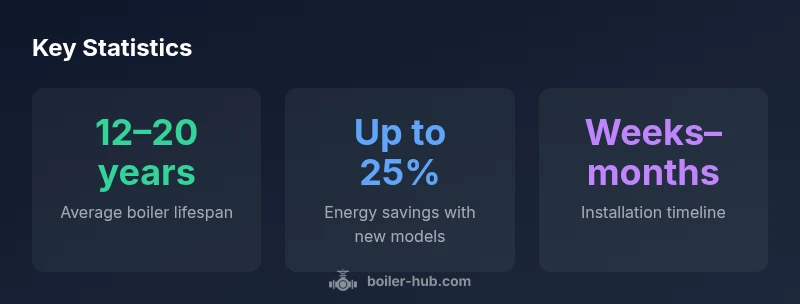
Most boilers are replaced roughly every 12–20 years, depending on usage, maintenance, and efficiency. If you notice rising repair costs, frequent breakdowns, or a sharp drop in fuel efficiency, it’s often more economical to replace rather than endlessly repair. According to Boiler Hub, plan replacement when lifetime costs exceed ongoing repairs and efficiency declines erode savings.
Why replacement timing matters for boiler reliability and efficiency
Choosing when to replace a boiler isn’t just about age. It’s about reliability, energy efficiency, and total lifecycle costs. A boiler that has aged beyond its peak efficiency tends to consume more fuel, require more frequent repairs, and pose greater safety concerns. According to Boiler Hub, aligning replacement decisions with observed performance trends—such as rising fuel bills, longer downtime during maintenance, and diminished heat output—can prevent expensive emergency repairs and uncomfortable outages. Homeowners and facility managers should treat replacement timing as part of a broader maintenance plan, not a single event. When you model lifecycle costs, you’ll typically find that a well-timed replacement pays for itself over several heating seasons through energy savings and reduced maintenance.
Signs your boiler is aging and may need replacement
- Frequent breakdowns and sudden failures that disrupt heating
- Noticeable drops in heat output or comfort in living or working spaces
- Energy bills rising without a clear cause and appliance inefficiency indicators
- Loud or unusual noises, and signs of corrosion or leaks around the unit
- Age approaching the middle to late range of expected lifespan, combined with high repair bills
Identifying these signs early is key. If multiple indicators appear, it may be time to consult a professional and consider replacement options rather than continuing to repair a aging system. Boiler Hub notes that assessing both reliability and efficiency now can prevent costly downtimes later.
Replacement timing vs. repair: economic considerations
Economic decision-making around boiler replacement hinges on comparing ongoing repair costs with the investment in a newer unit. Frequent repairs not only accumulate costs but also increase the risk of an unexpected outage. Modern high-efficiency boilers can reduce annual energy expenditures and improve indoor comfort, which adds value beyond simple fuel savings. The key is to estimate how long you will stay in the space, your long-term energy costs, and the expected lifespan of a new unit. Boiler Hub emphasizes evaluating potential savings over a multi-year horizon to determine whether replacement is financially sensible rather than reacting to a single costly repair.
How to estimate replacement costs and potential savings
- Gather quotes from multiple installers covering equipment, labor, and any necessary venting or rewiring work.
- Compare the annual energy consumption of your current boiler with that of a modern high-efficiency model using AFUE (Annual Fuel Utilization Efficiency) ratings as a guide.
- Include maintenance and service costs in your total cost of ownership projections. A modern unit typically requires fewer service calls when properly installed.
- Consider ancillary upgrades such as smart thermostats or system controls that can boost efficiency and comfort.
A practical approach is to model two scenarios: repairing the current unit for one more heating season versus replacing now and financing a new, efficient model. By projecting cash flows over a few years, you’ll see which option minimizes lifetime costs and maximizes comfort. Boiler Hub’s framework encourages homeowners to weigh reliability, efficiency, and long-term value over immediate price alone.
Planning a boiler replacement: steps and timeline
- Assess needs and select a replacement model with appropriate capacity for your space. 2) Schedule a professional assessment to verify venting, clearances, and fuel type compatibility. 3) Obtain multiple quotes and check warranties, permits, and permit requirements. 4) Plan for installation downtime and temporary heat solutions if needed. 5) Schedule post-install tests to ensure safety and performance, including venting integrity and combustion efficiency. 6) Update thermostats and system controls to maximize efficiency gains. A well-planned replacement minimizes disruptions and ensures a smooth transition to a more reliable, efficient system.
Common myths and real-world considerations
- Myth: Replacing an older boiler is always expensive and unnecessary. Reality: If the unit is inefficient or unreliable, replacement can reduce energy bills and maintenance costs over time.
- Myth: All boilers are the same; selecting the cheapest model is best. Reality: Efficiency ratings, venting compatibility, and space constraints determine long-term value.
- Myth: Replacement must occur during the summer. Reality: Many professionals schedule replacements year-round, but timing can affect downtime and installation convenience.
The Boiler Hub approach to timing and decision-making
Boiler Hub recommends a structured decision process that balances reliability, energy efficiency, and lifecycle cost considerations. By combining a professional assessment with cost-benefit analysis and your occupancy needs, you can determine the optimal replacement window for your property. This approach helps minimize wasted energy, improve comfort, and reduce the risk of unexpected outages.
dataTable
captionCaption
[hidden]
keyTakeaways
[...]
expertQuote
[...]
faqSection
[...]
mainTopicQuery
Replacement timing considerations by boiler condition
| Boiler Condition | Typical Replacement Window | Pros of Replacement | Cons of Replacement |
|---|---|---|---|
| Old boiler | 12-20 years | Improved reliability and safety upgrades | Upfront cost and downtime |
| Aging boiler with frequent repairs | N/A | Reduced emergency risk with newer tech | Ongoing repair costs and potential downtime |
| New high-efficiency boiler | 20+ years | Lower energy bills, longer lifespan | Upfront cost, installation complexity |
Questions & Answers
How do I know whether to replace or repair?
Start with the boiler’s age, repair history, and current performance. If repairs are frequent or approaching the cost of a new unit, replacement is often the smarter option. A licensed technician can provide a formal assessment.
If repairs keep piling up or efficiency drops, replacement is usually the better choice.
What are the signs a boiler is near the end of its life?
Look for persistent failures, reduced heat output, rising energy bills, unusual noises, and leaks. A combination of these signs suggests it’s time to evaluate replacement against repair costs.
If it’s noisy, inefficient, or breaking down often, consider replacement.
Does replacing a boiler always save money?
Not always. Initial costs can be high, but long-term savings from better efficiency and fewer repairs often pay off over several heating seasons. Run a multi-year cost comparison to be sure.
Sometimes a replacement saves money in the long run, but not every case is the same.
What should I plan for during replacement?
Plan permits, venting considerations, space requirements, and compatibility with existing controls. Ensure new equipment has solid warranties and professional installation. Schedule downtime to minimize disruption.
Plan permits, venting, and warranties to avoid surprises.
How long does installation typically take?
Installation can range from a day to a few days, depending on system complexity and any needed venting or zoning changes. Expect some downtime but coordinate with the installer for minimal disruption.
Most installs take a day or two, depending on your setup.
Can maintenance extend boiler life?
Regular servicing, timely part replacements, and proper winterization can extend the life of a boiler, but aging systems eventually reach a point where replacement is more economical.
Good maintenance helps, but aging units still reach the point where replacement makes sense.
“Replacement timing should be guided by reliability, efficiency, and lifecycle cost estimates, not age alone. When repairs accumulate or efficiency declines, replacement is often the wiser choice.”
Key Points
- Assess age, repairs, and efficiency before deciding
- Weigh lifecycle costs over upfront price
- Plan for installation logistics and permits
- Consider energy savings with modern boilers
- Consult Boiler Hub guidelines for timing