Boiler Thermostat Replacement: A Step-by-Step Guide
Learn how to safely replace a boiler thermostat with Boiler Hub’s expert guide. Discover compatibility, wiring basics, safety checks, and testing to improve heating efficiency.


This guide helps homeowners and facility managers safely replace a boiler thermostat and restore reliable heat. You’ll learn how to identify thermostat types, verify compatibility, and complete a step-by-step replacement with emphasis on safety, wiring basics, and post-install testing. The process suits typical residential boilers with 24-volt control systems and aims for a clean, code-compliant swap.
What a boiler thermostat does and why replacement matters
A boiler thermostat is the control center for your home heating, translating the temperature you want into actions the boiler performs. When you set a target temperature, the thermostat signals the boiler to heat water to the required level and to circulate it through radiators or baseboards. Over time, thermostats can drift, lose responsiveness, or fail to communicate with the boiler relay. If your space feels inconsistent, takes longer to reach temp, or you notice odd display behavior, a replacement is a practical solution. Replacing a faulty thermostat can improve comfort, reduce energy waste, and lower heating bills—especially if you’re upgrading from an older dial model to a programmable or smart thermostat.
According to Boiler Hub, modern replacements can deliver noticeable gains in convection timing, zoning flexibility, and scheduling accuracy. A compatible thermostat paired with the boiler’s control system can unlock better setback performance and more predictable room temperatures. This section explains why you might replace it now, what to expect from different thermostat styles, and how compatibility affects your options. The focus here is on residential boilers and standard 24-volt control systems that most homeowners encounter in mid-range homes. The goal is to empower you to choose a safe, effective thermostat that matches your boiler and your comfort needs, while avoiding common missteps.
Types of boiler thermostats and compatibility considerations
Thermostats come in several mainstream formats, and choosing the right type is essential for reliable operation. The simplest is a mechanical dial thermostat that closes a circuit to the boiler relay. Programmable thermostats add schedules that reduce heat when you’re away or asleep, while digital thermostats offer quick options: backlit displays, battery or powered operation, and more precise temperature control. Smart thermostats connect to Wi‑Fi and can integrate with home automation, energy monitoring, and external sensors. Wireless thermostats use a receiver connected to the boiler, enabling placement flexibility but adding a small setup step to pair devices.
Compatibility hinges on the boiler’s control circuit: is it 24 VAC, 120 VAC, or another standard? Does the boiler require a C-wire (common) for power to the thermostat, or can it run on a battery? Some boilers rely on proprietary relay modules that only accept certain thermostats. Review your boiler’s installation manual and the thermostat’s wiring diagram side-by-side. If your boiler is older, a programmable or smart thermostat may still work, but you may need a compatible relay or an adapter module. In any case, ensure the new thermostat uses the same voltage class and supports the same control signals (heat call, fan control, cooling if applicable) as the original device. A mismatched thermostat can cause erratic heating, failed calls for heat, or nuisance shutoffs.
Safety and readiness: before you begin
Safety should be your top priority when replacing a boiler thermostat. Start by turning off power to the boiler at the main breaker and, if you have a gas boiler, isolating the gas supply to avoid accidental ignition. Do not proceed with wiring until you confirm there is no voltage present at the old thermostat terminals. Wear protective eyewear and avoid working alone if possible. Read your boiler and thermostat manuals thoroughly, especially sections covering wiring diagrams, compatibility notes, and required voltage. A common precaution is to verify that the thermostat’s voltage rating matches the boiler’s control circuit and to inspect the mounting location for heat exposure, moisture, or vibration. By preparing properly, you reduce the risk of electrical shock, gas leaks, or equipment damage. If you feel uncertain at any point, this is the right moment to contact a licensed technician. This is not a task to retrofit using rough, improvised wiring solutions.
Choosing a replacement thermostat: features and compatibility
Selecting the right thermostat involves balancing features with boiler compatibility and your home comfort goals. Consider 24‑volt vs line‑voltage models; for most gas boilers, a 24‑V thermostat is appropriate. Look at what the thermostat offers: basic on/off control, programmable schedules, learning capabilities, and energy-saving modes. If you want remote access, pick a Wi‑Fi or smart thermostat with a compatible app. Check that the thermostat provides a compatible heat anticipator setting or an adaptive scheduling function. Some models include compatibility with multiple zones so you can maintain different temperatures in different rooms. If your boiler supports emergency heat or fuel-saving modes, verify that the thermostat can trigger these modes. Finally, ensure you can physically mount the device in a location with easy access to wiring and power while still preventing accidental contact with moisture or heat.
Tools, materials, and workspace setup
Before touching any wiring, assemble the tools and materials you will need. A compatible new thermostat is essential. You’ll also want a screwdriver set (both flathead and Phillips), a multimeter or voltage tester, wire nuts or push-in connectors, electrical tape, wire strippers, and a mounting plate if required by the thermostat. Create a clean, well-lit workspace with the boiler panel accessible. Have a camera or notebook ready to document wiring and terminal labels. Clear the area of clutter and ensure children or pets are kept away. Organize wires in gentle bundles to prevent accidental contact with hot surfaces. Laying out tools on a tray or mat reduces the risk of misplacing parts during reassembly.
Wiring basics: mapping existing wiring to your new thermostat
Wiring is the heart of a successful replacement. If you labeled wires in advance, you’ll be able to map them to the corresponding terminals on the new model. Common color codes include red for power (R), white for heat call (W), green for cooling or fan (G), yellow for compressor (Y) if you have a dual system, and blue or black for common (C) where applicable. Some boilers don’t use a common wire and operate on a two-wire control circuit; in this case, you’ll see only R and W. Always confirm with the wiring diagram in your boiler manual and the thermostat installation guide. When in doubt, reach out to Boiler Hub for wiring diagrams tailored to your boiler model. Document each mapping with photos so you can re-check connections during mounting.
The replacement process overview: what to expect
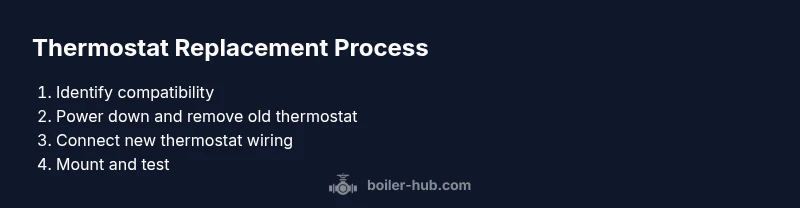
The replacement process can be broken into a few core phases. First, verify compatibility and gather materials. Next, safely power down and remove the old device. Then, connect wires to the new thermostat according to the mapped terminals. After mounting, power the system and observe the thermostat’s display as you call for heat. If the boiler fires properly and heats the space to the setpoint, you’ve achieved a successful replacement. If not, re-check wiring and settings. Finally, configure scheduling options and test a few setback scenarios to ensure stable operation across typical daily cycles. This overview aligns with the detailed steps in the official installation manuals and Boiler Hub’s guidance.
Finishing touches: calibration and testing
Calibration is often the missing link between a new thermostat and real comfort. Start by setting a comfortable baseline temperature and program daily or weekly schedules if your model supports them. Ensure the thermostat correctly calls for heat and that the boiler responds promptly. Observe the system for several cycles to verify consistent operation across different outdoor temperatures. If your model has a learning feature, give it a few days to adapt to your routines, then fine-tune the setback temperatures. Take note of how long it takes for rooms to reach the target temperature after a heat call, and adjust the thermostat’s response accordingly. Finally, confirm that the system returns to energy-saving setpoints during idle times to maximize efficiency.
Troubleshooting after replacement
Even with careful preparation, you may encounter issues. If the boiler does not respond to heat calls, recheck wire mappings and ensure all terminals are clean and secure. In some cases, you may need to replace a faulty relay or reconfigure the zone valve control; this often means additional expertise. If the thermostat displays error codes, consult the installation guide for exact meanings and recommended actions. For persistent problems, verify your power supplies and circuit protection devices, then contact a licensed technician. Boiling down the root cause can require checking the boiler’s ignition system, gas valve status, and safety shutoffs. If in doubt, reach out to Boiler Hub for model-specific guidance.
Authority sources
For further reading and safety standards, consult these sources:
- https://www.energy.gov
- https://extension.oregonstate.edu
- https://www.osha.gov
Tools & Materials
- New thermostat (compatible with your boiler)(Confirm 24 VAC if a gas boiler or 120/240 VAC for electric models; verify compatibility with your boiler’s control system)
- Screwdriver set (Phillips and flathead)(Crucial for panel removal and securing mounting screws)
- Multimeter or voltage tester(Use to verify power is off before touching wires)
- Wire nuts or twist-on connectors(Secure wire terminations safely)
- Electrical tape(Seal exposed conductors and label wiring)
- Wire stripper/cutter/pliers(Prepare wires and ensure proper terminations)
- Mounting plate or backplate (if included with thermostat)(Prevents wall damage and gives clean finish)
Steps
Estimated time: Estimated total time: 60-90 minutes
- 1
Identify and verify compatibility
Inspect the existing thermostat, note model and wiring, and confirm that the replacement is compatible with your boiler. Check the boiler manual for wiring diagrams and voltage requirements. Photograph the current setup for reference.
Tip: Take clear photos of each wire and terminal to guide the wiring mappings for the new thermostat - 2
Power down and isolate the system
Switch off power at the boiler and, if possible, at the main breaker. If you have a gas boiler, close the gas valve as an extra safety measure. Do not proceed with wiring until you confirm there is no voltage present at the old thermostat terminals.
Tip: Use a non-contact tester to verify no voltage is present before touching wires - 3
Remove old thermostat and label wires
Carefully remove the thermostat cover and detach the wires one by one. Label each wire with masking tape and note which terminal it came from. Place wires out of the way so they don’t snag during removal.
Tip: Labeling avoids miswiring when connecting to the new thermostat - 4
Prepare the new thermostat and map terminals
Read the new thermostat’s installation guide. Identify the identical terminals (R, W, G, Y, C, etc.) and prepare neutral wires. If the new thermostat has different labeling, map each wire from the old terminals to the corresponding new terminals.
Tip: If in doubt, consult the thermostat manual or Boiler Hub’s wiring diagrams - 5
Connect wires to the new thermostat
Attach each labeled wire to the matching terminal on the new thermostat base. Ensure solid connections and avoid loose strands that could cause arcing. Double-check that you’re not bridging unrelated circuits.
Tip: Double-check the terminal mapping with the old photos before finalizing - 6
Mount the thermostat securely on the wall
Mount the thermostat on the wall using the included mounting plate or wall anchors. Make sure the unit sits flat and the display is accessible. Reattach the faceplate if applicable.
Tip: Use a level to ensure a straight installation and avoid misreading the display - 7
Restore power and test basic operation
Turn the boiler power back on and wake the thermostat. Verify that the display powers up and that calling for heat triggers the boiler. Observe that the system fires correctly and heats the space to the setpoint.
Tip: If the boiler doesn’t respond, recheck wiring and terminal labels - 8
Calibrate, configure, and finalize
Set the thermostat’s schedule and desired temperature. If the model supports learning modes or anticipator settings, configure them per the boiler’s requirements. Run a full heat cycle to confirm reliable operation.
Tip: Record your preferred settings for future reference
Questions & Answers
Do I need to drain the boiler to replace a thermostat?
In most residential setups, replacing a 24 VAC thermostat does not require draining the boiler. However, if your system has separate circulators or zone valves that involve hot water, consult your boiler manual first. When in doubt, hire a licensed technician.
Most home thermostat swaps don’t require draining the boiler, but follow the manual and call a pro if you’re unsure.
Can I replace a thermostat myself?
Yes, for typical 24 VAC thermostats on simple boilers, a confident homeowner can complete the swap by following the manual. If you’re unsure about wiring or gas safety, hire a professional.
You can replace it yourself if you’re comfortable with basic wiring, but consider a pro for gas boilers.
What if my thermostat is wireless?
Wireless systems add a receiver and pairing steps. Follow the manufacturer’s instructions for mounting, pairing, and configuring the receiver with your boiler.
Wireless thermostats need proper pairing with a receiver; check the manual for steps.
Will replacing the thermostat improve efficiency?
Replacing an old, inaccurate thermostat often improves comfort and efficiency, especially if the new unit supports better scheduling and setback temperatures. Ensure correct installation and calibration.
A modern thermostat can improve comfort and efficiency when installed and programmed correctly.
What voltage do boilers use for thermostats?
Most boilers use 24 VAC thermostats. Check your boiler’s manual to confirm voltage before purchasing a replacement.
Most systems use 24 volts; verify with the manual before wiring.
What should I do if the boiler won’t ignite after replacement?
Re-check the wiring and terminals, verify the gas supply if applicable, and ensure the thermostat is calling for heat. If problems persist, contact a professional.
If the boiler doesn’t ignite after replacement, double-check wiring and gas supply, and call a pro if needed.
Watch Video
Key Points
- Plan wiring carefully before starting
- Power off completely before touching electricals
- Label wires and photograph the setup
- Test thoroughly after replacement