Boiler Replacement Cost: What to Expect in 2026
Understand boiler replacement cost ranges, what influences price, and practical tips to save. A Boiler Hub guide covering installation, labor, fuel types, and financing options for homeowners and facility managers.


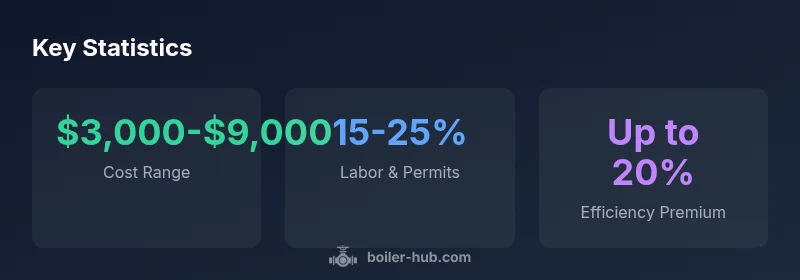
Boiler replacement cost typically ranges from $3,000 to $9,000, depending on boiler size, fuel type, and efficiency. Higher-efficiency models and complex venting can push costs toward the upper end. Planning with written quotes and a clear scope helps avoid surprise fees. According to Boiler Hub Analysis, 2026, most projects fall within this range when factoring equipment, labor, and permits.
What influences the total boiler replacement cost in 2026
In 2026, the total boiler replacement cost goes beyond the base price of the new unit. The Boiler Hub Analysis, 2026 notes that the final outlay typically includes equipment, labor, permits, and sometimes upgrades to venting, condensate drainage, and combustion air supply. The exact figure varies by boiler size (measured in BTUs per hour), energy source, and efficiency target. For homeowners and facility managers, understanding these components helps create a realistic budget and avoids sticker shock when the installer presents a final quote. Regional price differences, permit requirements, and installation challenges all contribute to the final number. The goal is to estimate total cost upfront and align it with long-term savings from improved efficiency and reliability.
Major cost drivers you should know
- Boiler size and efficiency: Higher BTU and efficiency ratings generally increase upfront cost but reduce operating costs over time.
- Fuel type and installation requirements: Gas, oil, electric, and combined systems each carry different installation needs, venting, and fuel line considerations.
- System complexity: If the existing footprint requires piping reconfigurations, radiant loops, or zone controls, expect higher labor costs.
- Permits and inspections: Local regulations can add time and fees; some jurisdictions require noxious-emissions checks or ductwork tests.
- Location and accessibility: Boiler placement, attic access, and proximity to utilities affect labor difficulty and safety measures.
- Removal and disposal of old equipment: Costs for hauling away the old boiler and any tanks can add to the total.
- Additional components: Expansion tanks, new pumps, and upgraded controls may be recommended and billed separately.
Carefully itemize each cost so you can compare apples-to-apples across quotes.
Cost ranges by fuel type and efficiency
- Gas condensing boiler: Typical ranges from roughly $4,000 to $9,000 depending on efficiency class and venting needs. Higher-efficiency models may push toward the top of that range.
- Gas non-condensing boiler: Often in the mid-range, about $3,500 to $6,500, with venting and installation complexity driving the final price.
- Oil-fired boiler: Commonly $5,000 to $10,000 due to fuel line considerations, storage requirements, and more extensive venting.
- Electric boiler: Generally $3,000 to $6,000; best for smaller homes or supplemental heat, with lower upfront costs but limited output.
- Combination boiler (combi): Typically $6,000 to $9,500, especially when space constraints or high domestic hot water demand are factors.
Note: These ranges reflect typical installations and can vary by region, contractor, and whether an extensive venting upgrade is needed.
Regional differences and timing considerations
Regional costs vary due to labor rates, permit fees, and the cost of utilities. Coastal cities may incur higher permitting costs and labor due to regulations, while rural areas might see longer travel times included in estimates. Climate also affects the urgency of replacement; harsher winters push a quicker decision but may escalate temporary heating rental costs if a replacement is delayed. Market conditions in 2026, including supply chain dynamics, can influence lead times for parts and equipment, potentially impacting project scheduling and total cost.
Hidden costs you should budget for
- Old unit removal and disposal: Many jurisdictions charge a disposal fee or require decommissioning procedures.
- Venting and ductwork upgrades: Existing venting may be insufficient for newer models, requiring upgrades.
- System tests and commissioning: Ensures safety and performance after installation.
- Water treatment and piping upgrades: Some homes need new piping, pressure adjustments, or scale treatment.
- Expansion tanks and circulator pumps: Not always included in base price but advisable for long-term reliability.
- Permits and inspections: Always verify which permits apply in your locality; fee structures vary widely.
Accounting for these ensures you don’t stumble on surprise charges after work begins.
How to get an accurate quote: a practical checklist
- Get multiple, detailed written estimates from licensed installers.
- Ensure each quote itemizes equipment, labor, permits, removal, and disposal.
- Ask about venting upgrades, expansion tanks, and zone controls.
- Request a plain-English explanation of any recommended upgrades or additional parts.
- Confirm timelines, lead times, and warranty terms.
- Compare energy performance ratings and estimated annual operating costs.
- Check for financing options, utility rebates, and tax incentives.
- Schedule a pre-install energy assessment if available to optimize system size and efficiency.
Financing, incentives, and total cost of ownership
Beyond the upfront price, total cost of ownership includes operating costs, maintenance, and potential incentives. Look for utility rebates, manufacturer financing, and contractor-led financing plans. Tax credits and incentives may apply for high-efficiency equipment, depending on local programs. Calculating the 5- to 7-year operating savings against the upgrade cost helps determine payback time and financial viability. A well-chosen boiler offers consistency, reliability, and lower energy bills over its life.
Real-world scenarios: typical homeowner cases
- Scenario A: A 2,000–2,500 sq ft single-family home in a temperate climate with natural gas and a standard-efficiency boiler. Replacement cost might land in the mid-range, with moderate labor and venting needs. The decision often hinges on efficiency improvements and maintenance history.
- Scenario B: A multi-story home in a dense urban area with limited space and a need for high domestic hot water. A compact combi or high-output system may be preferred, pushing the cost higher due to space constraints and more complex installation. In both cases, evaluating total cost of ownership, including fuel savings, is essential.
Quick-start checklist before you commit to a replacement
- Confirm total installed cost, not just the equipment price.
- Verify warranty terms for both equipment and labor.
- Check if the quote includes removal and disposal of the old boiler.
- Ask about venting, piping, and any required upgrades.
- Request energy performance data and annual operating cost estimates.
- Review financing options and available incentives.
- Inspect current insulation and consider upgrades to maximize efficiency.
Practical takeaways for planning a boiler replacement cost in 2026
- Expect a total project cost that includes equipment, labor, permits, and disposal; plan for contingencies.
- Higher efficiency often raises upfront cost but lowers long-term energy bills and payback time.
- Always obtain multiple, detailed quotes and compare energy performance data, warranties, and service terms.
- Consider financing and incentives to reduce the immediate burden while maximizing long-term savings.
Typical boiler replacement cost ranges by boiler type
| Boiler Type | Typical Cost Range | Key Considerations |
|---|---|---|
| Gas condensing | $4,000-$9,000 | High efficiency; potential venting upgrades |
| Oil-fired | $5,000-$10,000 | Fuel delivery logistics; storage and venting |
| Electric | $3,000-$6,000 | Lower upfront cost; limited heating capacity |
| Combination boiler (combi) | $6,000-$9,500 | No storage tank; may need higher input for DHW |
Questions & Answers
What is the typical boiler replacement cost?
Costs vary by boiler type, size, and installation complexity, but most projects fall within a broad range of several thousand dollars. Always obtain a written, itemized quote that includes equipment, labor, permits, and removal.
Costs vary by boiler type and install complexity. Get a detailed written quote to compare all components, including permits and removal.
What does the cost include besides the boiler unit?
Typical quotes include the new boiler, labor for installation, permits, venting upgrades if needed, disposal of the old unit, and basic testing. Some quotes exclude extended warranties or future maintenance.
Most quotes cover equipment, labor, permits, venting work, disposal, and basic testing.
How long does boiler replacement take?
Most replacements take 1-3 days depending on existing infrastructure, venting needs, and whether upgrades to piping or controls are required. Complex jobs can take longer.
Most installs are done in 1-3 days, depending on complexity.
Can I reduce boiler replacement costs?
Shop around for quotes, request itemized bids, compare efficiency ratings, and consider financing options. Regular maintenance on the old system before replacement can also help inform the sizing and cost.
Get multiple quotes and compare efficiency and financing options.
Are there incentives for high-efficiency boilers?
Utility rebates and tax incentives may apply for high-efficiency equipment, depending on location and programs active in 2026. Check local energy offices and manufacturers for current offers.
Look for rebates and tax credits for high-efficiency models.
What should I ask installers to ensure transparency?
Ask for a detailed, written quote with line-item pricing, a project timeline, warranty terms, and a breakdown of any optional upgrades. Request a post-installation test and a written energy-use estimate.
Get a written, detailed quote and warranty information.
“"A boiler replacement is most cost-effective when you factor total cost of ownership, not just the sticker price. Compare efficiency, installation complexity, and long-term energy savings to avoid overspending."”
Key Points
- Know the full installed cost, not just the equipment price
- Higher efficiency boosts upfront cost but lowers operating costs
- Obtain multiple, itemized quotes for apples-to-apples comparisons
- Budget for permits, disposal, and potential venting upgrades
- Explore financing and incentives to improve affordability