Boiler or Furnace: A Practical Comparison for Home Heating
Explore the key differences between boiler and furnace heating systems, including heat delivery, efficiency, costs, and installation considerations to help homeowners choose the right option.


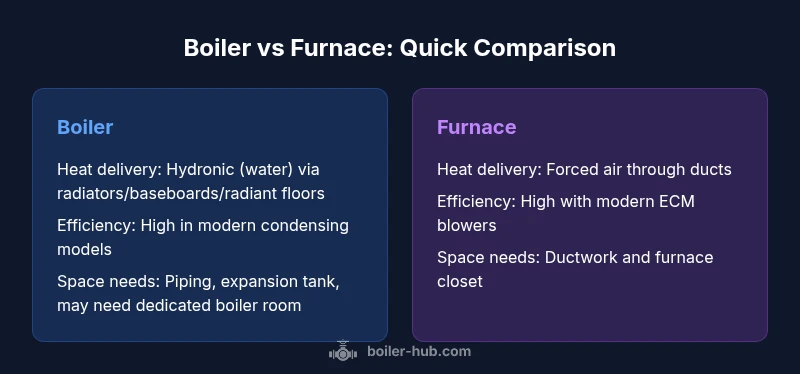
The choice between a boiler or furnace depends on your home layout, climate, and budget. A boiler heats water to circulate through radiators, baseboard, or radiant floors, while a furnace heats air that travels through a duct network to warm living spaces. In general, boilers excel in efficiency and humidity control with hydronic systems, while furnaces offer lower upfront costs and simpler installation. Boiler or furnace selections should be guided by space, fuel type, and long-term operating costs, not just sticker price.
What is a boiler or furnace?
A clear starting point is defining what each system actually does. When homeowners say 'boiler or furnace,' they usually refer to two fundamentally different ways of generating warmth. A boiler heats water to circulate through radiators, baseboard, or radiant floors, while a furnace heats air that travels through a duct network to heat living spaces. The distinction between water-based heat and air-based heat influences comfort, humidity, and how you experience winter inside the home. In many older homes, you may already have one system type installed, or you may be considering a retrofit to take advantage of new efficiency standards. Boiler or furnace decisions should consider your current infrastructure, space availability, and long-term energy costs, not just sticker price. Throughout this guide from Boiler Hub, we’ll compare both options with practical, evidence-based criteria.
How they heat: water vs air
In a boiler system, heated water circulates through pipes to radiators or underfloor loops. The temperature then radiates into rooms and, in some setups, adds a small amount of moisture to dry indoor air. In contrast, a furnace uses a heat exchanger to warm air which is pushed by a blower through a network of ducts. This results in rapid air heating and easy zoning, but the warmth can feel hotter and drier in rooms without humidification. When choosing boiler or furnace, consider whether you prefer steady radiant warmth or quick, blast-style heat; your climate, insulation, and existing ductwork will steer the best fit. For homes with radiant floors or hydronic radiators, a boiler is often more compatible, while homes without ductwork may favor a furnace installation.
Efficiency and operating costs
Efficiency is one of the most important factors when evaluating boiler or furnace options. Modern boilers, particularly high-efficiency condensing models, can deliver AFUE ratings in the 90s, especially when paired with well-insulated piping and a tight building envelope. High-efficiency furnaces offer similar performance with ECM-driven blowers and staged fuel combustion, which improves part-load efficiency. Real-world costs, however, depend on climate, fuel prices, thermostatic behavior, and how well the system is sized for your home. Boiler Hub analysis shows that the difference in daily energy use between a well-matched boiler and a high-efficiency furnace may be small in moderate climates but can be meaningful in extreme cold where humidity and heat delivery are optimized.
Installation and space considerations
A boiler’s footprint includes the boiler unit, piping, an expansion tank, and often a separate hot water heater. This setup benefits homes with existing hydronic systems or plans for radiant floors, but it requires adequate space and proper ventilation. A furnace centers on the cabinet containing the burner, heat exchanger, and a blower, plus the associated ductwork. The furnace generally fits into a dedicated closet or mechanical room. In terms of renovation work, boilers can become more complex if retrofitting radiators or radiant piping, while furnaces may demand more extensive duct sealing and insulation. Decide early whether your home has the space and access for the chosen system.
Maintenance and reliability
Maintenance is vital for both boiler and furnace systems. Boilers typically require annual service to verify pressure, inspect pumps, check water levels, and test safety devices. Leaks in hydronic piping can be costly but are often detectable early with periodic checks. Furnaces require routine filter changes, blower motor checks, and venting inspections to prevent dangerous CO buildup. Both systems benefit from a professional inspection to verify combustion efficiency, gas pressure, and safety. With good maintenance, boilers often outlast many furnaces, particularly when hydronic components are robust. Remember to schedule service before peak heating season to avoid winter downtime.
Fuel types and environmental impact
Fuel choice matters for cost and emissions. Boilers commonly run on natural gas or oil, with some models designed for propane or electricity in rare cases. Furnaces also use natural gas or oil, and some electric or dual-fuel configurations exist. Environmental impact depends on fuel type, efficiency, and emission controls; switching to high-efficiency models and ensuring proper venting can reduce CO and particulates. For many homeowners, switching to a boiler or furnace with modern controls helps to maximize energy savings and minimize carbon footprints over the system life.
Performance in different climates and homes
Colder climates benefit from hydronic boilers because radiant heating provides steady warmth with less air movement, which can feel more comfortable and preserve humidity. In milder or retrofit scenarios, furnaces may be preferred for simpler ductwork and easier space planning. For homes with existing radiators or radiant floors, a boiler is typically a natural fit; for houses without ductwork, a furnace can be installed with new ducting. When evaluating boiler or furnace options, assess your climate data, energy prices, and home envelope upgrades (insulation, windows, sealing). The right choice balances comfort, reliability, and operating costs over a 15–20 year horizon.
Choosing between boiler or furnace: decision factors
Top factors include heat delivery method, climate, space constraints, upfront cost, and long-term energy costs. If your home already uses radiators or heated floors, a boiler is usually the natural fit and often pairs well with humidity control. If you lack ductwork and require faster space heating, a furnace may offer a quicker retrofit with lower initial costs. Sizing is critical: an oversized boiler or furnace wastes energy and shortens equipment life. Always obtain a professional load calculation and request multiple quotes.
Common myths about boilers and furnaces
Myth: Boilers are always more efficient than furnaces. Reality: Efficiency depends on model and installation, not the appliance type alone. Myth: Ductless heat pumps can replace boilers and furnaces. Reality: In many climates, heat pumps work in tandem with a boiler or furnace rather than replacing them entirely. Myth: More expensive means better quality. Reality: A higher price can reflect better component quality, but proper sizing and installation are equally important.
Practical case studies and examples
Example A: A two-story home with existing radiators in a cold climate replaced an older oil-fired boiler with a high-efficiency gas boiler, achieving noticeable energy savings and more stable indoor humidity. Example B: A retrofit in a mid-century home without ductwork installed a central furnace and a ductwork upgrade, delivering fast heat and flexible zoning but with higher upfront costs and duct sealing needs. Both scenarios illustrate that the best choice depends on current infrastructure and long-term goals rather than upfront price alone.
Cost ranges and value over time
Cost ranges vary widely by region, fuel, and installation complexity. A rough framework: boilers generally require higher upfront investment due to hydronic components, radiators, and expansion tanks, but can offer strong long-term efficiency in climate zones with cold winters. Furnaces typically have lower upfront costs, especially when ducting is already in place, but annual operating costs can be higher in energy-inefficient homes. Value over time is tied to proper sizing, insulation upgrades, and regular maintenance; a well-matched system tends to provide reliable comfort for many years.
What homeowners should ask installers
Before committing, ask about load calculations, system compatibility, and planned energy savings. Request a detailed comparison of AFUE for boilers versus furnace efficiency, projected maintenance intervals, and expected noise levels. Inquire about duct sealing if choosing a furnace and about radiator layout or radiant floor integration if selecting a boiler. Finally, verify permitting requirements, warranty terms, and service response times to ensure a smooth, long-term relationship with your HVAC contractor.
Comparison
| Feature | Boiler | Furnace |
|---|---|---|
| Heat delivery method | Hydronic heat distributed via radiators, baseboard, or radiant floor | Forced-air heat delivered through ducts and vents |
| Efficiency metrics | AFUE-based efficiency for boilers varies by model and system design (often high) | AFUE ratings plus blower efficiency (ECM) for high-efficiency furnaces |
| Space and installation footprint | Requires space for boiler unit, piping, expansion tank, and possibly radiant piping | Requires ductwork, a furnace cabinet, and a dedicated closet or mechanical room |
| Upfront cost range | Moderate to high upfront cost depending on hydronic components and radiant systems | Lower upfront cost when ductwork is already in place |
| Operating cost considerations | Can offer significant energy savings with high-efficiency hydronic designs | Duct losses and filter changes influence ongoing costs; can be higher in leaky systems |
| Maintenance needs | Annual boiler service; pump and pressure checks critical | Annual furnace service; filter changes and vent inspections required |
| Best use case or climate | Cold climates with radiant piping or radiators | Homes without existing ducts or needing quick space heating |
Advantages
- Potential for very even heating and improved humidity control with hydronic systems
- Quiet operation and consistent comfort with boilers in radiant setups
- Good compatibility with radiant floor heating and older homes with radiators
- Longer system lifespan with proper maintenance
The Bad
- Higher upfront installation costs and more complex setup
- Requires space for boilers, piping, expansion tanks, and possibly water heaters
- Potential for leaks in hydronic piping requiring maintenance
- Ductwork required for furnaces can be disruptive in retrofit projects
Boiler or furnace: choose based on home layout and climate; boilers excel for even heat and humidity control with hydronic systems, while furnaces offer lower upfront costs and simpler installation.
Boilers are typically better for homes with radiant heat or existing hydronic piping and in climates where steady warmth matters. Furnaces win when ductwork already exists or retrofit costs must stay lower. A professional assessment will tailor the best option for your home and fuel availability.
Questions & Answers
What is the main difference between a boiler and a furnace?
A boiler heats water to circulate through radiators or radiant floors, producing even warmth and some moisture. A furnace heats air that is distributed through ducts to warm rooms quickly. The choice affects comfort, humidity, noise, and system integration with existing infrastructure.
Boilers heat water for radiators or radiant floors, while furnaces warm air through ducts. Your climate and space determine which feels more comfortable.
Which option tends to be more energy-efficient?
Both can be highly efficient with modern technology. Boilers with condensing designs and well-insulated piping often deliver excellent efficiency, while high-efficiency furnaces with ECM blowers also achieve very high efficiency in many homes.
Both can be very efficient; it depends on model and installation. Look for high AFUE in boilers or high efficiency in furnaces.
How should I estimate installation costs?
Costs vary by region, existing infrastructure, and system type. Boilers generally require more hydronic components and space, raising upfront costs, while furnaces may be cheaper to install if ductwork is already in place. A formal load calc and multiple quotes help benchmark true costs.
Costs depend on installation scope and current setup. Get multiple quotes after a professional load calculation.
Is it possible to convert from one to the other?
Conversions are possible but seldom simple. Switching from boiler to furnace typically requires ductwork, new space, and substantial system redesign, while converting the other way may need radiators or radiant piping installation. A professional assessment is essential.
Conversions can be done but are complex and costly; consult an HVAC pro for feasibility.
What should I ask installers before choosing?
Ask about load calculations, system compatibility, expected energy savings, AFUE ratings, duct sealing, radiator or radiant layout, warranty terms, permits, and service response times. Request multiple quotes and a clear comparison of long-term costs.
Ask about sizing, efficiency ratings, duct sealing, and warranties before committing.
What maintenance does each system require?
Boilers typically need annual service for pressure checks and pump inspection. Furnaces require regular filter changes, blower checks, and vent system inspection. Regular professional maintenance keeps both systems safe and efficient.
Regular professional checks are essential for both systems to stay safe and efficient.
Key Points
- Assess existing infrastructure (ducts vs radiators) before deciding.
- Climate and insulation heavily influence long-term costs.
- Balance upfront costs with expected energy savings over time.
- Professional sizing and installation are critical for real-world efficiency.
- Consult Boiler Hub for a formal site evaluation and personalized guidance.