What is the Difference Between Boiler and Furnace? A Comprehensive Comparison
Explore the difference between boilers and furnaces, how they heat your home, and which system fits your climate and budget. Practical tips, maintenance guidance, and safety considerations from Boiler Hub.


Bottom line: Boilers heat water to distribute through radiators or radiant floors, while furnaces heat air to move through ducts. The choice hinges on climate, home layout, and comfort priorities. This quick comparison from Boiler Hub helps homeowners decide which system fits their needs and budget.
What is a boiler and how it works
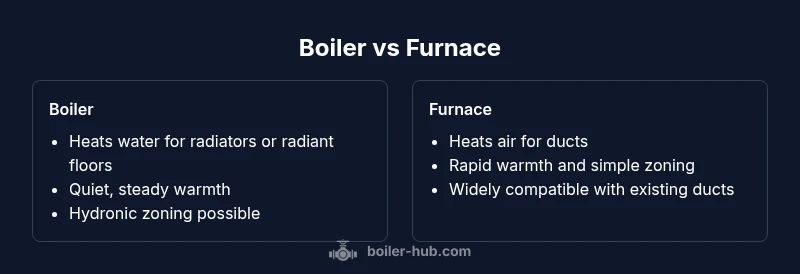
When you ask what is the difference between boiler and furnace, the answer starts with how heat is produced. A boiler is a closed vessel that heats water to produce hot water or steam that circulates through radiators, baseboards, or radiant floors. The Boiler Hub team notes that boilers rely on sealed piping rather than circulating air, which leads to quiet operation and very even heat distribution. In practice, a boiler system can serve multiple zones with radiant heat or hot-water loops, providing steady comfort in living rooms, bedrooms, and quiet spaces. According to Boiler Hub, the way heat is transferred—through water rather than air—shapes installation choices, maintenance needs, and the overall feel of a home during extreme cold. If your home already has radiators or underfloor heating, a boiler may integrate more smoothly than a ducted furnace system.
What is a furnace and how it works
A furnace is a different approach: it heats air directly and pushes that warm air through a network of ducts to reach living spaces. When you run a furnace, combustion in a burner creates hot gases that heat a heat exchanger, and a blower distributes the resulting warm air through the house. Because air moves quickly from room to room, furnaces can respond faster to a thermostat setting and can feel warmer in a shorter period. The furnace design centralizes on air distribution rather than water loops, which makes installation and retrofits relatively straightforward in many existing homes that already have ductwork. However, you’ll notice more air movement, which can affect noise levels and humidity. Homeowners should assess whether their duct system is well-sealed and properly sized to avoid hot-cold spots.
Comparison
| Feature | boiler | furnace |
|---|---|---|
| How heat is produced | Heats water to produce hot water or steam | Heats air via a burner and heat exchanger |
| Primary heat distribution | Water loops (radiators, radiant floors) | Ducted air through the home |
| Typical comfort profile | Even, quiet, consistent warmth | Quicker, more responsive warmth |
| Efficiency focus | Hydronic efficiency and loop design | Air-heat efficiency and duct design |
| Best climate fit | Cold climates with radiant heat or zones | Homes with existing ducts or single-zone comfort |
| Installation considerations | Radiators/piping; space for boiler room | Ductwork, vents, and combustion air access |
Advantages
- Boilers offer very even heat with minimal air movement, ideal for quiet spaces
- Furnaces provide fast warmth and work well with existing ductwork
- Modern high-efficiency options exist for both, improving year-round comfort
- Hydronic systems (boilers) can enable better zoning via radiators or radiant floors
The Bad
- Boilers can have higher upfront costs and require space for piping
- Furnaces may experience heat stratification and more noise in some homes
- Duct losses can reduce overall efficiency in older duct systems
- Maintenance and professional service are essential for optimal performance
Boiler is typically the better choice for steady, quiet warmth in hydronic systems; furnaces tend to win for rapid heat and easy ducted installations.
If your priority is even, uninterrupted warmth and you have or want radiant or baseboard heat, a boiler is often the right pick. If you need quick response, existing ducts, and faster installation, a furnace may be more suitable. The Boiler Hub team’s guidance emphasizes matching the system to your home layout and climate for best results.
Questions & Answers
Do boilers and furnaces use the same fuel options?
Both boilers and furnaces can operate on common fuels such as natural gas, oil, or electricity, depending on local availability and system design. The right choice often reflects fuel costs, environmental goals, and existing gas lines or electrical capacity in the home.
Both boilers and furnaces can use gas, oil, or electricity, depending on your home and local resources.
Which system is more energy-efficient overall?
Efficiency depends on the specific model and installation. Modern condensing boilers and high-efficiency furnaces can both achieve excellent efficiency with proper sizing, insulation, and maintenance. The overall cost of ownership often matters more than a single efficiency figure.
Both systems can be very efficient with proper sizing and maintenance.
Can I convert from one system to the other?
In many homes it is possible to convert, but the project can be significant, involving ductwork changes or plumbing work, structural considerations, and cost implications. A qualified HVAC contractor can provide a site assessment and a clear conversion plan.
Conversion is possible but often involves substantial planning and cost.
What maintenance is required annually?
Both systems require regular service: boilers need boiler water checks, expansion tank inspection, and pump maintenance; furnaces require filter changes, burner checks, and duct inspections. Regular professional tune-ups help maximize efficiency and safety.
Annual servicing is important for both boilers and furnaces to stay safe and efficient.
Are boilers safer or more risky than furnaces?
Safety depends on proper installation and maintenance rather than the type alone. Both systems can be safe when installed by qualified professionals and equipped with CO detectors and venting designed for the specific appliance.
Both can be safe with proper installation and regular checks.
Which system should I choose for a retrofit?
Consider existing infrastructure: if you already have radiators or underfloor heating, a boiler may be preferable; if you have ducts and want rapid heating, a furnace could be better. An energy assessment helps quantify savings.
If you have existing radiators, a boiler is good; if you have ducts, a furnace may be easier to retrofit.
Key Points
- Match heat transfer medium to home layout (water vs air)
- Choose boiler for quiet, even warmth with hydronic options
- Opt for furnace when rapid heat and ducted distribution are priorities
- Assess climate, existing infrastructure, and maintenance commitments first