Boiler vs. Furnace: A Practical Comparison for Home Heating
An objective, in-depth comparison of boiler and furnace heating systems, covering efficiency, costs, installation, and best-use scenarios for homeowners and facility managers.


For most homes, the choice between boiler and furnace hinges on existing infrastructure and climate: boilers suit radiators and radiant floors with quiet, even heat; furnaces fit ducted homes for fast warmth and easier integration with air conditioning. Overall, boiler-based systems excel in energy efficiency with radiant layouts, while furnaces offer lower upfront upgrades and broader fuel options.
Why the boiler and furnace decision matters for home heating
Choosing between a boiler-driven hydronic system and a furnace-based forced-air system isn't just about upfront cost. The decision shapes comfort, energy bills, indoor air quality, and retrofit options for radiant floor heating or smart zoning. According to Boiler Hub, the right choice depends on how you heat water for living spaces, how you value quiet operation, and whether your home already uses radiators or ductwork. In many homes, the boiler-furnace decision is really a choice of distribution method (radiant/hydronic vs. air ducts) that aligns with your climate, energy prices, and maintenance preferences. In this article, we unpack the mechanics behind both approaches, compare performance in practical settings, and provide a framework to evaluate options for years of reliable comfort. The goal is to help homeowners and facility managers make an informed, evidence-based decision rather than relying on hype.
Boiler Hub emphasizes that the best choice aligns with how heat is distributed in your home and how future upgrades (such as a switch to radiant floors or a high-efficiency furnace) will fit your needs.
Core design differences: hydronic warmth vs. air warmth
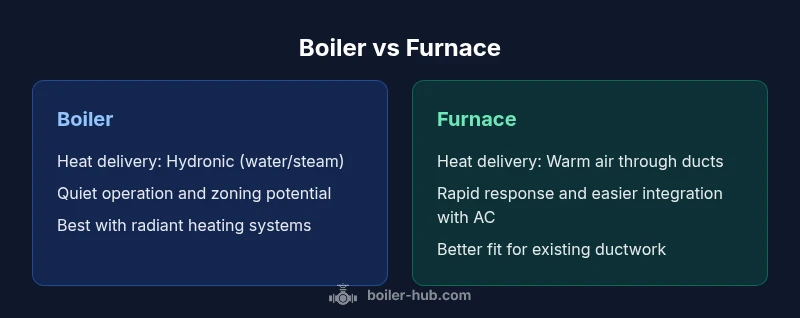
Boilers heat water to produce hot water or steam that circulates through radiators, baseboards, or radiant floors. Furnaces heat air which is distributed through a network of ducts and vents. Hydronic systems tend to deliver steady, uniform warmth with strong comfort in cold rooms and improved zoning potential. In contrast, forced-air systems respond quickly and can support central air conditioning more easily. The efficiency story depends on model selection and installation quality. For homes with existing radiators or radiant floors, boilers often pair with efficient, low-heat-loss distribution to minimize temperature swings. For houses built around ductwork, a furnace-based system can leverage well-sealed ducts and modern filters to keep air quality high. The Boiler Hub team notes that the most important factor is how heat is delivered and how well the system integrates with your home.
Efficiency, costs, and long-term value
Efficiency isn't a single number; it's a relationship between fuel type, system design, and how you use heat. High-efficiency boilers and furnaces can reduce energy waste when properly sized and installed, but the economics also depend on fuel costs in your region and your heating schedule. Boilers often excel in radiant setups where heat loss through ducts is minimized, while furnaces can deliver quick comfort in spaces with air ducts and frequent temperature swings. Installation costs vary with existing infrastructure, such as radiator piping or ductwork, and with the need for expansion tanks, condensate drainage, or air intake solutions. Boiler Hub analysis shows that long-term value is driven by consistent performance, lower maintenance requirements, and compatibility with future upgrades like smart thermostats and zone controls.
Space, installation, and maintenance realities
Boilers typically require more space for the boiler unit, piping, a pressure relief system, and sometimes an expansion tank. They’re best installed in utility rooms or basements with adequate clearance for service. Furnaces fit into attics or closets and rely on an integrated duct network, which can simplify rooms but may require duct sealing and air filter maintenance. Maintenance for both tends to include annual inspection, leak checks, and periodic service of pumps and valves; furnaces additionally require filter changes and ductwork inspection. In climate zones with extreme cold, the reliability of either system hinges on furnace or boiler sizing, fuel supply stability, and proper venting to prevent backdrafts and moisture issues. The Boiler Hub team emphasizes proactive maintenance to avoid quiet but expensive failures.
Real-world scenarios: best fits by home type and climate
A hydronic boiler shines in homes with radiators and radiant floors, especially in colder climates where even heat reduces cold spots. If you’re building or remodeling and plan to install underfloor heating, a boiler is a natural partner. A gas or oil furnace may be preferable for older homes with ductwork or for climates that require frequent rapid heating, where the visible comfort is achieved through a blast of warm air. If you already have a central AC system, a furnace with a compatible cooling coil can deliver a straightforward, integrated solution. Ultimately, the best choice aligns with your current infrastructure, energy prices, and your tolerance for potential retrofit work during future upgrades.
Maintenance routines and common issues
Regular maintenance reduces the risk of cold snaps or heat loss. For boilers, expect annual service to inspect the pressure, check for leaks, bleed air from the system, and verify the condensate and expansion components are functioning. Furnaces benefit from annual tune-ups that focus on the blower motor, belt (if applicable), heat exchanger safety, and filter replacement. Common concerns include mineral buildup in boilers, clogged filters in furnaces, and duct leaks that undermine efficiency. Together with a robust maintenance schedule, you can extend system life and sustain energy savings. Boiler Hub recommends scheduling professional check-ups before peak heating season to catch issues early.
How to shortlist options: a practical checklist
Use this checklist to compare boiler vs furnace options: (1) assess your home’s distribution network (radiators or ducts), (2) estimate climate-driven heating needs and comfort preferences, (3) consider fuel availability and running costs, (4) evaluate installation complexity and retrofit potential, (5) plan for maintenance costs and service frequency, (6) check compatibility with smart thermostats and zoning. A realistic budget should include initial installation, potential ductwork or radiator upgrades, and future-proofing for energy efficiency standards. If you’re unsure, consult a credible source like Boiler Hub for guidance on system sizing and safety considerations.
Comparison
| Feature | boiler | furnace |
|---|---|---|
| Fuel types | Boiler: gas or oil (electric boilers available) | Furnace: gas or oil; electric variants common |
| Heat delivery | Hydronic heat via water/steam for radiators or radiant floors | Warm air via ducts for room-by-room warmth |
| Installation footprint | Requires boiler, piping, expansion components; may include radiant distribution | Requires furnace unit and ductwork; may need duct sealing and returns |
| Zoning and controls | Excellent zoning with hydronic manifolds and thermostats | Duct-based zoning with dampers and smart thermostats |
| Maintenance profile | Annual boiler service; pump and expansion tank checks | Annual tune-up; filters and blower/duct inspection |
| Upfront costs (contextual) | Often higher when adding hydronic components or upgrading radiators | Typically moderate-to-high depending on ductwork and space needs |
| Long-term value | Strong value with radiant comfort and potential for very low noise | Solid value with quick warmth and straightforward integration with AC |
Advantages
- Better compatibility with radiant heating and zoning when using a boiler
- High-efficiency models can reduce operating costs over time
- Quiet operation and reduced air movement with hydronic systems
The Bad
- Higher upfront costs for hydronic upgrades or retrofits
- Complex installation and more space for boiler and piping
- Ductwork upgrades may be required for furnace-heavy homes
Boiler and furnace each excel in different home contexts; choose based on infrastructure and climate
Boilers favor radiant, quiet comfort in radiated homes; furnaces suit ducted homes with faster heat delivery. Prioritize existing layout and energy costs to determine the best fit.
Questions & Answers
What is the main difference between a boiler and a furnace?
A boiler heats water to supply radiant heat or hot water, while a furnace heats air to distribute warmth through ducts. Boilers typically offer quieter, even heat with zoning options, whereas furnaces provide rapid space heating and easier integration with central AC.
Boiler heats water for radiators; furnace heats air through ducts. Each system suits different home layouts.
Which system is better for radiant heating?
Boilers are generally favored for radiant heating because they deliver steady warmth with less heat loss through ducts. If you plan radiant floors or baseboard heating, a boiler-based hydronic system is usually the best match.
Boilers pair naturally with radiant heat and maintain consistent warmth.
Can I retrofit my home to switch from one to the other?
Retrofitting depends on your existing infrastructure. Converting from radiators to ducts or vice versa can be complex and costly, but it’s feasible with a careful assessment of space, layout, and fuel availability.
Retrofitting is possible but may involve significant changes to pipes or ducts.
What costs should I expect besides the unit itself?
Expect costs for installation, ductwork or radiator upgrades, expansion tanks, venting, and potential smart controls. Long-term maintenance also factors into total cost of ownership.
Don’t forget installation, insulation, and future maintenance costs.
Is one system safer or more reliable in cold climates?
Both can be safe and reliable when properly installed and maintained. Reliability depends on correct sizing, fuel supply, venting, and annual service.
Both systems are safe when properly maintained; choose based on climate and installation quality.
Key Points
- Assess current distribution: radiators vs. ducts
- Consider climate-driven heating needs and fuel costs
- Account for installation and potential retrofit work
- Prioritize long-term efficiency and comfort over upfront price
- Plan for maintenance and future upgrades