Boiler or Furnace Difference: A Comprehensive Comparison
Explore the boiler or furnace difference, how each system works, key distinctions, and practical guidance for homeowners and facility managers evaluating performance, efficiency, and installation. Learn to choose based on climate, home layout, and comfort needs with expert insight from Boiler Hub.


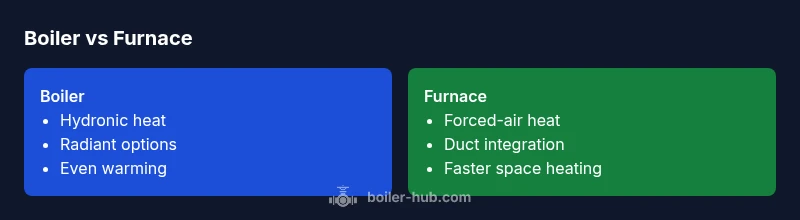
The boiler or furnace difference centers on heat delivery: boilers heat water for radiators or radiant floors, while furnaces heat air that’s blown through ducts. Boilers often offer even warmth and higher efficiency in well-insulated homes, whereas furnaces provide quicker space heating and flexible zoning, typically with different upfront costs and maintenance needs. This quick answer frames the deeper comparison that follows.
What is the boiler or furnace difference?
The term boiler or furnace difference describes two distinct approaches to heating a home. When we say boiler or furnace difference, we’re comparing water-based heat distribution with air-based heat delivery. Boilers heat a fluid—usually water or a glycol mixture—that circulates through radiators, baseboard units, or radiant floor loops. Furnaces heat air that is pushed by a blower through a network of supply and return ducts. This fundamental distinction drives comfort, efficiency, installation complexity, and compatibility with existing home layouts. According to Boiler Hub, homeowners should begin by mapping the home’s insulation, climate, and preferred heat feel before delving into efficiency claims. The boiler or furnace difference then becomes a practical framework for evaluating long-term costs, reliability, and control options.
In this guide, we’ll unpack the physics behind each system, highlight practical trade‑offs, and illustrate how the choice affects space, humidity, and maintenance schedules. The goal is to empower decision makers to act with clarity, not just to chase the latest marketing claims about the boiler or furnace difference.
paragraphTypeTagLetta: null}
How boilers work: hydronic heating explained
Boilers operate on a hydronic heating principle. Fuel—whether gas, oil, or electricity—fuels a heat exchanger that warms water. The heated water (or glycols for radiant systems) is pumped through a closed loop to emit heat via radiators, baseboard convectors, or radiant floor systems. Radiant heating offers comfortable warmth at lower air temperatures because surface temperature remains even, reducing drafts near floors. Hydronic systems can be zoned to different rooms or areas, but zoning requires careful planning of piping and controls. The boiler or furnace difference here hinges on heat transfer medium: liquid versus air. Because water stores and conducts heat efficiently, boilers typically deliver steady temperatures and can improve perceived comfort in larger or irregular spaces. Smart controls and weather-responsive modulation further optimize performance, ensuring a stable baseline temperature with less fluctuation.
paragraphTypeTagLetta: null}
How furnaces work: forced-air heating explained
Furnaces heat air that’s circulated through a home by a blower connected to an extensive duct network. Combustion or electric elements warm the air, and a distribution system delivers it to rooms via supply vents, while cool air returns to the furnace through returns. The airflow creates quick, noticeable warming, which can be beneficial in colder climates or in homes with limited insulation. A key aspect of the boiler or furnace difference is how humidity and temperature are controlled; furnaces can dehumidify or humidify space through ducted paths and by smart zoning. Air leaks, duct losses, and filter quality influence efficiency more visibly in forced‑air systems, making regular maintenance critical to sustaining comfort in the long term.
paragraphTypeTagLetta: null}
Key differences at a glance: heat medium, delivery, and zoning
- Heat medium: Water-based heat in boilers vs. air-based heat in furnaces. Water stores and transfers heat efficiently; air heats quickly but loses heat more easily through ductwork.
- Delivery speed: Furnaces often feel quicker to warm living spaces because air moves fast through ducts; boilers may take longer to raise room temperature but provide steadier comfort.
- Zoning and control: Hydronic systems excel with radiant floors and baseboard zones but require careful piping; forced-air systems can be zoned through ductwork and smart thermostats, sometimes with simpler retrofits.
- Humidity and comfort: Water-based systems tend to create a more even warmth with less draft; air-based systems can dry indoor air and may require humidification in dry climates.
- Upfront cost and retrofit: The boiler or furnace difference influences installation cost; retrofitting in an existing home is often more disruptive for ductwork than for piping, depending on current infrastructure.
paragraphTypeTagLetta: null}
Space, footprint, and location considerations
A central factor in the boiler or furnace difference is space requirements. Boilers demand a boiler room or mechanical closet with space for piping, a expansion tank, and often a separate vent or ventless configuration depending on fuel type. Furnaces need a dedicated furnace cabinet and an extensive duct network, which may traverse attics, basements, and crawl spaces. In homes with limited space, a compact boiler with a radiant floor solution or a high‑efficiency condensing boiler might be favored. Conversely, homes with existing ductwork, or renovations aiming to add central air conditioning, may lean toward a forced‑air furnace for compatibility and easier integration with air distribution and cooling systems.
paragraphTypeTagLetta: null}
Efficiency and operating costs: long-term view
Efficiency is a central pillar in the boiler or furnace difference. Hydronic systems can be extremely efficient when properly installed and well insulated, particularly with modern boilers that utilize condensation or advanced controls. However, steady energy usage depends on the heat emitters and building envelope. Forced‑air systems offer rapid space heating and can integrate with air conditioning, which can be a practical advantage in hot climates. The ongoing cost picture also depends on fuel prices, system age, maintenance, and the frequency of cycling between heat sources. The boiler or furnace difference, in this respect, is not a simple one-to-one statement about long-term savings; it hinges on climate, insulation, thermostat strategy, and service plans. Proper maintenance—such as cleaning, filter changes for furnaces, and occasional corrosion checks for boilers—plays a decisive role in sustaining efficiency over time.
paragraphTypeTagLetta: null}
Installation, maintenance, and reliability
Maintenance and reliability are often touted as differentiators in the boiler or furnace difference. Boilers require periodic inspection of flame quality, pump operation, and circulating pipes to prevent leaks or corrosion. Water quality matters; mineral buildup can reduce efficiency and lead to component wear. Furnaces rely on air handling components, blower motors, belts, and ductwork sealed against leaks. Regular filter changes, duct cleaning, and blower service help maintain performance. In terms of reliability, both systems benefit from professional installation and routine checkups. The choice may hinge on how easy it is to schedule service in your region, access to replacement parts, and the availability of technicians familiar with hydronic or forced‑air systems. In summary, ongoing maintenance is a shared responsibility, but the boiler or furnace difference influences the specific service needs and intervals.
paragraphTypeTagLetta: null}
Compatibility with existing systems: radiant vs ducted homes
Compatibility is a practical lens for evaluating the boiler or furnace difference. Homes with radiant heating or baseboard heat are naturally aligned with boilers, especially if there’s space for a dedicated mechanical area. Ducted homes with attic or basement routes for air ducts align well with furnaces, particularly if there is a cooling system or future plans for air conditioning. Retrofit considerations include the potential to replace an existing boiler with a high‑efficiency unit or to install a furnace alongside existing ducts while preserving zones. The boiler or furnace difference becomes critical when assessing how new controls, zoning, humidity, and comfort preferences interact with current infrastructure, insulation, and long‑term energy goals.
paragraphTypeTagLetta: null}
Climate considerations: when each makes sense
Climate and occupancy patterns influence the boiler or furnace difference in meaningful ways. Colder, longer winters often reward the even warmth and potential humidity control of hydronic systems, particularly in larger homes or those with radiant floor heating. Warmer climates or homes with well‑sealed ductwork may prefer forced‑air systems for their rapid heating and ease of integration with cooling equipment. Occupant behavior, such as preferred heat feel (even vs quick warmth), and tolerance for humidity variations also play a role. The boiler or furnace difference should be evaluated alongside insulation quality, window performance, and heat‑loss calculations to determine the best fit for the home. Boiler Hub emphasizes a climate‑aware approach to avoid mismatches between system capabilities and real-world needs.
paragraphTypeTagLetta: null}
Real-world decision framework: a practical checklist
To translate the boiler or furnace difference into a concrete choice, use this checklist: assess current infrastructure, climate, and occupancy schedules; estimate retrofit feasibility and disruption; examine potential energy savings with smart controls; compare upfront costs against anticipated operating costs; evaluate maintenance requirements and service availability in your area. A systematic approach reduces reliance on marketing claims and centers the decision on building performance, comfort, and total cost of ownership over time. For homeowners and facility managers, documenting your expectations for control, zoning, and humidity helps ensure the chosen system aligns with long‑term goals. The boiler or furnace difference becomes a practical decision matrix, not a single value proposition.
paragraphTypeTagLetta: null}
Common myths about boiler or furnace difference
Myth 1: Boilers are always more efficient than furnaces. Reality: efficiency depends on design, fuel, and usage patterns; a modern high‑efficiency furnace can outperform an older boiler in some scenarios. Myth 2: A furnace is cheaper to install than a boiler. Reality: installation costs vary with existing ductwork and space, and hydronic retrofits can be expensive if piping must be added. Myth 3: Hydronic systems are always more comfortable. Reality: comfort depends on emitters, room geometry, and fan controls; radiant floors can offer comfort benefits, but proper design is essential. Understanding these nuances helps prevent misinformed decisions about the boiler or furnace difference and guides a smarter, evidence‑based selection.
Comparison
| Feature | Boiler | Furnace |
|---|---|---|
| Primary heat medium | Water-based heat distribution (hydronic) | Air-based heat distribution (forced-air) |
| Heat delivery speed | Typically gradual warmth, depending on emitters | Often faster space heating via air flow |
| Zoning and controls | Complex piping; precise zoning possible with radiant systems | Easier zoning through ducted zones and smart thermostats |
| Space and footprint | Requires mechanical space for boiler and piping | Requires cabinet space plus extensive ductwork |
| Maintenance focus | Water quality, pumps, leaks; system flushes | Air filters, blower service, duct sealing |
| Best for climate | Hydronic, radiant comfort in cold climates | Forced-air, quick heat and cooling integration |
Advantages
- Clarifies heat delivery methods for planning
- Aligns with existing infrastructure (ductwork or piping)
- Highlights long-term energy implications and maintenance
- Supports integration with smart controls and zoning
- Helps predict compatibility with radiant or forced-air layouts
The Bad
- Does not guarantee a one-size-fits-all solution
- Depends heavily on home insulation and climate
- Retrofits can be disruptive and costly
- May require professional assessment for accurate cost estimates
Choose based on existing infrastructure and climate: boilers suit radiant, energy-efficient setups; furnaces excel in fast heat and ducted layouts.
The boiler or furnace difference should guide whether you prioritize steady, even warmth or rapid space heating and duct compatibility. Consider home layout, insulation, and long-term operating costs, then consult a professional for a tailored assessment.
Questions & Answers
What is the boiler or furnace difference in simple terms?
The boiler or furnace difference refers to heat delivery: boilers use water-based systems (hydronic) to radiate heat, while furnaces heat air that is distributed through ducts. The choice affects comfort, installation, and efficiency, depending on your home’s layout and climate.
In short, boilers use water to heat, furnaces heat air. This choice shapes comfort and installation.
When is a boiler the better option over a furnace?
Boilers are typically preferable when you want even, long-lasting heat and the potential for radiant floor heating. They work well in homes with good insulation and space for a mechanical room. The boiler or furnace difference matters most when your climate and infrastructure align with hydronic systems.
Choose a boiler if you want even warmth and radiant-floor options.
Are boilers compatible with radiant floor heating?
Yes. Boilers are often paired with radiant floor heating due to their steady heat and efficient heat transfer through floors. Proper loop design and controls are essential to realizing comfort and efficiency.
Boilers pair well with radiant floors when the system is designed correctly.
Can a furnace be more cost-effective upfront than a boiler?
Upfront costs vary by home. In some cases, a furnace with existing ductwork can be cheaper to install than a new boiler, but total costs depend on duct condition, insulation, and planned cooling integration.
Upfront costs depend on your current setup and required ductwork.
What maintenance differences should I expect between boilers and furnaces?
Boilers require attention to water quality and circulating pumps, while furnaces need regular filter changes and blower maintenance. Both benefit from professional annual checks to ensure safety and efficiency.
Boilers need water system care; furnaces need filter and blower upkeep.
Is it possible to switch from a furnace to a boiler later?
Switching is possible but involves significant work: removing or repurposing ductwork, adding piping, and ensuring zoning compatibility. A phased plan with a contractor’s assessment helps manage disruption.
A switch is doable but complex; plan with a pro.
Key Points
- Assess your current infrastructure before choosing
- Boilers excel with radiant heat and efficiency potential
- Furnaces suit homes with existing ducts and cooling plans
- Plan for zoning, humidity control, and maintenance
- Total cost of ownership depends on climate, usage, and service access