What is a Boiler vs Furnace: An In-Depth Comparison
Learn the essential differences between boilers and furnaces, how they work, cost and efficiency considerations, and when to choose each for your home or facility heating.


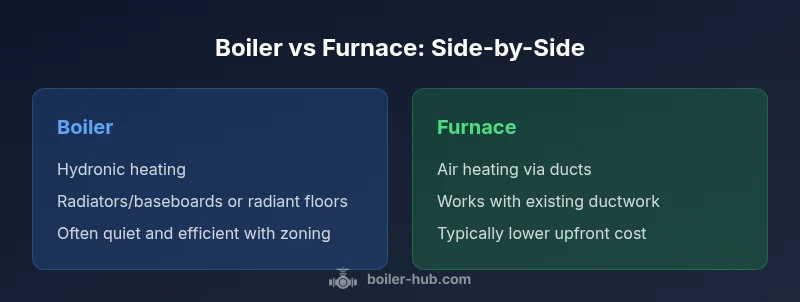
What is a boiler vs furnace? In short, both heat your home, but they operate differently: a boiler heats water to create steam or hot water; a furnace burns fuel to heat air that is distributed through ducts. The best choice depends on climate, existing equipment, and long-term costs.
What is a boiler vs furnace: setting the scene
Understanding the difference between a boiler and a furnace is essential for homeowners and facility managers planning a heating system retrofit or replacement. The terms describe two distinct approaches to generating and distributing heat: boilers create heat in the form of hot water or steam that is circulated through radiators, baseboards, or radiant floors; furnaces produce heated air that travels through a network of ducts. The result feels similar—a warm home—but the path to warmth, energy use, and long-term costs can be quite different. According to Boiler Hub, the decision hinges on your climate, existing infrastructure, and long-term goals for comfort and efficiency. This framing helps readers evaluate whether a hydronic system (boiler-based) or a forced-air system (furnace-based) better matches their home design. Throughout this guide we will use neutral language, present practical criteria, and avoid hype around single-model claims. We will also emphasize safety, maintenance, and real-world costs so that homeowners and facility managers can make an informed choice with confidence.
How boilers work: Hydronic heating explained
Boilers heat water to a set temperature and circulate it through sealed piping to emitters such as radiators, baseboard convectors, or radiant floor systems. In a hot-water (hydronic) system, the circulator pump moves the heated fluid from the boiler to the emitters, where heat is transferred to the living spaces and the cooled water returns to the boiler for reheating. Steam boilers, by contrast, expand water into steam, which travels through pipes to steam radiators. The advantages of this approach include excellent steady heat, minimal air movement, and the potential for precise zoning. The main components are the boiler itself, a pump or circulator, a pressure or expansion tank, and a network of pipes and emitters. Fuel options commonly include natural gas, oil, or electricity, depending on availability and local codes. In many homes, installing or updating a boiler also involves upgrading the piping and adding a dedicated mechanical room or basement space. According to Boiler Hub, hydronic systems can deliver very even temperatures and can be paired with radiant floor heating for enhanced comfort and efficiency.
How furnaces work: Air heating explained
Furnaces generate heat by burning fuel inside a heat exchanger and then blow the warmed air through a system of ducts to rooms across the home. The warm air is distributed by a blower or furnace fan, travels through the ductwork, and returns to the furnace to be reheated in a continuous cycle. The key readers notice here is that furnaces warm air, not water, and that air must travel via ducts to reach living spaces. The main components are the furnace cabinet, burners or an electric heating element, a heat exchanger, a blower, and a venting system that expels exhaust gases. Most homes with forced-air heating already feature ductwork for central air conditioning, making furnace installation or replacement less disruptive if ducts are in place. Fuel options mirror those of boilers, but the efficiency metrics differ in how heat is delivered. High-performance furnaces can offer substantial energy savings when combined with modern insulation and a well-sealed building envelope.
Efficiency, costs, and value: what to measure
When comparing boilers and furnaces, energy efficiency ratings are a central factor, but they are not the whole story. Boilers typically rely on thermal efficiency at the water side, with performance influenced by how well the hydronic network is designed and insulated. Furnaces use annual fuel utilization efficiency (AFUE) to gauge how effectively fuel is converted to heat for the home and are influenced by duct design, filter maintenance, and air sealing. In practice, the most important outcome is not the label on the unit but the delivered comfort per dollar spent. Boiler Hub analysis shows that the level of insulation, air sealing, and zoning can dramatically affect calculated operating costs, sometimes more than small differences between high- and mid-range models. For homes with extensive radiant or baseboard heating, a well-designed boiler with modern controls and smart thermostats can outperform a ducted furnace in several climates. Conversely, for homes with older ductwork, a high-efficiency furnace might offer quicker comfort with a lower upfront investment. The bottom line: model ratings matter, but installation quality and house envelope are equally decisive.
Climate, home design, and distribution: choosing wisely
Your climate largely dictates which heating approach makes the most sense. In very cold regions, hydronic systems with well-insulated radiators or radiant floors can provide steady, comfortable heat with excellent efficiency when combined with proper zoning. In warmer or mixed climates, forced-air systems with properly sealed ducts can be more cost-effective and simpler to maintain. The distribution method—radiators and radiant floors versus ducts—affects not only comfort but also indoor air quality, noise levels, and the potential for heat loss through leaky ducts. Building envelope improvements, such as attic and wall insulation and air sealing, can substantially influence the long-term cost of either option. The Boiler Hub team emphasizes that homeowners should evaluate whether their current space supports a boiler room or a ducted furnace cabinet, and whether future upgrades (like smart thermostats or zone control) align with the chosen path.
Installation, maintenance, and safety considerations
Installation and ongoing maintenance are major determinants of overall cost and reliability. Boilers require a dedicated space with venting and piping runs, a properly sized expansion tank, and attention to water quality to prevent corrosion. They produce little noise but rely on the rest of the hydronic system to distribute heat. Furnaces require venting and a sealed flue for exhaust and, if powered by electricity, a reliable electrical supply. Regular maintenance for both systems includes filter changes (more critical for furnaces), checking for leaks or corrosion, and testing safety controls. CO detectors and proper venting are essential for safety, and a professional inspection at least once a year is recommended. Weather, fuel availability, and local codes will influence permitting and installation requirements. The boilers and furnaces you compare should be evaluated by a qualified technician who can assess the specific house orientation, duct or pipe runs, and the potential need to upgrade insulation or air sealing to realize full performance.
Life-cycle costs and future-proofing
Choosing between a boiler and a furnace involves analyzing life-cycle costs, including equipment price, installation, fuel costs, maintenance, and potential repairs over 15–25 years. Boilers generally excel in long-term cost efficiency when paired with well-designed radiant systems and smart controls, especially in homes with high heating demand or extended heating seasons. Furnaces can deliver quicker comfort and lower initial expense, which may be attractive for remodels, milder climates, or homes with pre-existing ductwork. A critical part of this analysis is understanding how your energy prices are likely to evolve and whether a modernization plan (such as adding zoning, variable-speed pumps, or sealing leaks) can improve the total cost of ownership. Boiler Hub's guidance stresses the importance of aligning equipment choice with your climate, envelope quality, and long-range maintenance plans to maximize return on investment.
Practical decision checklist
Use this quick-start checklist to frame your decision:
- Map your current distribution: radiators/baseboards or ducts?
- Assess climate: heating season length and outdoor temperatures you expect to endure.
- Inventory your space: do you have room for a boiler room or is a compact furnace cabinet preferable?
- Review insulation and air sealing: how much can be improved to reduce heat losses?
- Forecast energy costs and potential rebates: are there incentives for high-efficiency systems?
- Consider future needs: do you want radiant floors or advanced zone control?
- Get professional quotes that clearly separate equipment and installation costs.
- Check safety systems: CO detectors, venting, and code compliance. This plan will help you pick the option that offers the best balance of comfort, reliability, and long-term value.
Comparison
| Feature | Boiler | Furnace |
|---|---|---|
| Heating medium | Hydronic (water-based) | Air-based |
| Distribution system | Pipes/radiators/baseboards | Ductwork |
| Energy sources | Gas/oil/electric | Gas/oil/electric |
| Installation complexity | Medium-high | Medium |
| Space requirements | Boiler room/utility space | Ventilation area/closet |
| Maintenance focus | Pressure, leaks, corrosion | Filters, blower, ducts |
| Best climate fit | Hydronic homes/cozy radiators | Ducted homes with existing ducts |
Advantages
- High potential energy savings with zoning and radiant heat
- Quiet operation and comfort control
- Long system life with proper maintenance
- Supports radiant or baseboard heating and hot water on demand
The Bad
- Higher upfront cost and more complex installation
- Requires compatible distribution system (pipes or ducts)
- Maintenance can be more specialized
Choose boiler or furnace based on your existing system design and climate; boilers excel in energy efficiency with radiant heating, while furnaces offer cost-effective installation and quick heat via ducts.
Boilers suit hydronic/radiant layouts and long-term savings; furnaces are strong when rapid heat in ducted homes and lower upfront costs matter. The best choice balances climate, space, and lifecycle costs.
Questions & Answers
What is the key difference between a boiler and furnace?
The main difference is the heat medium: boilers heat water for hydronic or steam systems, while furnaces heat air for a warm-ducted system. Both convert energy into usable heat, but distribution and setup determine efficiency and comfort.
Boilers heat water for radiators or underfloor systems; furnaces heat air for ducts. Distribution and climate matter for selecting the right one.
Can I convert an existing system from one to the other?
Conversion is possible but involves reworking the distribution system, venting, and control wiring. It is typically expensive and may require permits and a professional assessment.
Conversion is possible but requires professional assessment and often substantial work like changing ductwork or piping.
Which is more energy-efficient?
Efficiency depends on model and setup. High-efficiency boilers and condensing furnaces can be very efficient, but overall savings rely on insulation, climate, and proper installation.
Efficiency depends on the model and installation; look for high AFUE or season efficiency along with proper zoning and insulation.
What upfront costs should I expect?
Upfront costs vary with type and installation complexity. Boilers often require more piping and space planning, while furnaces may need ductwork modifications; both include unit price and installation labor.
Expect higher installation costs for boilers due to piping; furnaces may be cheaper to install if ducts are ready.
Are boilers or furnaces better for cold climates?
Boilers generally perform exceptionally well in very cold climates when paired with radiant heating, while high-performance furnaces can be effective with robust duct systems. The right choice depends on distribution and insulation.
In very cold climates, boilers with radiant heating often shine; but a strong furnace with efficient ducts can also be effective.
What maintenance is required for boilers and furnaces?
Boilers require regular pressure checks and corrosion prevention; furnaces need filter changes and duct cleaning. Both should have CO detectors and periodic professional inspections.
Boilers need pressure and corrosion checks; furnaces need filter changes and occasional duct maintenance.
Key Points
- Identify your current distribution: radiators/baseboards or ducts
- Assess climate: longer heating seasons favor boiler-based efficiency
- Evaluate life-cycle costs over upfront price
- Consider space requirements for a boiler room or furnace closet
- Plan for maintenance and safety (CO detectors, venting)