Boiler and Furnace Difference: A Practical Guide
Explore the boiler and furnace difference, how each system works, costs, efficiency, and which option fits your climate and home. This comprehensive Boiler Hub guide helps homeowners and facility managers decide confidently.


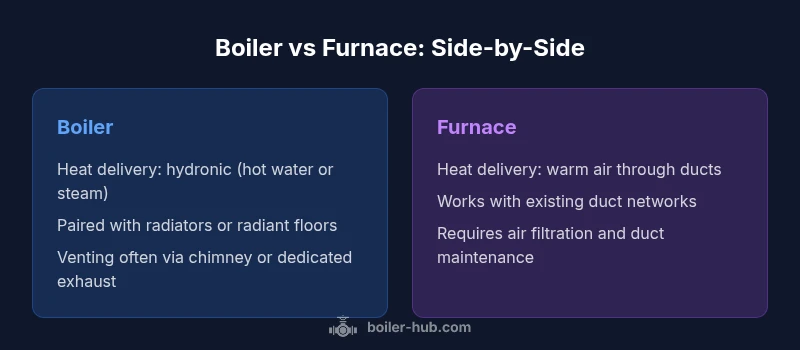
The boiler and furnace difference refers to two heat-delivery approaches: boilers heat water for hydronic systems (radiators or radiant floors), while furnaces heat air for forced-air ducts. This quick comparison highlights how each works, typical installation considerations, and which setup aligns with your climate and home design. Understanding the boiler and furnace difference helps you plan for comfort, energy use, and long-term costs.
Understanding the boiler and furnace difference
The boiler and furnace difference centers on how heat is produced, distributed, and integrated with a home’s or building’s existing infrastructure. Boilers create hot water (or steam) that travels through pipes to radiators, baseboard heaters, or radiant floors. Furnaces heat air that is blown through a network of ducts to convectors and registers. This fundamental distinction shapes every decision from installation layout to maintenance duties. Homeowners and facility managers should consider not just initial costs, but also how heat is felt, how evenly it is distributed, and how the system will perform in harsh winter conditions. The boiler and furnace difference is not merely about equipment; it’s about matching heat delivery to your building envelope, control systems, and long-term energy strategy. In this guide, we compare design, operation, and lifecycle factors with a practical, evidence-based lens.
How boilers work
A boiler heats water, which then travels through pipes to baseboard radiators, panel radiators, or radiant floor systems. In steam systems, the boiler creates pressurized steam that rises to radiators. The key advantage of boilers is steady heat with minimal air movement, which contributes to a consistently comfortable environment in many homes. Modern boilers range from traditional non-condensing models to highly efficient condensing units that maximize fuel use. Regular servicing keeps boilers reliable and safe, as combustion byproducts must be vented safely and heat exchangers kept clean. When considering the boiler and furnace difference, remember that boiler performance is closely tied to the health of the hydronic loop and the home’s insulation.
How furnaces work
Furnaces burn fuel to heat air directly. The heated air travels through a duct network and is dispersed via vents into living spaces. The main benefit of furnaces is rapid heating, which can quickly raise indoor temperature, especially in larger or open-plan spaces. Furnaces often pair with air filtration systems, humidifiers, and thermostats that optimize comfort on demand. Efficiency depends on the furnace design (non-condensing vs condensing), venting integrity, and ductwork condition. Like boilers, furnaces require regular maintenance—filters, flue inspection, and blower motor checks are common tasks.
Fuel types and efficiency considerations
Both boilers and furnaces can run on natural gas, oil, electricity, or propane, depending on availability and home configuration. Fuel selection influences upfront cost, ongoing fuel bills, and emission profiles. Hydronic systems (boilers) can leverage high-efficiency condensing models, while forced-air systems (furnaces) also offer high-efficiency options. Efficiency is affected by system design, insulation, duct leakage, and thermostat control logic. The boiler and furnace difference becomes clearer when you assess how control strategies (zone heating, setback schedules) affect overall energy consumption. In colder climates, properly designed and maintained boilers can deliver superior comfort with lower heat loss in well-insulated envelopes.
System design implications: space, venting, and compatibility
Boilers require a dedicated mechanical room or enclosure with space for piping, valves, and often a chimney or venting system. Radiant heat and radiators offer quiet operation with uniform temperatures but may demand more space for piping. Furnaces rely on ductwork and a return-air system; their footprint is influenced by attic or basement space for the furnace and the size of the duct network. The boiler and furnace difference here shows up in retrofit scenarios: converting an existing ducted home to hydronic heat involves significant piping and zoning work, while upgrading a hydronic system to heat air through ducts has its own ductwork challenges.
Installation considerations and compatibility with existing infrastructure
Your current home framework largely determines which path makes sense. Homes with extensive ductwork may favor furnaces for lower retrofitting costs, while homes with radiators or radiant floor setups align with boilers. Consider climate, heating load, and the desired level of heat distribution control. A building with strong insulation and smaller living spaces may efficiently use a boiler-based hydronic system; a larger, open-plan home in a mild climate might benefit from a furnace with modern zoning. Always assess venting, clearance, and local codes during design to ensure a safe, compliant installation. The boiler and furnace difference in compatibility terms often hinges on how ready your home is to support the chosen heat-delivery method.
Operating costs, maintenance, and reliability
Ongoing costs include fuel consumption, energy prices, and maintenance. Boilers tend to require periodic inspection of the heat exchanger and circulator pumps, plus boiler-specific venting checks. Furnaces require filter changes, blower maintenance, and duct cleaning. In general, both systems benefit from improved insulation, tight seals around windows and doors, and properly sized equipment to avoid short cycling or overheating. The boiler and furnace difference in maintenance demands means scheduling annual service with a qualified technician should be a priority for either option. Proper maintenance helps prevent costly failures and maintains indoor comfort.
Climate suitability and heat distribution patterns
Climate and heat distribution patterns strongly influence the boiler and furnace difference in practical terms. In very cold climates, boilers paired with well-insulated radiators or radiant floor systems deliver gentle, consistent warmth with fewer temperature swings. In milder climates or homes with extensive ductwork, a high-efficiency furnace may provide fast, responsive heat and easier integration with central air conditioning. Therefore, climate, insulation, and occupancy patterns determine which system delivers the most value while meeting comfort expectations. Always model seasonal heating loads to estimate energy use accurately.
Common myths and misconceptions about boilers and furnaces
A common myth suggests boilers are universally more expensive to install. In reality, total cost depends on existing infrastructure and zone control goals. Another misconception is that boilers always provide slower warmth; modern modulating boilers can respond quickly when correctly integrated with radiant floors or well-designed loops. Conversely, furnaces are not inherently inefficient; high-efficiency condensing furnaces can rival hydronic systems in energy performance. The boiler and furnace difference should be evaluated with cooperation from an experienced contractor who can explain how the system aligns with your home's specifics.
Decision framework: choosing boiler vs furnace for your home
Start with your heat distribution: hydronic versus forced-air. Consider climate severity and desired comfort level, then assess existing ductwork, radiators, or radiant floor presence. Evaluate the cost of adding or upgrading venting, control systems, and zoning. Finally, project long-term energy costs, serviceability, and local incentives. The boiler and furnace difference becomes practical when you prioritize the heat distribution you want, the compatibility with your home, and the total cost of ownership over time.
Maintenance and safety best practices for both systems
For both boilers and furnaces, schedule annual professional service. Check venting integrity, CO detectors, and ensure proper combustion air supply. Inspect heat exchangers, burners, and controls for signs of wear. Replace filters in furnaces on a routine basis. Keep the surrounding area clear of clutter and ensure the system has a clean air path. Understanding the boiler and furnace difference in this context means recognizing that regular maintenance, proper installation clearances, and protective devices are essential for safe operation and longevity.
Comparison
| Feature | Boiler | Furnace |
|---|---|---|
| Heat delivery | Hydronic (hot water or steam) to radiators or radiant floors | Air (warm air via ducts) |
| Typical system layout | Boiler room with pipes, radiators/underfloor loops | Closet or mechanical room with ducting and air handler |
| Space requirements | Requires space for boiler, piping, and venting | Requires ducts and return air paths, often smaller unit footprint |
| Venting and exhaust | Venting through chimney or dedicated vent; condensation management matters | Exhaust through venting or chimney; air leakage more critical |
| Efficiency potential | High efficiency with condensing hydronic models | High efficiency with modern condensing furnaces |
| Maintenance focus | Circulator pumps, heat exchangers, pressure relief and water quality | Filters, blower, duct cleanliness, and thermostat control |
| Best climate fit | Cold climates with hydronic distribution or radiant floors | Homes with duct systems and need for quick space heat |
Advantages
- Hydronic heating provides very even comfort and can work with radiant floors
- Boilers can be extremely efficient with modern condensing designs
- Furnaces offer fast heat delivery and integrate easily with central air
- Multiple fuel options can be available for both boiler and furnace systems
The Bad
- Boilers often require more space and piping; installation can be complex
- Ducted furnaces can waste energy through duct leaks and poor insulation
- Both systems require regular professional maintenance to stay safe and efficient
Boilers excel in hydronic comfort and radiant heating, while furnaces shine with rapid heat and lower upfront logistics.
Choose a boiler when you have radiators or radiant floors and want steady warmth in a cold climate. Opt for a furnace if you already have ducts or need quick, flexible heating with simpler retrofit options.
Questions & Answers
What is the fundamental difference between a boiler and a furnace?
The fundamental difference is how heat is generated and distributed: boilers heat water for radiators or radiant floors, while furnaces heat air that moves through ducts. This affects comfort, installation, and maintenance needs. The boiler and furnace difference matters for climate and home design.
Boilers heat water for radiators or radiant floors, while furnaces heat air through ducts. The choice impacts comfort and installation.
Which system is more energy efficient for a typical home?
Both can achieve high efficiency with modern equipment. Condensing boilers and high-efficiency furnaces minimize fuel use, but actual performance depends on system design, insulation, and control strategies. The boiler and furnace difference should be evaluated with realistic load calculations.
Both can be highly efficient; efficiency depends on design, insulation, and controls.
Can I retrofit my home to switch from one system to the other?
Retrofitting is possible but varies by home. Converting from a boiler to a furnace requires ductwork and space for an air-handling unit, while moving from a furnace to a boiler needs piping, radiators, or radiant floors. A professional assessment is essential.
Retrofitting depends on your home; a pro can confirm feasibility and cost.
What are the typical upfront and long-term costs?
Upfront costs depend on installation complexity, existing infrastructure, and local labor. Long-term costs are driven by fuel prices, maintenance, and potential incentives. The boiler and furnace difference influences these costs through heat delivery efficiency and zoning options.
Costs vary; long-term costs hinge on fuel prices, maintenance, and efficiency.
Is a boiler safer than a furnace?
Both systems are designed with safety features, but venting, combustion air, and CO detection are critical to monitor in either setup. Proper installation and periodic service reduce risks associated with combustion appliances. The boiler and furnace difference should be assessed with a reputable contractor to ensure safety.
Both can be safe with proper venting and maintenance.
What maintenance is required for boilers and furnaces?
Boilers require checks of heat exchangers, pumps, and water quality, plus venting checks. Furnaces require filter replacement, blower and duct inspection, and venting checks. Regular professional service and timely part replacements are key to reliability.
Annual professional service with routine filter changes and vent checks.
Key Points
- Assess heat delivery: hydronic versus forced air.
- Climate and existing infrastructure should drive the choice.
- Ducts or radiators determine installation complexity.
- Prioritize annual maintenance regardless of system type.
- Use a contractor to validate sizing and zoning before replacement.