Is Boiler the Same as Furnace? A Practical Comparison
Explore whether a boiler and furnace are interchangeable, with clear explanations of operation, main differences, efficiency, costs, and ideal uses for homes and facilities.


Is boiler the same as furnace? Not exactly. A boiler heats water for radiators or radiant floors, while a furnace heats and distributes warm air through ductwork. The best choice depends on your existing system, available space, and long-term energy goals. Understanding these differences helps homeowners and facility managers plan reliable, efficient heating without overhauling their entire HVAC setup.
Introduction to Boiler and Furnace Context
According to Boiler Hub, the heating question many homeowners ask is is boiler the same as furnace? While both deliver warmth, they do so via different physical principles and infrastructure. A boiler heats a fluid (usually water) that circulates through radiators, baseboard convectors, or radiant floors. A furnace, by contrast, heats air that circulates through a network of ducts. This section sets the stage for a factual comparison by outlining core definitions and typical system layouts that many homes already have in place, helping readers map their situation to a likely best-fit option.
How a Boiler Works and When It Excels
A boiler operates by heating water to produce hot water or steam for distribution. In hydronic systems, the heated water travels through pipes to radiators or underfloor coils, releasing heat into rooms. Modern boilers may be condensing, extracting additional heat from exhaust gases to improve efficiency. Boilers can run on gas, oil, electricity, or renewable sources where available. They are particularly effective in homes with radiant floor heating, baseboard radiators, or existing hydronic networks. The Boiler Hub team notes that boiler designs emphasize steady, zone-controlled comfort and quiet operation in many residential and commercial settings.
How a Furnace Works and Common Applications
A furnace heats air directly and pushes it through ducts with a blower. The heated air is distributed to rooms via registers, while cooler air is drawn back to the furnace intake to repeat the cycle. Furnaces can be gas-fired, oil-fired, or electric and are often paired with central air conditioning. Forced-air systems are typically easier to retrofit into homes with existing ductwork, and they can offer rapid space heating, which is advantageous in cold climates. The Boiler Hub analysis identifies duct-based systems as a clear strength when uniform air distribution matters.
Core Differences: Heat Medium, Distribution, and Space Needs
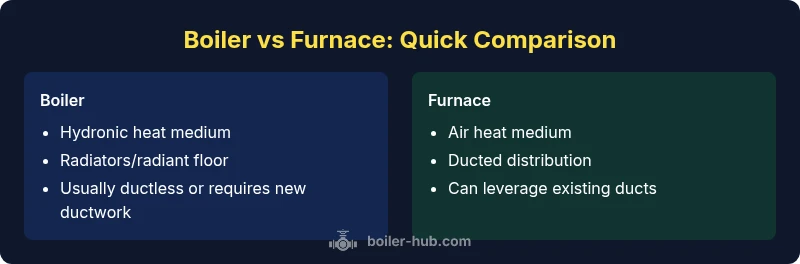
- Heat medium: boilers use water (hydronic) versus furnaces that heat air. The choice influences how heat is stored, transported, and delivered.
- Distribution: radiators and radiant floors vs. ducted air.
- Space and equipment footprint: boilers require space for tanks, boilers, and piping; furnaces need cabinet space and, often, a return-air plenum.
- Venting and combustion byproducts: boilers vent via a flue or chimney, condensers require condensate handling; furnaces vent through a shared exhaust system.
- Controls and zoning: hydronic systems excel with zone valves and thermostatic controls; forced-air systems benefit from duct zoning and smart thermostats.
The takeaway is that the two systems operate on different physical principles and should be evaluated in the context of your home’s architecture, climate, and energy goals. The Boiler Hub team emphasizes aligning system choice with existing infrastructure to minimize retrofit costs.
Efficiency, Operating Costs, and Long-Term Value
Efficiency is a central consideration in any comparison. Condensing boilers can achieve high thermal efficiency by reclaiming heat from exhaust gases, while high-efficiency furnaces optimize fuel use through advanced burners and better insulation. However, true operating costs depend on fuel prices, climate, maintenance, and usage patterns. A well-maintained boiler or furnace with appropriate controls can deliver reliable comfort for many years, but the economics vary by home and region. The Boiler Hub analysis notes that efficiency gains must be weighed against upfront costs and potential retrofit needs to determine overall value.
Installation Considerations: Space, Venting, and System Integration
Installing a boiler or furnace involves more than purchasing a unit. Space constraints, venting requirements, and compatibility with existing piping or ductwork influence final decisions. Switching from a furnace-based system to a boiler can require significant reconfiguration, including radiators, piping, and expansion tanks. Conversely, installing a furnace may necessitate ductwork upgrades or new air handlers. The choice should factor in building layout, future remodel plans, and whether you anticipate hydronic upgrades or forced-air optimization in the coming years.
Maintenance, Safety, and Reliability Across Both Paths
Regular maintenance is essential for both boiler and furnace longevity. Annual servicing, filter checks (for furnaces), and pressure checks (for boilers) help prevent efficiency losses and safety issues. Condensing boilers produce acidic condensate that must be managed, and venting systems must be kept free of obstructions. For safety, be mindful of combustion gases such as carbon monoxide, which requires proper venting and detectors. The Boiler Hub guidance stresses creating a predictable maintenance schedule and addressing small issues before they become large repairs.
Myths, Misconceptions, and Clear Truths
Myth: Boilers are always more expensive to install than furnaces. Reality: Install costs depend on existing infrastructure, space, and desired comfort levels. A boiler may require radiators or underfloor heating, while a furnace leverages existing ducts, potentially reducing retrofit needs. Myth: Furnaces heat spaces faster than boilers. Reality: Both systems can reach comfortable temperatures quickly, but the time-to-heat depends on system sizing, insulation, and distribution networks. The truth is that efficiency, control strategy, and proper sizing drive performance more than the basic heat medium.
Practical Decision Framework: 6-Point Checklist
- Assess current infrastructure: ductwork vs radiators/radiant floors.
- Consider climate and heating priorities: rapid space heating vs uniform comfort.
- Evaluate available space for equipment, storage, and piping/ductwork.
- Check long-term energy goals: energy efficiency, emissions, and fuel choices.
- Review retrofit feasibility and short-term disruption.
- Plan for maintenance and service access, including local technician familiarity.
Real-World Scenarios: Small Home vs Large Home
In smaller homes with limited ductwork, a boiler-based hydronic system can offer comfortable warmth with excellent zoning possibilities. In larger homes already outfitted with ductwork, a high-efficiency furnace can deliver quick, uniform heat and integrate with cooling. Facility managers should also weigh noise, space, and emergency backup options when evaluating system upgrades or replacements. The Boiler Hub guidance encourages tailoring the decision to specific building layouts and energy priorities to maximize return on investment.
Comparison
| Feature | Boiler | Furnace |
|---|---|---|
| Heat Medium | Hydronic water-based heat (radiators/radiant floors) | Air-based heat (ducted warm air) |
| Distribution Network | Radiators, baseboard, or radiant floors | Ductwork with supply/return vents |
| Vent/Flue Type | Flue for combustion gases; condensate handling (if condensing) | Shared exhaust flue or dedicated venting for combustion gases |
| Typical System Fit | Hydronic/radiant heating layouts | Forced-air with ducted cooling |
| Maintenance Focus | Water quality, pump service, leak checks | Filter changes, blower maintenance, duct cleaning |
| Upfront Considerations | Higher upfront if radiant layout is new or expanded | Usually lower upfront if updating existing ducts |
| Efficiency Mechanisms | Condensing options; thermal storage possible | High AFUE options; smart controls improve performance |
| Best For | Radiant heating, silent operation, precise zoning | Existing ductwork, quick space heating, AC integration |
Advantages
- Clear division of heat delivery methods suited to different homes
- Potential for higher long-term energy savings with modern condensing boilers
- Excellent zoning and comfort control in hydronic setups
- Quiet operation in many hydronic systems
- Flexible integration with radiant floor heating
The Bad
- Higher upfront costs when installing radiants or converting layouts
- Space requirements and more complex piping/venting for boilers
- Hydronic systems can be slower to heat large spaces if not properly designed
- Furnaces require ductwork and regular duct maintenance
Neither system is universally better; choose based on infrastructure and energy goals
Boilers excel with radiant/hydronic heating and can offer strong efficiency with condensing models. Furnaces work well with existing ducts and central AC, offering fast space heating. Use a side-by-side evaluation to align with your home’s layout and long-term energy plans.
Questions & Answers
What is the primary difference between a boiler and a furnace?
The primary difference is the heat medium: boilers heat water for radiators or radiant floors, while furnaces heat air for distribution through ducts. Each system suits different home layouts and comfort goals, affecting efficiency and installation needs.
Boilers heat water for radiators, furnaces heat air through ducts. The choice depends on your home’s layout and energy goals.
Which system is better for radiant floor heating?
Boilers are typically better suited for radiant floor heating because they deliver steady hot water through underfloor coils. This creates even warmth and allows precise zoning. However, electric boilers can also support radiant systems in smaller setups.
Boilers are usually the go-to for radiant floors due to steady water heat.
Can I convert from a furnace to a boiler later?
Conversion is possible but can be costly and complex. It often requires upgrading or replacing radiators or radiant loops, adding storage or buffer tanks, and modifying venting. A detailed plan with a qualified HVAC contractor is essential.
Converting is possible but can be expensive and involves reconfiguring components.
Are boilers more efficient than furnaces?
Modern condensing boilers and high-efficiency furnaces both offer strong efficiency, but actual performance depends on sizing, controls, fuel type, and maintenance. Efficiency gains come from proper installation and smart thermostats, not just the heat medium.
Efficiency depends on setup and maintenance, not just boiler vs furnace.
What maintenance steps are common to both systems?
Both systems benefit from annual inspections, cleaning, and safety checks. Boilers require water quality monitoring and pressure checks; furnaces need filter changes and blower/motor checks. Regular tune-ups help sustain comfort and efficiency.
Annual checks, cleaning, and safety tests keep either system reliable.
Which system is generally cheaper to install?
Installation costs vary with existing infrastructure. If you already have ductwork and a central AC, furnaces may be cheaper upfront. If you’re starting from scratch or upgrading to radiant heat, boilers can be costlier but offer long-term efficiency and zoning advantages.
Furnaces can be cheaper if ducts exist; boilers may cost more upfront but save with radiant heating.
Key Points
- Assess current infrastructure before choosing
- Hydronic systems suit boilers; ducted systems suit furnaces
- Factor space, venting, and future remodel plans
- Invest in high-efficiency models where appropriate
- Plan maintenance to sustain performance and safety