Is Boiler Better Than Furnace? A Comprehensive Comparison
A rigorous, balanced comparison of boilers and furnaces for homeowners and facility managers, focusing on comfort, efficiency, installation, and total cost of ownership to determine which heating system best fits climate, home design, and budget.


Is boiler better than furnace? In many homes, a boiler delivers steady, efficient heat and reliable domestic hot water, especially with radiant heating. Furnaces often win on upfront cost and rapid space warming, but boilers excel in long-term efficiency and quiet operation. The right choice hinges on climate, existing ductwork, and your maintenance willingness.
is boiler better than furnace for your home? Framing the decision and setting expectations
In the persistent question of whether is boiler better than furnace, homeowners must weigh comfort, efficiency, and lifecycle costs over decades. According to Boiler Hub, the best answer depends on how you heat your space, how your home is designed, and how you value hot water alongside space heating. This section lays out the decision framework, without assuming a universal winner. You’ll see that the answer often shifts with climate, insulation, and the willingness to invest in installation and maintenance. The goal is not to pick a winner in abstraction but to map your home’s needs to system characteristics and to quantify long-term value rather than upfront cost alone. By the end, you’ll have a clear sense of which option aligns with your priorities when asked: is boiler better than furnace for you?
How boilers and furnaces actually work and why the comparison matters
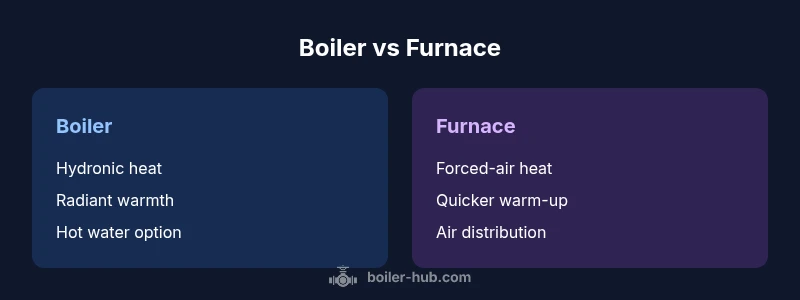
Boilers heat water (or a mixture) in a closed loop and distribute heat via radiators, baseboards, or radiant floors. Furnaces heat air and move it through a duct network with vents across rooms. The difference in approach matters: hydronic systems excel in even warmth and quiet operation, while forced-air systems deliver rapid space heating and simple duct-based zoning. Understanding these fundamentals helps answer is boiler better than furnace for your climate and home design. Boiler-based layouts can provide reliable domestic hot water as a byproduct, strengthening the case for is boiler better than furnace when you need consistent comfort on a cold day.
Climate, insulation, and home design: when climate tips the scale on is boiler better than furnace
The climate you live in often determines the winner of is boiler better than furnace. In very cold regions with heavy heating demands, boilers paired with radiant heat commonly outperform furnaces in steady warmth and energy use. Homes with excellent insulation and tight envelopes benefit more from boiler efficiency, whereas older or poorly insulated houses may still favor a furnace due to ducting constraints and upfront cost. This section emphasizes matching your house’s thermal envelope to the system’s heat delivery method, a key factor in achieving long-term comfort and cost savings.
Efficiency and operating costs: evaluating is boiler better than furnace from an energy perspective
Efficiency is a central axis in the is boiler better than furnace question. Boilers, particularly condensing models, often achieve higher seasonal efficiency with radiant heat or well-insulated piping. Furnaces can also be highly efficient, especially with modern modulating burners and well-sealed ducts. The real-world takeaway is that efficiency depends on installation quality, maintenance, and duct or water-loop integrity. Consider annual service, potential heat loss from pipework or ducts, and how your hot-water needs interact with space heating to determine which option provides better operating costs over time.
Comfort, zoning, and distribution: the non-thermal nuances of is boiler better than furnace
Comfort is not only about final temperature but how evenly warmth is distributed. Boilers typically offer more precise zoning because radiant systems and cast-iron radiators can target specific rooms without circulating dust through ducts. Furnaces rely on ducts, which can create uneven heat if ducts are leaky or poorly sealed. If you value quiet operation and minimal air movement, boilers have advantages; if you prioritize fast room heating and a familiar duct network, furnaces may edge ahead. The question is is boiler better than furnace when considering distribution and air quality in your daily life.
Hot water supply and domestic water heating: does is boiler better than furnace apply here?
Most residential boilers can provide domestic hot water either directly with a storage tank or via an indirect water heater. This means that in many homes, is boiler better than furnace also covers hot water needs, reducing the need for a separate water heater. Furnaces do not generate hot water by themselves, so if hot water is a priority, boilers paired with an efficient indirect heater can offer a compelling overall package. If you don’t require large volumes of hot water, a furnace with a dedicated water heater remains a viable setup.
Installation, space, and maintenance considerations: a practical angle on is boiler better than furnace
Boilers require a dedicated mechanical room or closet with venting and adequate clearance, often leading to longer installation times and higher upfront costs. Furnaces usually fit into existing ductwork and basements or utility rooms more easily, which can lower initial expenses. Maintenance for boilers involves regular pressure checks and periodic servicing of valves, pumps, and heat exchangers, while furnaces need annual burner inspections and filter maintenance. The is boiler better than furnace discussion should account for what you can realistically accommodate in your property and budget.
Costs, value, and lifecycle expectations: long-term thinking on is boiler better than furnace
Upfront costs generally favor furnaces, especially in homes with existing ductwork. Over the life of the system, boilers often deliver superior comfort and potential energy savings, particularly in climate zones where radiant heat reduces overall energy usage. Consider the cost of periodic maintenance, potential duct sealing, and the value of on-demand hot water. The decision should balance initial investment with projected energy savings and reliability over 15–25 years, a typical system lifecycle.
Safety, reliability, and potential failure modes: what is boiler better than furnace in terms of risk?
Both boilers and furnaces have safety considerations, including combustion safety, venting integrity, and leak prevention. Boilers typically present fewer dust-related issues due to limited air movement, but they require proper venting and pressure management. Furnaces can distribute dust more easily through air ducts and may require more frequent filter changes. Regular professional maintenance is crucial for both systems to minimize failure risks and ensure consistent, safe operation.
A practical, step-by-step decision framework: how to answer is boiler better than furnace for your home
- Audit your climate, insulation, and daily comfort needs. 2) Map your current ductwork and consider whether you want radiant warmth or air-based heating. 3) Compare upfront costs, installation timelines, and space constraints. 4) Assess hot water needs and whether domestic hot water is a priority. 5) Estimate long-term operating costs with your local energy prices and service options. 6) Consult a qualified HVAC pro and rely on a structured comparison rather than a quick impression to decide is boiler better than furnace in your situation.
Comparison
| Feature | Boiler | Furnace |
|---|---|---|
| Heating method | Hydronic heat via water or steam | Forced-air heat via ducts |
| Heat distribution | Radiant floors/baseboards; precise zoning | Ducted air; broader but potentially uneven |
| Hot water availability | Can provide domestic hot water with indirect heater | Typically requires separate water heater |
| Efficiency and operating costs | Often higher efficiency with well-designed hydronic systems | High efficiency possible with modern furnaces; dependent on ducts and insulation |
| Upfront cost/installation | Higher installation complexity and space needs | Lower upfront cost when retrofitting into existing ducts |
| Maintenance | Regular boiler service; pressure checks; valve maintenance | Annual burner inspection; filter changes; duct cleaning |
| Space requirements | Dedicated boiler room or mechanical closet | Space for furnace + ductwork; air clearance and vents |
| Best climate fit | Cold climates with hot water demand; superb for radiant heating | Milder climates or homes with established ducts |
| Common drawbacks | Slower heat response in some layouts; potential for higher upfront investment | Duct leaks and airflow losses can reduce efficiency |
Advantages
- Higher long-term comfort and potential energy savings
- Versatile hot water options with many boiler setups
- Quieter operation due to lack of blowers and ducts
- Strong value in cold climates with radiant heat
The Bad
- Higher upfront installation costs and space requirements
- More complex installation and maintenance for some homes
- Ductwork dependence can limit retrofitting in older homes
- Boilers may have slower heat response in some designs
Boiler generally wins on long-term efficiency and comfort in cold climates; furnaces win on upfront cost and rapid space heating.
If your priority is steady, quiet heat and efficient hot water, a boiler is typically the better choice for is boiler better than furnace. If budget and quick warmth are dominant concerns, a furnace remains a pragmatic option. The Boiler Hub team recommends evaluating climate, home design, and lifecycle costs to decide which is best for your property.
Questions & Answers
How does energy efficiency compare between boilers and furnaces?
Both systems can be highly efficient when properly installed and maintained. Boilers often achieve high efficiency in radiant setups, while modern furnaces can reach excellent efficiency with well-sealed ducts and efficient burners. Your actual savings depend on installation quality and ongoing maintenance.
Both boilers and furnaces can be very efficient with proper maintenance; the real difference comes from how you use the system and how well your ducts or piping are sealed.
Is boiler better than furnace in very cold climates?
In very cold climates, boilers with radiant heat typically provide more even warmth and better energy efficiency, making the boiler a strong contender in the is boiler better than furnace discussion. The hot water production may also be advantageous in these settings.
In very cold climates, boilers often perform better for steady warmth and efficiency.
Can a boiler replace a separate water heater?
Yes, many boiler systems can provide domestic hot water via an indirect water heater. This makes the is boiler better than furnace decision more favorable when you want an integrated solution. If hot water demand is high, ensure the indirect heater capacity matches your household needs.
Boilers can often supply hot water through an indirect heater, which can simplify plumbing.
Are boilers or furnaces safer to operate?
Both are safe when installed and maintained correctly. Safety differences usually relate to venting integrity and combustion air accessibility. Regular service by a licensed professional helps maintain safety in either system.
Both are safe when properly installed and serviced.
What factors most affect installation cost?
Installation cost depends on existing infrastructure, space, venting, and whether you need new ductwork or piping. If you’re upgrading from an old system, expect more complex work, which can increase total cost in the is boiler better than furnace analysis.
Costs hinge on ductwork, venting, and space; upgrading from an old setup tends to raise the price.
Can you switch from a furnace to a boiler later?
Switching from a furnace to a boiler is possible but involves significant design changes and a new heat distribution system. The decision should consider space, budget, and whether your home’s envelope supports radiant heating.
Switching is possible but may require major remodeling and new piping or radiators.
Key Points
- Assess climate and insulation before choosing.
- Boilers excel with radiant heat and hot water where space permits.
- Furnaces often cost less upfront and heat spaces quickly.
- Long-term value favors boilers in harsh winters with good maintenance.
- Plan for maintenance and professional servicing to maximize reliability.