What boiler temperature for underfloor heating: A practical guide
Learn the typical boiler water temperature ranges for underfloor heating (UFH), how to choose the right setting for your floor, and strategies to balance comfort with efficiency. Includes real-world benchmarks, tables, and expert guidance from Boiler Hub.


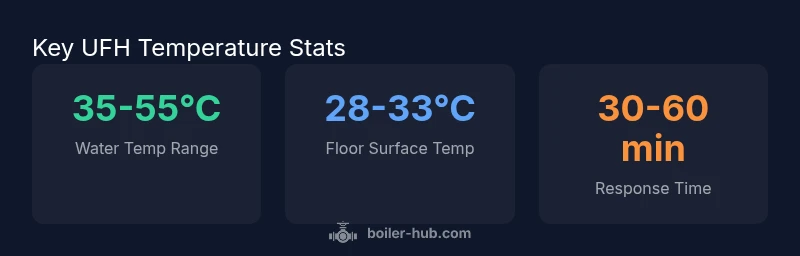
For most underfloor heating systems, target boiler water temperatures typically fall in the 35°C to 55°C range, with 40–50°C common for retrofit installs and 45–50°C typical for new builds. The exact setting depends on floor construction, insulation, and heat source. Balance comfort with efficiency, per Boiler Hub Analysis, 2026.
Understanding UFH and boiler temperature
Underfloor heating (UFH) relies on circulating warm water through loops embedded in floors to heat a space. Because the floor acts as a large thermal mass, UFH operates efficiently at lower water temperatures than traditional radiators. This means that the boiler temperature setting is not about blast heat but about maintaining a comfortable floor surface while avoiding cold spots or overheating. According to Boiler Hub, the optimal starting point for most homes is a boiler water temperature in the mid-30s to mid-40s Celsius for many UFH layouts, with adjustments based on insulation and floor construction. The same principle applies whether you have a concrete slab, wooden subfloor, or a heated tiled finish. The goal is steady, even warmth rather than rapid bursts of heat.
How to determine the right temperature range
Choosing the right boiler temperature for UFH starts with understanding the floor assembly. A well-insulated slab with a thick screed will tolerate lower water temperatures (often in the 35–45°C range) because heat stays in the floor longer. Conversely, poorly insulated floors or shallower screeds require higher water temperatures to overcome heat losses. Always consider the floor finish: carpet, timber, or tile each has different thermal conductivity, which affects how comfortably hot the surface will feel. A professional should verify insulation levels and floor construction before finalizing a target range. Use a floor sensor to monitor actual surface temperature and adjust the boiler output to maintain the desired 28–33°C surface target.
The impact of heat source on temperatures
The heat source dramatically influences UFH water temperature targets. For gas condensing boilers, a typical UFH range is roughly 35–50°C, leaning toward the lower end when efficiency is the priority. For older non-condensing boilers, you may need higher water temperatures within a similar ceiling, but this comes at a cost to efficiency and emitter life. Heat pumps, which operate more efficiently at lower temperatures, commonly run UFH water in the 30–45°C band to maximize COP (coefficient of performance). In all cases, raising water temperature reduces efficiency gains from UFH, so aim for the lowest temperature that still achieves comfortable floor warmth. Boiler Hub Analysis, 2026 notes that optimization often hinges on proper controls and insulation more than raw boiler output.
Control strategies for consistent comfort
Control is king with UFH. A room-by-room thermostat strategy—with zone controls or valves—lets you tailor temperature to usage. Pair thermostats with floor sensors embedded in or under the receiving room to prevent overheating. Weather-compensation or outdoor reset strategies adjust boiler return temperature based on outdoor conditions, conserving energy during milder days and ramping up heat when it’s cold outside. Consider a mixing valve to prevent high return temperatures that could burden the boiler and floor assemblies. Regularly auditing insulation, pipe routing, and screed thickness helps maintain the intended temperature band and avoids uncomfortable cold spots or hot patches.
Practical steps to set your boiler for UFH
- Confirm floor construction and insulation with a professional. 2) Start with a conservative range (e.g., 35–45°C) and adjust based on floor surface feedback. 3) Install a floor sensor and connect a weather-compensated control; keep the boiler within advised ranges for your heat source. 4) Use a mixing valve if your system lacks one to avoid excessively high return temperatures. 5) Document actual floor temperatures and energy usage over several weeks, then fine-tune. 6) If you retrofit UFH, consider a staged approach to heat-up and cool-down cycles to minimize thermal shock to the floor.
Common pitfalls and how to avoid them
Overheating the floor is the most common error; it leads to discomfort and energy waste. Insufficient insulation around the loops causes heat losses that push temperatures higher than intended. Avoid relying on boiler output alone—pair temperature settings with good controls and sensors. Skipping floor-sensor installation makes it difficult to maintain a stable surface temperature. Finally, do not ignore scrupulous commissioning: a professional check ensures balancing across zones and validates that the system responds predictably to thermostat changes.
When to consult a professional
If you’re planning a UFH retrofit or a new build, consult a heating specialist to set target ranges based on floor type, insulation, and heat source. A professional can perform a charge-test and calibrate flow rates, valve positions, and sensor locations for optimal performance. Ongoing maintenance—like checking for air in the system, verifying pump operation, and confirming boiler efficiency—helps sustain desired temperatures and comfort levels over time. The Boiler Hub Team recommends periodic reviews of thermostat programming and sensor placement as part of routine maintenance.
Case study examples: retrofit vs new build
In retrofit scenarios, older homes often require enhanced insulation or a thicker screed to allow lower water temperatures while preserving comfort. A newly built home with a well-insulated slab can operate comfortably at the lower end of the UFH range (approximately 35–45°C) because there’s less heat loss through building envelope. In both cases, the critical factor is accurate floor temperature sensing and correct control strategy. Boiler Hub analysis stresses that small adjustments to sensor placement or zoning can translate into meaningful comfort gains and energy savings without a large increase in boiler output.
Typical UFH water temperature ranges by system type
| System Type | Recommended Water Temp Range (°C) | Target Floor Temp (°C) |
|---|---|---|
| Retrofit UFH on existing slab | 35-50 | 28-32 |
| New build UFH with slab | 40-55 | 29-33 |
| UFH with heat pump | 30-45 | 28-32 |
Questions & Answers
What is underfloor heating and why does boiler temperature matter?
UFH distributes heat through floor loops and relies on lower water temperatures than radiators. The boiler temperature determines how quickly and evenly the floor warms, affecting both comfort and energy use.
UFH uses warm water through floor pipes; lower boiler temps keep the floor comfortable and efficient. It’s about balance, not blasting heat.
Can I use a standard radiator boiler for UFH?
Yes, but you may need a mixing valve and zone controls to prevent overheating and to match UFH’s lower temperature needs. An older, non-optimized boiler will struggle to sustain efficiency.
You can, but you’ll likely need a mixing valve and good controls to keep the floor from getting too hot.
What happens if the boiler temperature is set too high?
Excessively high water temperatures heat the floor too quickly, increasing energy use and risking uncomfortable surface temperatures. It can also shorten component life if cycling is aggressive.
Too hot means an uncomfortable floor and wasted energy. Keep within recommended ranges and use good controls.
Do I need weather compensation for UFH?
Weather-compensation aligns boiler output with outdoor conditions, improving efficiency and comfort. It helps prevent over- or under-heating during seasonal changes.
Yes, weather compensation helps your system stay comfortable and efficient across the seasons.
How do I adjust if I don’t have floor sensors?
Install floor sensors or at least a representative room sensor and rely on zone controls. Without sensors, you’ll be guessing at temperatures and comfort will vary.
If you don’t have a floor sensor, add at least one room sensor and use zone controls for steady comfort.
When should I consult a professional?
If you’re planning a retrofit or new build UFH, a professional can validate floor construction, select targets, and calibrate controls for reliable performance.
If you’re unsure about insulation, floor type, or control strategy, call a heating professional.
“Getting the right boiler temperature for underfloor heating isn’t about one exact number. It’s about balancing floor warmth, system efficiency, and stable comfort across zones.”
Key Points
- Start with a conservative UFH water temp range.
- Insulation and floor finish drive the ideal setting.
- Use floor sensors and weather compensation for balance.
- A professional should confirm the final range for reliability.