Gas Boiler vs Oil Boiler: In-Depth Comparison for Homeowners and Managers
A detailed, objective comparison of gas boiler vs oil boiler, covering operation, efficiency, costs, installation, safety, and practical guidance for homeowners and facility managers.


Gas boiler vs oil boiler presents a clear choice for most homes: gas typically offers lower running costs and easier fuel supply in dense networks, while oil boilers provide reliability where gas isn't available and can offer similar heat output with different maintenance needs. Boiler Hub's quick take: for urban areas with gas access, gas wins on cost and convenience, otherwise oil is a solid alternative.
Gas Boiler vs Oil Boiler: An At-a-Glance Overview
Choosing between a gas boiler and an oil boiler is one of the most consequential decisions for heating a home or building. The gas boiler vs oil boiler question centers on fuel availability, cost dynamics, maintenance demands, and the practical implications of installation. In many regions, mains gas offers a straightforward path to reliable heat, while rural or off-grid sites often rely on oil as a secure alternative. This block sets the stage for a deeper comparison by outlining the core differences in how these systems heat water, how they are powered, and what homeowners should expect over the equipment’s life.
The Boiler Hub perspective emphasizes that the best choice is seldom universal: it hinges on your local fuel infrastructure, your climate, and long-run price expectations. As you read, note how each option affects storage requirements, safety considerations, and service needs, because these factors often outweigh upfront purchase price in total cost of ownership. Throughout, keep in mind that the ultimate decision should balance reliability, cost of ownership, and local energy policy dynamics in your region. Boiler Hub’s analysis stresses context over creed.
How Gas and Oil Boilers Work Differently
Gas boilers burn natural gas delivered through a city or regional network, while oil boilers burn heating oil stored on-site or delivered regularly. Both types typically use a heat exchanger to warm water that circulates through radiators or underfloor circuits. Modern condensing boilers recover additional heat from exhaust gases, improving efficiency, but the fuel source determines emissions, fuel storage needs, and the practical footprint of venting and service access.
Gas systems benefit from fast ignition and compact footprints, with simpler flue requirements if the home already has a gas chimney or liner. Oil systems, by contrast, require a storage tank, a delivery plan, and often a larger ventilation footprint. The combustion chemistry is similar in principle, but the fuels have different calorific values and sulfur content, which influences boiler choice, fuel filters, and maintenance schedules. In short, the two systems work toward the same heating goal, but the path they take—through the fuel chain and the energy content—shapes performance and reliability in everyday use.
Fuel Availability, Storage, and Supply Chain
Access to fuel is a critical differentiator. If your property sits on a reliable gas network, the fuel is typically cheaper to run and easier to source on-demand. However, you are tied to the gas utility’s service hours and pricing structures, and a prolonged service outage can disrupt heating. Oil, in areas without mains gas, often makes sense because you can stock a reserve supply and receive deliveries on a schedule that suits your property.
Oil storage tanks require appropriate outdoor or indoors space, weatherproofing, and regular top-ups to avoid running dry in winter. Distribution reliability, price volatility, and the environmental rules around tanks (leakage prevention, secondary containment) also matter. From a risk management perspective, homeowners in frost-prone regions may lean toward oil because seizing a gas service interruption could have broader consequences. The decision is not just about current fuel prices; it includes storage costs, tank integrity, and the local supply chain's resilience.
Efficiency, Emissions, and Running Costs
Both gas and oil boilers can be highly efficient, with modern condensing models extracting additional heat from exhaust gases. The key driver of running costs is the fuel price trend and the boiler’s efficiency rating. Gas typically offers lower price volatility in many regions, translating into steadier annual fuel bills, but price spikes do occur and may tilt the economics in favor of oil during certain periods. Efficiency improvements in both fuels come from better heat exchangers, better burner control, and smarter modulation. Operators should compare Seasonal Efficiency, Net Supply Efficiency, and the boiler’s energy performance certificate to gauge expected running costs. In practice, a well-maintained gas boiler often delivers lower operating costs when gas prices are stable, while oil can be cost-competitive in markets with robust local refineries or favorable delivery contracts. The overall answer depends on price trends, boiler efficiency, and how well the system is matched to heating demand.
Installation, Siting, and Maintenance
Installation considerations differ markedly between gas and oil. Gas boilers typically connect to a mains gas supply and require a venting path compatible with existing chimney or a dedicated flue, which can simplify retrofits in urban spaces. Oil boilers demand an on-site fuel tank, robust fuel lines, and potentially larger ventilation space, which can increase site footprint and planning permissions. Maintenance for either system should include annual servicing, combustion efficiency checks, and safety inspections. Gas systems benefit from a dense service network and standardized components, while oil systems require attention to tank integrity, fuel quality, and delivery schedules. The choice may hinge on access to qualified technicians, local regulations on fuel storage, and the practicality of maintaining a continuous supply in cold months.
Environmental Impact and Safety Considerations
Environmental and safety considerations intersect with fuel choice. Natural gas generally produces fewer particulate emissions and lower CO2 per unit of heat than heating oil, especially when paired with high-efficiency condensing boilers. Oil systems can still be extremely efficient, but their higher carbon footprint and the risks associated with fuel storage tanks (leaks, spills) require careful containment and regular inspections. Safety measures include carbon monoxide detectors, proper ventilation, and a clear maintenance plan. Regardless of choice, a well-maintained boiler with a modern control system will be safer and more reliable. Boiling down safety—install CO detectors, ensure professional servicing, and follow local regulations on storage and disposal of fuels.
Practical Decision Guide: When to Choose Gas vs Oil
Use this practical guide when evaluating your options:
- If you have a reliable mains gas supply, starting with a gas boiler is typically sensible due to lower running costs and a wide service network.
- If you live in a rural area without mains gas or if gas prices spike unpredictably, an oil boiler can offer a secure alternative with on-site fuel storage.
- For new builds in urban areas, consider gas if local electricity and gas pricing are favorable and the site allows a compact, efficient installation.
- For retrofits, evaluate the existing piping, flue routing, and the practicality of adding an oil tank versus a gas line upgrade.
- Always price not only the boiler but also installation, fuel storage, service contracts, and potential conversion costs if you anticipate a future fuel switch.
Common Myths and Real-World Scenarios
Myth: Gas is always cheaper than oil. Reality: Fuel prices fluctuate and depend on regional markets; in some periods, oil can be competitive. Myth: Oil is inherently dirtier and more polluting. Reality: Modern oil boilers with condensing technology can be highly efficient, though they typically emit more CO2 per energy unit than gas. Myth: Switching fuels is simple. Reality: Conversions require careful planning, permits, and potential renovations to your fuel storage, flue, and boiler room. Real-world scenarios show that careful assessment of fuel availability, space, and long-term price trends often reveals the most cost-effective path.
Long-Term Considerations: Replacement, Incentives, and Policy
Over the life of a boiler, consider not just upfront costs but also long-term maintenance, energy efficiency upgrades, and regional incentives tied to fuel choices. Some regions offer subsidies or rebates for high-efficiency gas boilers, while others support oil-saving upgrades or alternative heat sources. Environmental and building regulations can affect permissible fuels for new installations or retrofits. Boiler lifecycle planning should account for future price volatility, the cost of tank upkeep (for oil), and the potential need for fuel storage upgrades if codes tighten.
How to Move Forward: Assessing Your Property and Next Steps
Begin with a property audit that catalogues fuel access, space for equipment, and existing infrastructure. Obtain at least three quotes that cover the boiler unit, flue work, tank installation (if oil), and annual servicing. Check local regulations on fuel storage, environmental impact, and required CO alarms. Finally, align your choice with a long-term heating strategy, considering future energy trends, potential upgrades to insulation, and whether a switch to a different heating source (like heat pumps) could complement the chosen boiler.
Main Takeaway: Don’t Choose in a Vacuum
The gas boiler vs oil boiler decision hinges on local fuel infrastructure, long-term price outlooks, space constraints, and maintenance expectations. A well-suited choice minimizes total cost of ownership while maximizing comfort and safety. Engage a qualified heating professional to validate your plan and ensure compliance with applicable codes and safety standards.
Comparison
| Feature | Gas boiler | Oil boiler |
|---|---|---|
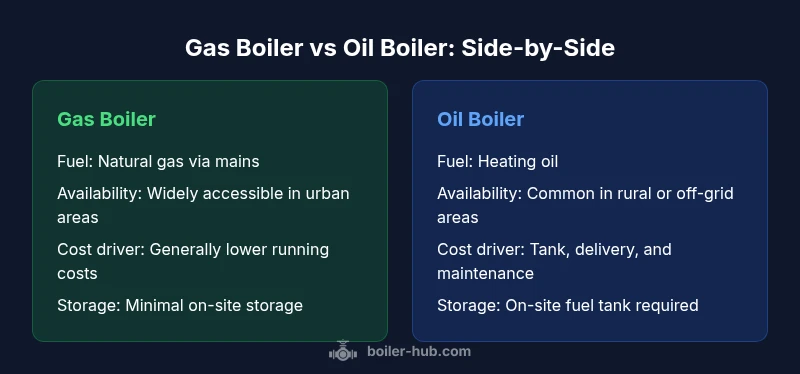
| Fuel type | Natural gas via mains | Heating oil stored on-site |
| Fuel availability | Widely available in gas-connected areas | Common in rural/off-grid areas |
| Installation footprint | Compact footprint; relies on existing gas line and venting where present | Requires outdoor storage tank and larger ventilation; may need more space |
| Upfront costs | Generally moderate when gas lines exist; boiler cost plus standard install | Often higher due to tank, lines, and potential conversion work |
| Running costs | Typically lower with gas when prices are favorable | Oil costs track heating oil prices and can be higher over time |
| Maintenance needs | Strong service networks; regular annual servicing common | Tank management and fuel delivery logistics add complexity |
| Emissions and efficiency | High-efficiency gas condensing options; lower CO2 for gas | Oil condensing options exist but generally higher CO2 per energy unit |
| Reliability in outages | Gas networks with consistent supply in many regions | Oil on-site storage can cushion outages but depends on tank size |
| Best for | Urban/suburban homes with reliable gas supply | Rural homes without mains gas or where oil is cheaper |
Advantages
- Lower running costs when mains gas is affordable
- Extensive service networks and proven reliability for gas boilers
- Compact footprint and modern condensing options in many homes
- Oil boilers offer reliable heating where gas isn't available
The Bad
- Oil storage tanks require space, shielding, and regular deliveries
- Gas outages or price volatility can impact running costs
- Oil can have higher CO2 emissions and odor concerns from fuel handling
Gas boilers are generally the better option where mains gas is available; oil boilers are the preferred fallback in rural areas without gas access.
If your property has a reliable gas supply, gas boilers typically offer lower running costs and easier maintenance. If you lack gas service or prefer on-site fuel storage, an oil boiler remains a solid alternative; plan for storage and delivery logistics.
Questions & Answers
What is the main difference between a gas boiler and an oil boiler?
Gas and oil boilers both provide central heating, but gas uses natural gas via mains supply, while oil uses heating oil stored on-site. The choice affects fuel storage, maintenance, and running costs.
Gas boilers use mains gas; oil boilers require an on-site oil tank and deliveries.
Which boiler is cheaper to run?
In most markets, gas is cheaper per unit of energy than oil, but prices vary; overall cost depends on fuel price trends, efficiency, and heating demand.
Gas is usually cheaper, but prices change; efficiency matters.
Can I convert an oil boiler to a gas boiler?
Conversion is possible but involves gas supply installation, boiler replacement, and associated costs; feasibility depends on the property, chimney/flue, and local regulations.
Conversion is possible but requires assessment and upgrades.
Are both options compatible with modern high-efficiency boilers?
Yes; both gas and oil boilers can be high-efficiency condensing models that maximize heat extraction and minimize waste heat.
Both can be high-efficiency with condensing tech.
What safety considerations should I know?
Gas boilers carry risk of gas leaks and carbon monoxide; oil boilers carry storage hazards; both require annual servicing and CO detectors.
Install CO detectors; have annual service.
What should I consider for a new-build vs retrofit?
New builds with reliable gas access favor gas for cost and convenience; retrofits in off-grid locations may lean toward oil or alternative heat sources.
Gas is often preferred in new builds with gas access.
Key Points
- Assess local fuel infrastructure before choosing
- Prefer gas if mains supply is reliable and prices are favorable
- Plan for storage and safety if choosing oil
- Factor in maintenance and service network quality
- Consider long-term policy and incentives related to fuel choices