Gas boiler vs furnace: A practical comparison
Explore the essential differences between gas boilers and gas furnaces, including heat delivery, efficiency, installation, and when each system is the better fit for hydronic vs. ducted homes.


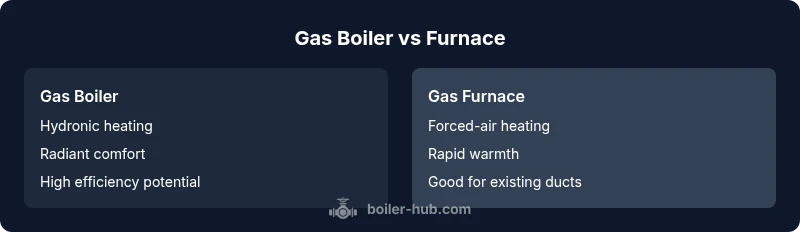
Gas boiler vs furnace: both run on natural gas but heat your home differently. A gas boiler heats water for a hydronic system, while a gas furnace warms air for a central forced-air system. Boilers often pair with radiant floors or baseboard radiators and deliver high efficiency in steady climates; furnaces provide rapid space heating and easier retrofit where ductwork exists. The right choice depends on your home's distribution and priorities.
Gas boiler vs furnace: Key differences
When you’re weighing a gas boiler vs furnace, the core distinction is how heat is produced and distributed. A gas boiler creates hot water (or steam) that travels through pipes to radiators, baseboard heaters, or radiant floors. A gas furnace, by contrast, heats air that is blown through ducts to warm rooms. The boiler is typically paired with a hydronic system, while the furnace is paired with a central air distribution network. The Boiler Hub team emphasizes that the choice should align with your home’s current distribution, climate, and comfort priorities. In homes with existing radiators or radiant floor systems, a boiler often provides more uniform, steady heat and can support advanced zoning. In homes with ductwork, a furnace can deliver fast, even warmth and may be easier to retrofit around an existing ventilation system. Practical consequences include differences in space needs, upfront costs, maintenance, and long-term operating costs. Read on to understand how these fundamental differences shape real-world performance.
You should consider how your home’s heating distribution (radiators vs ducts) and climate influence whether a boiler or furnace is the better fit. According to Boiler Hub, hydronic systems excel in comfort and efficiency when zoning is important, while forced-air systems offer swift, whole-home heat with straightforward upgrades.
How hydronic vs forced-air heating works
A gas boiler powers a hydronic heating loop that circulates hot water through a network of pipes to radiators, baseboard heaters, or radiant floors. The heat transfer is steady and can be tuned via thermostats and zoning valves. In contrast, a gas furnace heats air in its combustion chamber and distributes it through ducts using a blower. The result is rapid warming, especially useful in homes with variable occupancy or zone needs. Hydronic systems tend to be quieter in living spaces and provide a comforting, even warmth. Ducted systems can spread heat quickly but may be more prone to temperature stratification if not properly balanced. The choice between hot-water and warm-air delivery affects comfort, indoor air quality, and HVAC design, so it’s essential to match the distribution method to your lifestyle.
The key distinction lies in heat transfer: water-based hydronic systems heat evenly and quietly, while air-based forced-air systems respond quickly to temperature changes. Boiler Hub notes that many homes benefit from a hybrid approach, integrating zoning with either hydronic radiators or ducted air for flexible comfort.
Efficiency and performance: AFUE and heating metrics
Efficiency in gas heating is commonly described using AFUE for both boilers and furnaces, with boilers often achieving high efficiency in condensing models. When comparing gas boiler vs furnace, it’s important to look beyond a single number and consider real-world usage, climate, and system design. Boilers can claim high seasonal efficiency, especially when paired with modern radiators and well-insulated piping. Furnaces can deliver strong performance, particularly in colder months, when they operate at steady firing and maintain comfortable air temperatures. Boiler Hub Analysis, 2026, emphasizes that the best-performing systems combine a high AFUE with proper installation, reliable controls, and proper sealing of ducts or pipes. Efficiency gains are maximized through proper insulation, sealing, and regular maintenance, which minimize heat loss and ensure the system operates close to its rated performance.
Boiler Hub Analysis, 2026 highlights that real-world efficiency depends as much on installation quality and weather conditions as on the equipment rating itself.
Sizing, climate, and installation considerations
Sizing a gas boiler or furnace correctly is crucial for comfort and energy use. Oversized equipment leads to short cycling, humidity spikes with forced-air, or uneven room temperatures with radiators. Undersized systems struggle during peak winter and can wear out sooner. Climate plays a major role: in milder climates, a high-efficiency boiler with radiant heating can sustain comfortable temperatures with lower energy use, while in climates with harsh winters, a powerful furnace may be preferred for rapid space heating. Installation considerations include existing ductwork or radiator/radiant floor loops, basement or attic space, venting needs, and local code requirements. A thoughtful assessment by a qualified professional helps determine whether a gas boiler or furnace best matches your home’s thermal envelope and occupancy patterns.
Pricing and installation pains often hinge on retrofit work: adding radiant piping for a boiler or extending/adjusting ductwork for a furnace can influence both cost and downtime. Boiler Hub recommends a pre-installation assessment that maps heat distribution, insulation, and zone control potential.
Installation, maintenance, and service needs
Both systems require professional installation and periodic service, but the specifics differ. Boilers rely on well-sealed plumbing loops and precise thermostat control for reliable hydronic heat. Furnaces depend on clean ducts, healthy air filters, and a well-maintained blower and heat exchanger. In either case, regular checks of venting, combustion safety, and condensate management are essential. Condensing boilers and high-efficiency furnaces benefit from annual or seasonal inspections to preserve performance and safety. The Boiler Hub team notes that service frequency and cost are influenced by fuel quality, usage patterns, and the complexity of the system. Proactive maintenance often reduces the risk of sudden failures and improves overall reliability.
If you’re replacing an older system, plan for potential upgrades to venting or duct sealing to optimize performance. Boiler Hub stresses the value of a preventive maintenance plan that covers combustion safety, vent condition, and control calibration.
Space requirements, zoning, and air quality
Hydronic systems for boilers require space for a boiler unit, piping, and radiators or underfloor heating loops, which influences where the equipment can be placed. Zoning is a strong suit of boilers, enabling different rooms or areas to heat independently through thermostatic valves. Furnaces with existing ducts offer straightforward zoning via dampers, but additional ductwork and air handler capacity may be needed for new zones. Air quality considerations differ: boilers mostly affect humidity and radiant comfort, while furnaces influence air flow, filtration, and potential dust distribution. Proper filtration, humidity control, and duct sealing contribute to comfortable, healthy indoor environments. The Boiler Hub team encourages homeowners to evaluate the thermal envelope, insulation levels, and how often spaces are occupied to determine the most effective distribution strategy.
Zoning flexibility, energy use, and air quality all hinge on your distribution network. If your home is well insulated and features modern radiators or radiant flooring, a boiler can maximize comfort with targeted heat. For ducted homes, furnaces paired with good filtration offer convenient daily use and rapid warm-ups.
Comfort, noise, and lifestyle compatibility
Comfort experience varies between hydronic and forced-air systems. Hydronic heating tends to produce a steady, silent warmth and is less prone to air movement noise, since radiators and warm floors are passive emitters. Forced-air systems with furnaces may introduce more noise in operation due to blowers and air movement, but they deliver rapid temperature changes and can be integrated with whole-home media filters and humidifiers. Lifestyle considerations—like the importance of quiet spaces, the presence of children or pets, and how often you use cooling—will influence the choice. Homeowners who value radiant warmth and quiet environments may lean toward a boiler, while those who want fast, uniform heating and simple upgrades for existing ducts might prefer a furnace. The right option balances comfort preferences with practical installation realities.
People living in open-concept spaces or homes with extensive duct networks often favor furnaces for immediate warmth, whereas homes with traditional radiators or radiant floors benefit from boilers for even heat distribution.
Safety, venting, and emissions
Both gas boilers and gas furnaces require proper venting to the outdoors and safe combustion air. Modern condensing boilers and high-efficiency furnaces include safety controls such as flame sensors and pressure switches. Venting material, diameter, and routing should comply with local codes, and condensate disposal must be managed correctly for boilers. Emissions considerations include ensuring adequate combustion and minimizing backdraft risks. Regular maintenance reduces the risk of carbon monoxide leaks and other hazards. Boiler Hub emphasizes choosing certified installers who adhere to current safety standards and who can provide clear venting and combustion safety documentation.
Proper venting and combustion safety are non-negotiable for both systems. A correct installation minimizes risk and ensures long-term reliability.
Cost considerations: upfront and operating costs
Upfront costs for a gas boiler or furnace depend on the complexity of the installation, existing distribution, and whether retrofits are required. Boilers may involve additional costs for radiators, piping, and potential radiant-floor or baseboard looping. Furnaces may incur ductwork upgrades or air handler improvements if the existing duct network is undersized or leaky. Operating costs hinge on efficiency ratings, fuel prices, and how you use the system. While boilers can offer very high efficiency in hydronic setups, furnaces can perform very well in homes with established ducts. Boiler Hub notes that the total cost of ownership over time is driven by installation quality, ongoing maintenance, and how well the system matches your climate and occupancy patterns.
Energy costs are influenced by how effectively a system is sealed, insulated, and controlled. A thorough pre-purchase evaluation helps estimate long-term savings more accurately.
Choosing the right system for your home
The decision between gas boiler vs furnace should start with your home’s heat distribution, climate, and comfort goals. If you have a modern radiator network, underfloor heating, or heavy zoning needs, a boiler is often the best fit. If your home has a ducted cooling system and you desire rapid heat with simple zoning, a furnace can be the more practical option. Your selection should also factor in maintenance expectations, space available, and compatibility with smart thermostats and humidification systems. Getting a professional load calculation and a detailed comparison from Boiler Hub can help you weigh upfront costs against long-term savings and comfort.
A practical decision framework includes assessing existing infrastructure, projecting seasonal load, and evaluating installation logistics. Boiler Hub recommends obtaining multiple quotes and asking about warranty coverage, venting, and potential energy rebates.
Common myths about gas boilers and furnaces
Many homeowners believe boilers are always more expensive to operate than furnaces. In reality, efficiency and usage patterns matter more than the label. Some assume boilers are noisier or less reliable than furnaces; however, modern hydronic systems can be quieter and longer-lasting with proper maintenance. Another misconception is that you must replace your entire distribution network when switching from one system to the other. In most cases, targeted upgrades—like adding radiators for a boiler or sealing ducts for a furnace—can achieve a balanced, comfortable system. Boiler Hub debunks these myths by focusing on real-world performance, climate, and occupancy patterns rather than generic assumptions.
Myths often overlook the importance of installation quality and ongoing maintenance in realizing a system’s true potential.
Comparison
| Feature | Gas boiler | Gas furnace |
|---|---|---|
| Heating method | Hydronic (water-based) distribution | Forced-air (air-based) distribution |
| Best fit for | Radiant heating, radiators, or underfloor systems | Ducted homes with centralized air |
| Efficiency considerations | High potential with condensing boilers | Strong performance with modern furnaces |
| Space/installation | Requires plumbing loops and radiators or radiant floors | Requires ductwork; may need retrofit if absent |
| Maintenance needs | Periodic boiler service and boiler-specific checks | Regular filter changes, duct cleaning, and blower maintenance |
| Noise levels | Typically quieter inside; boiler room operates with minimal sound | |
| Upfront cost range | Moderate to high; depends on distribution and radiators | |
| Operating costs | Depends on AFUE, heat distribution, and usage pattern | Depends on AFUE, duct design, and usage pattern |
Advantages
- High-efficiency potential with condensing boilers
- Excellent compatibility with radiant heating and precise zoning
- Quiet operation and comfort with hydronic systems
- Longer lifecycle potential with quality maintenance
The Bad
- Higher upfront installation costs and complexity
- Requires compatible heat distribution (radiators or radiant floors)
- Potentially more invasive retrofit if no existing distribution
- Maintenance may require specialized service technicians
Gas boiler vs furnace: choose based on your home’s heat distribution and comfort priorities
Boilers excel with radiant heat and precise zoning, especially in well-insulated homes. Furnaces shine when rapid, uniform heat is needed and existing ducts are in good shape. The best choice balances distribution, climate, and maintenance willingness.
Questions & Answers
What is the main difference between a gas boiler and a gas furnace?
The main difference is heat distribution: boilers heat water for radiators or radiant floors, while furnaces heat air and distribute it through ducts. This affects comfort, installation, and efficiency depending on your home’s layout.
Boilers use water to transfer heat; furnaces heat air. The choice depends on whether your home uses radiators or ducts.
Which system is more energy efficient for a typical home?
Both can be highly efficient when properly installed. Boilers often achieve excellent efficiency with condensing technology and radiant heat, while modern furnaces perform very well with sealed ductwork and quality filters. Real-world efficiency depends on installation quality and climate.
If you have good ductwork, a modern furnace can be very efficient; if you have radiant floors, a boiler can be exceptionally efficient.
Can I convert my existing system from one to the other easily?
Conversions are possible but involve significant work: changing heat distribution, venting, and control systems. A professional load calculation and site assessment are essential to determine feasibility and cost.
A switch isn’t trivial; you’ll likely need major duct or piping changes and professional planning.
Does venting differ between boilers and furnaces?
Yes. Boilers vent exhaust through a dedicated vent or chimney as part of a hydronic system, while furnaces vent combustion gases through a ventilation system sized for air handling. Proper venting is critical for safety and code compliance.
Venting must match the system—pipes for boilers, ducts for furnaces.
What maintenance should I expect for either system?
Most systems benefit from annual combustion safety checks, vent and condensation inspections, and periodic cleaning of components. Filters and ductwork in furnaces require more frequent attention due to airflow.
Regular checks and cleaning keep performance high and safety risk low.
Is a boiler always quieter than a furnace?
Typically, boilers are quieter in living spaces because heat is radiated rather than blown, but a loud boiler or hatch in a mechanical room can be noticeable. Furnaces may produce more sound due to the blower and air movement.
Boilers are often quieter, but installation quality matters.
Key Points
- Assess your home's heating distribution (radiators vs ducts) before deciding
- Prioritize compatibility with radiant heating if selecting a boiler
- Consider climate; hydronic systems benefit steadier heat in cold, dry environments
- Factor installation complexity and long-term operating costs in your decision
- Consult Boiler Hub for an objective load assessment and quotes