Oil Boiler vs Propane Boiler: A Practical Comparison
Compare oil and propane boilers for efficiency, cost, safety, and installation. Learn which option fits your home, fuel access, and budget with expert insights from Boiler Hub.


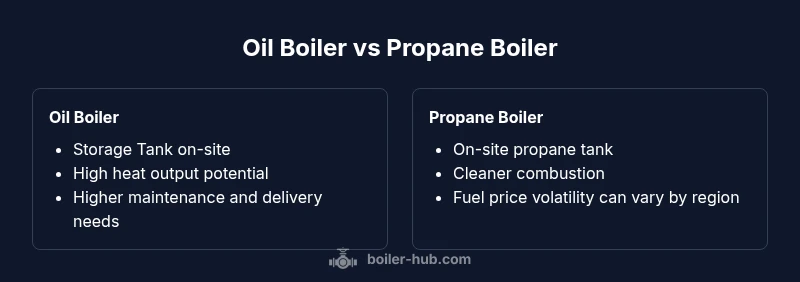
Oil boiler vs propane boiler presents a fuel-side choice shaped by availability, cost, and climate. Propane boilers typically offer cleaner combustion and on-site storage, while oil boilers deliver high heat output in very cold winters but require regular fuel deliveries. Boiler Hub analysis suggests weighing local fuel costs, equipment efficiency, and service networks to decide the best fit for your home.
Oil vs Propane: Core Differences and Context
Choosing between an oil boiler and a propane boiler hinges on a blend of local fuel access, climate, and long-term ownership costs. The Boiler Hub team emphasizes that the decision is rarely about one single factor but about how fuel availability, maintenance needs, and system efficiency align with your home’s heating profile. In many regions, oil systems are common in homes that lack natural gas service, while propane systems can be ideal where gas lines are unavailable but a storage tank is feasible on site. Understanding the fundamental differences helps homeowners frame a practical comparison before getting quotations from installers or fuel suppliers.
From a design perspective, both options can use modern condensing technology to capture waste heat and improve efficiency. However, the fuel characteristics drive operating patterns: oil systems often require more frequent deliveries and occasional tank management in parts of the country with higher oil price volatility, whereas propane systems depend on on-site storage and refueling logistics. This block sets the stage for deeper analysis of cost, performance, and practicality across real-world homes. Boila Hub’s guidance underscores the importance of aligning your system with fuel access and service networks to minimize disruption and optimize comfort.
Fuel Availability and Delivery Logistics
Fuel access shapes every major decision about boiler choice. Oil is delivered by tanker to an on-site storage tank, which works well for properties that already have a sizable tank and routine delivery routes. Propane is stored on-site in a dedicated tank and refilled as needed, offering flexibility for homes without a natural gas line. In rural areas with dispersed living patterns, propane delivery can be more reliable, whereas oil delivery infrastructure may be more robust in traditional urban and suburban corridors. Boiler Hub observations highlight that the reliability of supply and the price stability of each fuel lead many homeowners to prefer propane when local gas networks exist and delivery is predictable. Storage capacity, tank location, and municipal regulations on above-ground tanks are practical considerations that can influence installation costs and long-term convenience.
Maintenance implications also follow fuel choice. Oil tanks require regular inspection for leaks and corrosion, especially in older installations. Propane systems demand tank integrity checks and safe venting to avoid gas buildup. In both cases, carbon-monoxide detectors and proper combustion safety practices are essential. The bottom line is: your fuel strategy should match your access, climate demands, and tolerance for service intervals and potential disruptions in supply. Boiler Hub’s framework reinforces that informed choices minimize frustration and maximize consistent warmth.
Emissions, Environmental Impact, and Safety
Environmental concerns and safety considerations are central to choosing between an oil and a propane boiler. Propane is a clean-burning hydrocarbon with lower VOC emissions per unit of heat output compared with older oil formulations, translating to reduced on-site air quality impacts in well-ventilated spaces. Oil systems historically produce higher sulfur and particulates, though modern condensing boilers can mitigate some of these effects through advanced combustion control. Safety protocols, including CO detectors, regular venting inspections, and reputable installers, are crucial for both fuels. Boiler Hub notes that the best option for safety and environmental performance often depends on the quality of the system installation, maintenance discipline, and the surrounding indoor air quality management. A properly tuned and serviced boiler—regardless of fuel—will yield safer operation and more predictable emissions profiles.
From a risk-management perspective, assess the combined impact of fuel storage, burner technology, and ventilation on indoor air quality. In practices, homeowners should follow local codes, install CO alarms on every floor, and schedule annual safety checks with a qualified technician. The intent is to minimize emissions-related concerns while maintaining comfortable indoor conditions throughout the heating season.
Efficiency and Thermal Performance in Cold Climates
Efficiency is a central criterion, but its interpretation varies with fuel type and system design. Modern oil and propane boilers can achieve high seasonal efficiency when paired with condensing technologies and properly insulated distribution networks. Oil systems often deliver strong heat output, which can be advantageous in very cold climates where high-temperature water or steam is desirable. Propane systems, conversely, typically operate with lower ambient temperatures in the combustion chamber and can excel in rapid heat response and system responsiveness. Boiler Hub’s guidance emphasizes evaluating AFUE (or equivalent efficiency metrics) provided by the boiler manufacturer, rather than assuming all oil units are inherently less efficient. The key is to compare similarly sized, modern, high-efficiency models and to ensure proper system sizing for your home. A larger unit will not automatically improve comfort if it is oversized; conversely, an undersized unit will struggle during peak demand. A well-muned system yields the most meaningful efficiency gains across both fuels.
Maintenance, Servicing, and Reliability
Regular maintenance is the backbone of reliable heat. Oil boilers require periodic fuel line inspections, filter changes, and checks for tank integrity, particularly in older installations where corrosion risk is higher. Propane boilers depend on tank integrity, valve checks, and regulator performance, with a strong emphasis on leak detection. Either option benefits from a professional annual service that includes burner adjustment, heat exchanger inspection, and venting checks to prevent back-drafting and carbon monoxide buildup. The Boiler Hub approach is pragmatic: invest in a service plan that covers both fuel types if you expect to manage a mixed equipment environment; otherwise, standardize on one fuel system to simplify maintenance. This consistency reduces the risk of missed service items and ensures more predictable performance across seasons.
Installation, Space Requirements, and Retrofit Considerations
Installing an oil boiler and its storage tank typically requires space for the tank, clearances for venting, and appropriate wiring for controls and safety devices. Propane installations demand outdoor storage of the propane tank, with distance requirements from the living space and ignition sources, plus access to a regulated gas supply. In older homes, retrofits may involve upgrading venting systems, increasing attic or crawl-space access, and updating piping. While both options can be integrated with modern radiant or baseboard heating, the upfront labor and material costs can vary substantially depending on existing infrastructure and local permitting. Boilers that are properly matched to the home’s heat load and climate will deliver the best long-term comfort with manageable maintenance demands. It is essential to obtain multiple quotes and verify the contractor’s experience with the chosen fuel type to ensure a smooth installation.
Cost of Ownership: Initial Costs and Operating Expenses
Comparing upfront costs between oil and propane boilers involves factors like equipment price, installation complexity, and fuel storage needs. Oil systems often incur higher initial costs if a tank replacement or relocation is required, as well as potential upgrades to venting and piping. Propane systems may present lower initial installation costs in cases where an existing propane tank is available, yet the price volatility of propane and the need for regular refueling can influence long-term expenses. Operating costs hinge on fuel price trends, boiler efficiency, and winter demand. Boiler Hub advises homeowners to model annual fuel costs using current local prices and to factor in maintenance, insurance, and potential tank replacement. A thoughtful calculation helps reveal which option offers the best value over the life of the system.
Practical Scenarios: Which Home is Best Suited
Urban homes with natural gas service may already be leaning toward gas-fired boilers, indirect opportunities, or a mixed-fuel system. In contrast, rural or off-grid properties without access to a natural gas line often rely on oil or propane. If your climate features extreme winter demands and you value high heat capacity, an oil boiler with a properly sized storage tank can be advantageous. If storage capacity or space is a premium and a reliable propane network exists, a propane boiler may be the more flexible choice. In all cases, a qualified HVAC contractor should assess your home’s heat load, insulation levels, and distribution system to determine the most appropriate fuel and boiler type. Boiler Hub’s recommendation is to tailor the choice to your home’s physical attributes and your region’s fuel market dynamics, rather than selecting a fuel type in a vacuum.
Buying, Financing, and Getting Professional Help
When you’re ready to buy, request detailed quotations that show equipment specifications, fuel requirements, and installation costs for both options. Look for HVAC contractors who are familiar with both oil and propane systems and who can provide references from similar homes in your area. Financing options, government incentives, and manufacturer rebates can influence the decision, so compare total installed cost and projected fuel expenses over a 10- to 15-year horizon. Be prepared to ask about availability of service plans, warranty terms, and any required safety upgrades. A well-planned procurement strategy reduces the risk of future surprises and ensures smoother maintenance and service.
Authoritative Sources
- Central guidance on boilers and home heating energy can be found at reputable energy agencies and environmental protection resources. These sources emphasize safe operation, regular maintenance, and the importance of proper venting and CO detection. For readers seeking more information, consult government and university-level resources that discuss boiler efficiency, fuel safety, and installation standards.
Comparison
| Feature | Oil Boiler | Propane Boiler |
|---|---|---|
| Fuel type | Oil-fired boiler | Propane-fired boiler |
| Fuel delivery & storage | On-site oil tank with regular deliveries | On-site propane tank with refills |
| Emissions & air quality | Higher potential emissions relative to propane | Lower emissions with cleaner combustion |
| Heat output capacity | High heat output potential for cold climates | Strong output with rapid heat response |
| Installation considerations | Tank placement, venting, and piping considerations | Tank location, venting rules, and access to propane supply |
| Maintenance frequency | Tank inspection, filter changes, burner adjustments | Tank inspection, regulator checks, and leak testing |
| Best for | Homes with established oil infrastructure or no gas line | Homes with reliable propane infrastructure or limited indoor space for fuel storage |
Advantages
- Propane boilers generally offer cleaner combustion and lower on-site emissions
- Propane storage can be flexible and suited to properties without natural gas service
- Oil boilers deliver high heat output for very cold regions when paired with the right distribution
- Both fuels can achieve high efficiency with modern condensing boilers when properly installed
The Bad
- Oil availability and price volatility can increase operating costs over time
- Oil storage and tank maintenance pose spill and corrosion risks
- Propane price spikes and supply disruptions can affect running costs
- Space required for storage tanks and the need for ventilation can impact installation
Propane boilers are typically the more balanced choice when propane access is reliable and emissions are a concern; oil boilers remain a strong option where existing oil infrastructure and high heat output are priorities.
If you have good propane access and want cleaner combustion with flexible storage, propane is usually best. If your home already uses oil or demands extreme heat in very cold climates, an oil boiler may be the more sensible fit. In both cases, modern condensing models with proper sizing offer top-tier efficiency.
Questions & Answers
What is the primary difference between an oil boiler and a propane boiler?
Oil boilers burn heating oil delivered to an on-site tank, while propane boilers burn propane stored in a tank on the property. Both can be highly efficient with modern condensing technology, but the decision depends on fuel access, cost, and maintenance considerations.
Oil and propane boilers differ mainly in the fuel they burn and where that fuel is stored on your property. Both can be efficient if properly sized and maintained.
Which boiler is more energy efficient, oil or propane?
Both fuels can achieve high efficiency with modern condensing boilers. Efficiency depends on the boiler model, installation quality, and system design rather than solely on the fuel type.
Both can be highly efficient if you pick a modern, properly installed boiler; the key is selecting a model that matches your load and climate.
How do fuel costs affect operating expenses?
Operating expenses follow fuel price trends and consumption patterns. Oil prices can be volatile and delivery costs vary by region; propane prices can fluctuate with supply and demand. The exact impact depends on fuel efficiency and annual usage.
Fuel costs swing with market conditions, so calculate total annual fuel spend for your area and model it over the expected life of the boiler.
Is propane safer than oil?
Safety depends on proper installation, regular maintenance, and detectors. Propane leaks require immediate attention, and oil systems demand careful tank and venting management. In both cases, CO detectors and professional servicing are essential.
Both are safe when properly installed and maintained. Always install CO detectors and have annual safety checks.
Can I switch from oil to propane?
Switching typically involves installing a new burner or boiler, plumbing changes, and a propane supply line. Tank removal or reconfiguration may be required. Check local codes and incentives; plan for downtime during conversion.
Switching fuels is possible but involves equipment changes and potential permitting—plan with a qualified installer.
What maintenance is required for each system?
Oil systems require tank inspection and burner adjustments; propane systems need regulator checks and leak testing. Both benefit from annual professional servicing, including venting and heat exchanger inspection.
Regular servicing is essential for both fuels to keep efficiency high and safety risks low.
Which option is best for small homes with limited space?
Propane systems are often preferable for smaller homes with limited space due to on-site tank options and easier expansion. However, the best choice depends on local fuel costs and service availability.
If space and flexibility matter, propane often wins, but run the numbers for your area first.
How does climate affect the choice between oil and propane?
In very cold climates, an oil system may provide robust heat output, while propane can offer rapid heat response and reliable operation where fuel delivery is stable. The optimal choice depends on insulation, heat load, and fuel costs in your region.
Cold climates favor strong heat output; ensure your system size aligns with your home’s needs.
Key Points
- Assess local fuel availability and long-term costs before choosing.
- Propane offers cleaner combustion and flexible storage where available.
- Oil systems provide strong heat output, especially in very cold environments.
- Choose based on an accurate heat-load assessment and reliable service networks.