Oil boiler vs heat pump: which heating system fits your home
An in-depth comparison of oil boilers and heat pumps for homeowners and facility managers, covering cost, efficiency, climate suitability, installation, and maintenance.


Oil boiler vs heat pump: the choice hinges on climate, cost, and your home's heating demands. In mild regions with electricity pricing favorable to heat pumps, a heat pump often delivers lower running costs and faster payback; in colder climates or where fossil fuel infrastructure remains, an oil boiler can be more reliable. According to Boiler Hub, evaluating total cost of ownership over a long horizon helps avoid surprise expenses.
What oil boiler vs heat pump means for your home
Choosing between an oil boiler and a heat pump is a decision that goes beyond sticker price. In practical terms, it determines how your home collects heat, how much energy you pay, and how comfortable you stay during the coldest months. The Oil boiler vs heat pump comparison is most useful when you consider climate, building envelope, and fuel availability. According to Boiler Hub Team, the right choice balances upfront investment with long-term operating costs and environmental considerations. Oil boilers rely on fossil fuel and typically deliver quick heat delivery, while heat pumps move heat with electricity and can extract warmth from outdoor air even in cold weather. For homeowners and facility managers, the key is to map your local climate, energy prices, and hot-water needs against the characteristics of each technology. This article focuses on practical decision factors, backed by real-world guidance from Boiler Hub, and aims to help you make a cost-conscious, climate-appropriate choice.
wordCountTotalWordsOverride":null}
Core differences at a glance
The oil boiler and the heat pump are both capable heating solutions, but they operate on fundamentally different principles. An oil boiler generates heat through combustion of fossil fuel and distributes it via radiators or underfloor systems. A heat pump transfers existing heat from the outdoors into the home, using electricity to power a compressor and refrigerant cycle. In practice, the main differentiators to consider are running costs, installation complexity, fuel reliability, and emissions. The choice should reflect not only current energy prices but also future policy expectations and the character of your building envelope. In many regions, the decision comes down to climate suitability and how aggressively you plan to decarbonize the heating load. Boiler Hub’s approach emphasizes a holistic view: energy price trends, home insulation, and long-term total cost of ownership.
wordCountTotalWordsOverride":null}
How an oil boiler works and where it shines
Oil boilers burn liquid fuel to heat water, which is then circulated through radiators or underfloor networks to warm living spaces. Modern oil boilers include condensing designs that recover some of the heat from exhaust gases, improving efficiency compared with older non-condensing models. Oil boilers are often favored in settings where natural gas is unavailable or where a retrofit to a gas line would be impractical. They can deliver reliable, rapid room heat and plentiful domestic hot water, especially in homes with established radiator systems. Because fuel can be stored on-site, households in rural or remote areas may see fewer supply disruptions compared with gas service. The trade-off is ongoing fuel cost volatility and fossil-fuel emissions, which many homeowners weigh against the convenience of steady heat delivery.
wordCountTotalWordsOverride":null}
How a heat pump works in heating mode
A heat pump extracts ambient heat from the outdoor air (air-source) or from the ground (ground-source) and concentrates it for indoor heating. In heating mode, electricity powers a compressor and a refrigerant circuit that transfers heat into the home. Heat pumps can supply both space heating and hot water (with proper system design) and, in some configurations, offer cooling in the summer. They are particularly attractive in climates with moderate to mild winters or where electricity pricing is competitive and decarbonization policies favor electrification. A well-sized, well-insulated home will maximize a heat pump’s efficiency, reducing energy waste and improving comfort consistency across rooms. The technology has matured to handle a wide range of building types, but performance can still be sensitive to outdoor temperatures, insulation quality, and distribution efficiency.
wordCountTotalWordsOverride":null}
Energy efficiency and running costs: AFUE, COP, and price dynamics
Efficiency metrics for heating systems can be confusing because they stem from different measurement philosophies. Oil boilers are typically evaluated by annual fuel utilization efficiency (AFUE) or similar boiler efficiency ratings, while heat pumps use coefficients of performance (COP) or seasonal performance factors (SCOP). In practice, a modern condensing oil boiler can offer robust efficiency in optimized conditions, but its cost of operation tracks fossil fuel prices. Heat pumps, on the other hand, often deliver superior efficiency when electricity prices are favorable and the climate is within the design envelope of the equipment. The real driver of running costs is the price of fuel, system efficiency, and how well the home is insulated. Boiler Hub analysis shows that local energy price trends and climate influence the economic case far more than nominal efficiency ratings alone. A comprehensive planning approach should compare long-term energy expenses, not just upfront installation costs.
wordCountTotalWordsOverride":null}
Climate and building factors that influence the decision
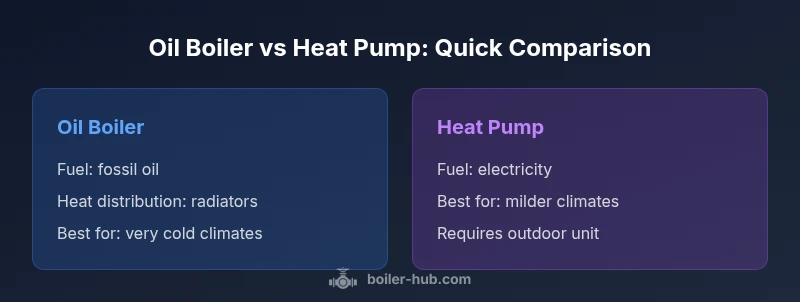
Climate plays a pivotal role in whether an oil boiler or a heat pump makes more sense. Oil boilers tend to be more straightforward in very cold environments where heat extraction from outdoor air becomes energy-intensive for a heat pump. In contrast, heat pumps excel in milder climates with moderate winter loads and generally lower running costs when electricity price structures are favorable. Building characteristics—such as wall insulation, air leakage, and window performance—significantly affect performance. Homes with heavy insulation and efficient distribution will see greater benefit from a heat pump, while older, poorly insulated structures might first require envelope improvements before switching. Boiling this down, climate and building envelope are the two biggest levers in the decision, and both should be evaluated before selecting a primary heating strategy. Boiler Hub’s guidance emphasizes tailoring the choice to your local climate and insulation quality.
wordCountTotalWordsOverride":null}
Installation considerations and space requirements
Installing either system involves more than the boiler or outdoor unit alone. An oil boiler requires a fuel storage tank, safe venting, and adequate clearance for service access. The distribution network (radiators or underfloor heating) must be compatible with higher return temperatures typical of oil systems. A heat pump installation may entail an outdoor unit, refrigerant lines, and potentially a new or upgraded electrical service. Ground-source heat pumps add another layer of complexity with trenching or boreholes. Space planning, noise considerations, and proximity to living areas influence placement. In retrofit projects, upgrading insulation, sealing air leaks, and balancing the heating system to ensure even heat distribution are critical steps. The right plan minimizes disruption and maximizes comfort from day one.
wordCountTotalWordsOverride":null}
Maintenance, reliability, and typical failure modes
Oil boilers generally require annual professional servicing to maintain combustion efficiency, safe venting, and reliability. Regular maintenance helps prevent leaks, improper ignition, and scale buildup in the heat exchanger. Heat pumps tend to have lower routine maintenance needs, but refrigerant integrity and electrical components require periodic checks by qualified technicians. Reliability for both systems depends on proper sizing, installation quality, and the quality of the distribution system within the home. Common failure modes for oil systems include fuel delivery issues and venting blockages, while heat pumps may encounter refrigerant leaks or coil icing in extreme conditions. Proactive maintenance and selecting equipment with robust service support are key to minimizing downtime and maximizing longevity.
wordCountTotalWordsOverride":null}
Environmental impact and emissions
Emissions considerations are often central to the oil boiler vs heat pump decision. Oil boilers burn fossil fuel and emit carbon dioxide and other pollutants, contributing to local air quality concerns. Heat pumps run on electricity; their environmental footprint depends on the carbon intensity of the grid. In regions where electricity comes from low-carbon sources, heat pumps offer significantly lower net emissions over the lifecycle of the heating system. In areas with high fossil-fuel electricity, the advantage may be less pronounced, though heat pumps still minimize on-site combustion and can improve indoor air quality. Policy trends increasingly favor electrification and decarbonization, which can tilt the balance toward heat pumps in new builds or during major renovations. Boiler Hub analysis underscores that the emissions picture improves as the electricity mix gets cleaner and as homes improve insulation and heat distribution efficiency.
wordCountTotalWordsOverride":null}
Financing, incentives, and lifecycle costs
Cost considerations for the two options extend beyond the upfront price. Oil boilers typically involve ongoing fuel costs that are sensitive to oil price volatility, while heat pumps incur higher upfront equipment and installation costs but offer lower monthly operating expenses in climates with affordable electricity. Financing options, warranties, and maintenance plans influence the total cost of ownership. Many regions offer incentives or subsidies for heat pump installations as part of decarbonization programs, which can help bridge the gap to oil boiler economics in the near term. When calculating lifecycle costs, include equipment depreciation, maintenance, energy usage, and potential future grid changes. A careful, long-horizon view tends to favor heat pumps in many temperate regions, while oil boilers remain relevant where fuel security and fuel price dynamics favor fossil-fuel usage in specific contexts. Boiler Hub’s guidance emphasizes aligning incentives with climate realities and home readiness upgrades a priori.
wordCountTotalWordsOverride":null}
Decision framework: a practical checklist
To move from analysis to action, use this practical framework:
- Climate check: Is your winter climate routinely severe or moderate?
- Building envelope: Have you addressed insulation and air leakage first?
- Radiator compatibility: Do your radiators and distribution support the chosen technology?
- Energy price forecast: What are the expected trends for oil and electricity in your area?
- Installation impact: Can you accommodate outdoor units, tanks, or new electrical circuits?
- Long-term plans: Do you expect to repower gradually or replace the entire system at once?
Use this checklist as a decision aid rather than a one-size-fits-all rule. It helps ensure you select a system that meets comfort goals, budget constraints, and decarbonization targets. Boiler Hub recommends pairing a robust building envelope with your heating system choice for best results.
wordCountTotalWordsOverride":null}
Common misconceptions debunked
Many homeowners assume heat pumps cannot function in cold weather or that oil boilers are always cheaper to run. In truth, performance depends on system design, insulation quality, and local energy prices. Another common myth is that replacing a traditional boiler with a heat pump automatically decarbonizes a home; the electricity source matters, as does the energy efficiency of the entire heating distribution. A well-informed decision accounts for climate, energy portfolio, and the practicality of retrofits. Finally, some buyers believe maintenance is lighter for heat pumps; while they can require less routine combustion service, refrigerant and electrical components still demand professional attention. By separating fact from assumption, homeowners can avoid costly missteps and select the best fit for their scenario.
wordCountTotalWordsOverride":null}
Real-world scenarios and decision pathways
Consider three representative scenarios to guide your planning. In a temperate climate with strong efficiency programs, a heat pump paired with good insulation will typically deliver superior running costs and comfort, especially if you can access incentives. In a rural area where fuel supply is reliable but grid electricity is comparatively expensive, an oil boiler might be a straightforward, reliable choice with manageable operating costs. In very cold regions or where retrofitting radiators is impractical, an oil boiler or a hybrid approach (backup heat source alongside a heat pump) could be the most sensible solution. Each scenario emphasizes the same decision criteria: climate suitability, energy pricing, building readiness, and long-term decarbonization goals. The key is to tailor the plan to your building and energy context, rather than applying a generic rule. Boiler Hub’s framework supports this tailored approach by centering climate, insulation, and cost dynamics.
wordCountTotalWordsOverride":null}
Comparison
| Feature | oil boiler | heat pump |
|---|---|---|
| Installation cost | Moderate upfront, with fuel storage and venting considerations | Generally higher upfront due to outdoor unit, refrigerant lines, and electrical prep |
| Running cost sensitivity | Linked to oil price volatility and fuel delivery | Linked to electricity price and climate; often lower per unit of heat in mild to moderate climates |
| Efficiency metrics | Condensing, boiler efficiency varies by model | COP/SCOP-based efficiency; performance improves with mild winters and insulation |
| Emissions and environmental impact | Fossil fuel burning with associated emissions | Electricity-based with emissions tied to grid mix; potential for lower on-site pollution |
| Space and installation footprint | Requires fuel storage and dedicated space for boiler room | Requires outdoor unit or indoor closet, plus potential ground work for some setups |
| Maintenance needs | Annual service for combustion efficiency and venting | Less combustion maintenance but refrigerant and electrical checks needed |
| Reliability and resilience | High reliability with fuel supply but vulnerable to fuel price swings | Dependable with proper install; may require backup heat in extreme cold |
| Best for | Traditional homes with radiators and ready access to oil | New or retrofit homes in milder climates prioritizing energy efficiency |
Advantages
- Potentially lower running costs in suitable climates when heat pumps are efficient
- Oil boilers offer reliable heat delivery with existing radiator systems
- Fuel availability and infrastructure are familiar for many homes
- Heat pumps support broader decarbonization goals in electrified grids
The Bad
- Higher upfront costs for heat pumps and installation
- Oil boilers depend on fossil fuel price stability and emissions
- Heat pumps may require insulation upgrades and radiator adjustments
- Maintenance and service networks vary by region
The Boiler Hub Team recommends heat pumps for most temperate homes, with oil boilers as a viable fallback in very cold climates or where gas infrastructure is unavailable.
Heat pumps typically deliver better long-term energy efficiency and lower emissions in climates with moderate winters, supported by incentives in many regions. Oil boilers remain a realistic option in areas with extreme cold or limited electrical infrastructure, particularly when there is existing radiator compatibility and fuel supply reliability. A hybrid approach can also offer resilience in uncertain energy markets.
Questions & Answers
What is the main difference between an oil boiler and a heat pump?
Oil boilers generate heat through combustion of fossil fuel, while heat pumps transfer existing heat from the outdoors using electricity. The technologies differ in installation needs, fuel sources, and how they deliver warmth. The choice depends on climate, electricity prices, and long-term decarbonization goals.
Oil boilers burn fuel; heat pumps move heat using electricity. Climate and costs drive which is more practical for your home.
Which is cheaper to run in winter, oil boiler or heat pump?
Running costs depend on local fuel prices and electricity rates, as well as system efficiency. In many temperate areas, heat pumps win on running costs when electricity is reasonably priced and winters are moderate. In very cold regions, oil can be cheaper if electricity is expensive or if insulation is poor.
Costs vary with energy prices and climate; heat pumps often save money in mild winters, oil can win in harsh cold depending on fuel prices.
Will a heat pump work in very cold climates?
Modern air-source heat pumps can operate in cold weather, but performance drops as outdoor temperatures fall. In extremely cold regions, a supplementary heat source or a hybrid system can help maintain comfort and efficiency. Proper insulation and a correctly sized system are essential.
Heat pumps can work in cold weather, but may need support in very cold climates.
Can I reuse my existing radiators with a heat pump?
Yes, many homes can reuse radiators with a heat pump, especially if the system is redesigned to run at lower water temperatures. In some cases, oversized radiators or improved distribution help maximize efficiency. A professional assessment can confirm compatibility.
You might keep your radiators, but sizing and flow must be checked by a pro.
Are there incentives or subsidies for heat pumps?
Many regions offer subsidies, tax credits, or rebates for heat pump installations as part of decarbonization programs. Availability and amounts vary by location and project specifics. Check local government resources and energy programs for current offerings.
Look for local incentives; programs vary by location and project type.
What maintenance is required for these systems?
Oil boilers require annual service to ensure safe combustion and venting. Heat pumps require periodic checks for refrigerant and electrical components. Both benefit from regular filter changes, system balancing, and professional inspections on a schedule.
Both systems need professional checks; oil boilers focus on combustion safety, heat pumps on refrigerant and electronics.
Key Points
- Assess climate and electricity costs before deciding
- Upgrade insulation and distribution to maximize efficiency
- Compare long-term operating costs, not just upfront price
- Account for fuel availability and local incentives
- Plan a staged transition if decarbonization timelines are uncertain