Boiler vs Heat Pump: Key Differences and Guide
Explore the differences between boilers and heat pumps, including how they work, efficiency, climate suitability, and installation considerations. A practical, analytic comparison from Boiler Hub to help homeowners and facilities decide the best heating solution.


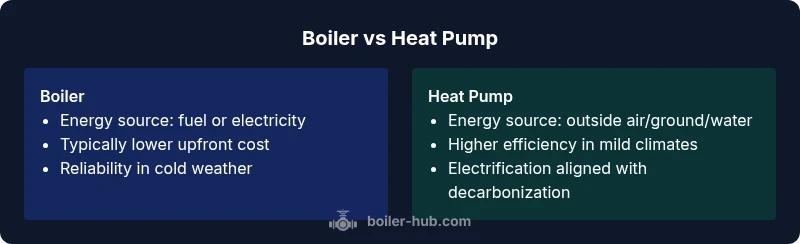
Boiler vs Heat Pump: the difference between boiler and heat pump centers on energy source, efficiency, climate performance, and long-term costs. Boilers burn fuel or use electricity to generate heat, while heat pumps move heat from outside the home into living spaces, delivering higher apparent efficiency in moderate climates. According to Boiler Hub, the best choice depends on climate, electricity prices, and retrofit goals.
Foundational differences between boiler and heat pump
The difference between boiler and heat pump centers on how they obtain heat, how they transfer it into living spaces, and how that process interacts with your energy prices and climate. A boiler creates or releases heat by burning a fuel or using electricity, then distributes that heat through a network of radiators or a hot-water system. A heat pump, by contrast, moves existing heat from outside your home into the interior, using refrigeration-cycle principles. Because heat pumps move heat rather than generate it, they often deliver more usable energy for each unit of electricity consumed. This distinction matters for overall energy planning, long-term costs, and carbon footprint. Boiler Hub’s analysis highlights that the optimal choice hinges on climate, electricity prices, and retrofit goals, not just sticker price.
For homeowners evaluating the difference between boiler and heat pump, framing the decision around three questions helps: What climate do you live in? What is your current energy mix and price trend? Do you prioritize upfront simplicity or long-term efficiency and electrification? The answers guide whether a traditional boiler, a heat pump, or a hybrid approach makes the most sense for your home or facility.
Comparison
| Feature | Boiler | Heat Pump |
|---|---|---|
| Primary energy source | Fossil fuels (gas/oil) or electricity for electric boilers | Outside air/ground/water heat as the energy source |
| Typical efficiency context | Depends on boiler type; modern condensing boilers improve efficiency | Generally high efficiency due to heat transfer; COP varies with outdoor temperature |
| Best climate | Regions with reliable fuel supply; very cold climates may favor boiler reliability | Mild to moderate climates where electricity is affordable and electric grids are clean |
| Upfront cost | Lower upfront cost (equipment and install) | Higher upfront cost (equipment plus possible ground/air-source installation) |
| Maintenance needs | Moderate maintenance; periodic servicing | Regular maintenance; potential refrigerant checks and outdoor unit care |
| Best for | Existing fossil-fuel infrastructure; retrofit constraints | Electrification goals; energy savings in temperate zones; new builds |
Advantages
- Potentially lower upfront costs with boilers and familiar install paths
- Heat pumps can offer higher operating efficiency and lower running costs in moderate climates
- Hybrid setups can combine reliability with improved efficiency and futureproofing
- Growing availability of refrigerant-free and low-GWP options supports environmental goals
- Wider installer networks and service support for boilers in many markets
The Bad
- Higher upfront costs and possible electrical upgrades with heat pumps
- Heat pumps may underperform in extreme cold without supplemental heat
- Boilers require ongoing fuel supply and may have higher fuel costs over time depending on prices
- Heat pumps depend on electricity grid cleanliness and price stability
Neither option universally wins; choose based on climate, energy strategy, and total cost of ownership.
In milder climates with clean electricity, heat pumps typically offer superior energy efficiency and long-term savings. In colder regions or where gas/oil infrastructure is strong, boilers remain reliable and cost-effective. A hybrid or phased electrification can bridge gaps as needs evolve.
Questions & Answers
What is the main difference between boiler and heat pump systems?
The main difference is how heat is produced and moved. A boiler generates heat by burning fuel or using electricity, while a heat pump transfers heat from outside the building to the indoors. Heat pumps generally offer higher energy efficiency, especially in moderate climates.
Boilers create heat from fuel or electricity; heat pumps pull heat from outside. The choice depends on climate and energy prices.
Are heat pumps cheaper to operate than boilers?
Operating costs depend on electricity prices, climate, and usage. Heat pumps often have lower running costs in mild climates due to higher efficiency, but in very cold weather their performance can decline without supplemental heat.
Heat pumps can be cheaper to run in milder climates, but cold weather can affect efficiency.
Can a heat pump replace a boiler in cold climates?
Yes, but you may need a supplemental heating strategy in very cold periods or a dual-system setup. Many homes combine a heat pump with a boiler as a backup for extreme conditions.
A heat pump can replace a boiler, but some homes use a backup heat source for very cold days.
What maintenance do boilers require compared with heat pumps?
Boilers require regular servicing, venting inspection, and fuel system checks. Heat pumps need annual servicing, refrigerant checks, and outdoor unit maintenance. Both benefit from professional inspections.
Boilers need fuel and vent checks; heat pumps need refrigerant and outdoor unit care.
Are there hybrid systems available?
Hybrid systems combine a boiler and a heat pump to optimize efficiency across temperatures, providing reliability and gradual electrification. They are common in transitional upgrades.
Yes, hybrids mix boiler and heat pump for better efficiency and reliability.
How should I start choosing between these options?
Start with a climate assessment, energy price projections, and current heating needs. Consult a quality HVAC pro and reference independent sources to compare total cost of ownership over 10–20 years.
Evaluate climate, costs, and needs, then consult pros for a tailored plan.
Key Points
- Assess climate before choosing heating tech
- Prioritize long-term energy costs over upfront price
- Consider hybrid solutions for flexibility and reliability
- Factor electricity prices and grid decarbonization in planning
- Plan maintenance and service access when selecting a system