Boiler vs Furnace: Which System Is Truly Better in 2026?
Compare boilers and furnaces to decide which heating system fits climate, space, and budget. This analytical guide covers how they work, efficiency, installation, maintenance, safety, and cost considerations to help homeowners and facilities choose the right solution.


Is boiler or furnace better? In most homes, the answer depends on climate, fuel availability, and long-term costs. Boilers tend to offer higher efficiency and more even heating with radiant systems, while furnaces provide faster heat delivery and simpler maintenance. The Boiler Hub analysis suggests evaluating home size, space, and annual energy costs to choose the right system.
Overview: Is boiler or furnace better
Choosing between a boiler and a furnace hinges on climate, existing infrastructure, and energy priorities. According to Boiler Hub, there is no one-size-fits-all winner; the best choice aligns with how you heat, comfort, and pay for energy. A boiler heats water that travels through radiators or radiant floors, delivering steady warmth with minimal temperature swings. A furnace heats air and moves it through ductwork, offering quick heat delivery and straightforward zoning in many homes. The decision also depends on fuel type (gas, oil, electricity) and system age. This section helps homeowners and facility managers evaluate core differences so you can select the right technology for your building and budget.
Key differentiators to weigh
- Heat transfer method (water vs air) and resulting comfort profile
- Response time to heat up spaces
- Maintenance requirements and component exposure
- Space needs and installation constraints
- Long-term energy costs and potential incentives
According to Boiler Hub, framing the choice around climate, space, and cost trajectory leads to a more confident decision.
Comparison
| Feature | Boiler | Furnace |
|---|---|---|
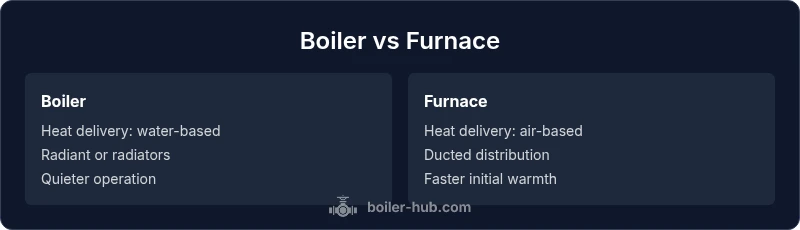
| Heat transfer method | Water-based heat delivery (radiant/through floors) | Air-based heat delivery (ducted) |
| Heating speed | Steady, even warmth over time | Faster initial warmth and comfort |
| Zoning flexibility | Typically easier with radiators or radiant floors | Flexible with ducts and zones |
| Space requirements | Requires a dedicated mechanical room or closet | Requires ductwork and air handler space |
| Maintenance profile | Fewer moving parts; looped fluids | Filters and blower/motor components require attention |
| Lifespan and reliability | Long lifespan with regular service | Dependent on ductwork and filter upkeep |
| Fuel compatibility | Gas, oil, or electric options; water-based system |
Advantages
- Potential for higher long-term efficiency with boiler systems
- Even heating and improved comfort with radiant distribution
- Fewer duct losses in well-sealed homes
- Quiet operation in many installations
The Bad
- Higher upfront and installation complexity for boilers
- Ductwork systems may require ongoing filter maintenance and sealing
- Water-based systems require pumping and more complex controls
- Space and zoning adjustments can be disruptive during upgrades
Neither system is universally better; the right choice depends on climate, home layout, and energy priorities.
Boilers tend to excel for energy efficiency and uniform comfort in cold climates, especially with radiant heat. Furnaces excel at rapid warmth and compatibility with existing ductwork. A careful assessment of space, fuel availability, and long-term costs will determine the best option for your building.
Questions & Answers
What is the main difference between a boiler and a furnace?
A boiler heats water to transfer heat through radiators or radiant floors, while a furnace heats air and distributes it via ducts. The choice affects comfort style, installation, and maintenance requirements. Both systems can be highly efficient when properly sized and installed.
Boilers heat water for radiators, furnaces heat air through ducts; the right pick depends on your home and how you want heat delivered.
Which system is more energy-efficient?
Efficiency depends on the model and fuel type. Boilers often offer highly efficient operation with radiant heat, while modern furnaces can be extremely efficient with proper duct sealing and maintenance. The overall efficiency also depends on proper sizing and system condition.
Efficiency varies by model; boilers with radiant heat often perform well, and efficient furnaces depend on duct care.
Can I switch from a boiler to a furnace or vice versa?
Yes, switching is possible but involves significant work: duct installation or removal, venting changes, and system controls. A professional load calculation and site assessment are essential to avoid under- or over-sizing.
You can switch, but it’s a major project that needs a professional assessment.
What maintenance is required for each system?
Boilers require periodic servicing of pumps, valves, and heat exchangers; furnaces need filter changes, blower maintenance, and vent checks. Regular annual or semi-annual service helps sustain efficiency and safety for both systems.
Keep up with regular service; boilers focus on pumps and valves, furnaces on filters and blowers.
Which system is better for apartments or small homes?
In compact spaces, boilers can be a good fit when radiant heat is feasible. Furnaces work well where ducting exists or where rapid warmth is preferred. The best choice depends on space, existing infrastructure, and budget.
If you have existing ducts, a furnace can be convenient; otherwise, boilers with radiant heat can be efficient in small spaces.
Are boilers safer than furnaces?
Both systems have safety risks if not properly installed or maintained. CO detectors and proper venting are essential for both. Follow code requirements and manufacturer guidelines, and have periodic inspections by a qualified technician.
Safety depends on proper installation and maintenance; CO detectors and correct venting are non-negotiable.
Key Points
- Assess climate and energy costs before deciding
- Consider existing ductwork or radiant layouts when choosing
- Radiant heat pairs well with boilers for comfort and efficiency
- Furnaces offer quick warmth and easier retrofits in ducted homes
- Total cost of ownership depends on installation, fuel, and maintenance
- Check local incentives and warranties before upgrading