Boiler vs Furnace Cost: A Practical 2026 Comparison
Analyze boiler vs furnace cost in 2026, including upfront installation, operating costs, fuel choices, and maintenance to help homeowners and facility managers decide.


TL;DR: Boiler vs furnace cost often hinges on upfront price and long-term operating costs. Boilers typically require higher installation costs but can be cheaper to operate in hydronic systems, while furnaces usually cost less to install and may have higher fuel bills depending on efficiency and fuel type. For most homes, a high-efficiency option balances initial cost with long-term savings.
Understanding the Cost Components
When you compare boiler vs furnace cost, the total ownership price rounds to three buckets: the upfront hardware and installation, the ongoing energy expense based on fuel and efficiency, and routine maintenance and service. This framework helps you separate what you pay today from what you pay over time. According to Boiler Hub, the total cost to own a boiler or furnace is driven by these three buckets, with regional labor rates and local fuel prices shaping the final numbers. In many homes, the choice between boiler and furnace hinges on existing infrastructure (radiators and piping versus ductwork) and climate-driven efficiency opportunities. A careful assessment of both upfront and long-term costs, rather than sticker price alone, reveals which option provides better value. For the keyword boiler vs furnace cost, the aim is to balance initial investment with annual energy use, which can swing dramatically with fuel prices and system efficiency. In short, the cheapest option today may not minimize expenses over a 5- to 10-year horizon, especially in regions with high heating demand. Boiler Hub Analysis, 2026 emphasizes this long-term view.
wordCountNoteOnlyForValidation":null
wordsApprox":null},
bodyBlocks
Upfront Costs: Boiler vs Furnace
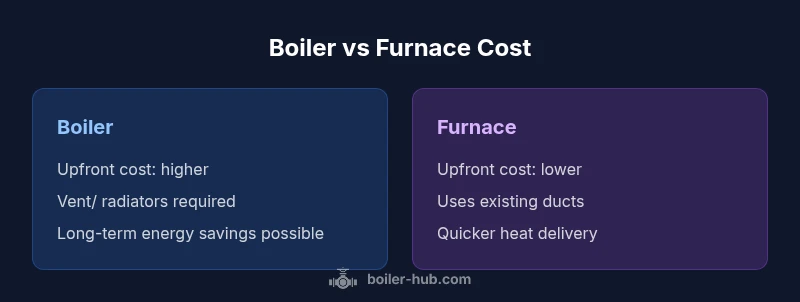
The sticker price when you install a new heating system is heavily influenced by hardware, labor, and the required support systems (venting for boilers or ductwork for furnaces). Boilers typically require more complex piping, radiators or radiant heating distribution, and proper venting, which can push installation costs higher. Furnaces, by contrast, often leverage existing ductwork and require less bespoke plumbing, which can bring the upfront price down. In many markets, a high-efficiency boiler will still land in a higher upfront cost band than a mid-range furnace, though the gap can narrow with ductwork changes or a retrofit. Factor in fuel line upgrades, condensate drainage, and possibly a new chimney liner for gas appliances. The Boiler Hub team notes that a well-planned installation that minimizes heat loss and ensures proper venting can save money in the long run, even if the initial price is steeper. When comparing boiler vs furnace cost, be sure to obtain multiple quotes that detail equipment price, labor, venting/ductwork modifications, and any required permits. This helps avoid surprises and highlights true ownership costs.
wordCount":226
-slot-1":null
Comparison
| Feature | Boiler | Furnace |
|---|---|---|
| Upfront Install Cost | Higher upfront cost | Lower upfront cost |
| Space & Ducting/Venting | Requires dedicated boiler room and venting (radiators/UFH) | Integrates with existing ductwork (basement/utility room) |
| Fuel Type & Availability | Gas/oil/electric options; fuel costs vary by region | Gas/oil/electric options; fuel costs vary by region |
| Operating Efficiency | High-efficiency condensing options available (AFUE 90%+ and up) | High-efficiency condensing options available (AFUE 90%+ and up) |
| Maintenance Frequency | Annual professional service commonly recommended | Annual professional service commonly recommended |
| Lifespan & Reliability | Longer lifespan with proper hydronic distribution | Reliable with modern forced-air systems |
| Noise & Comfort | Quieter inside living spaces; mechanical room typically separate | Potential blower noise in some setups if ducts are not well balanced |
| Total Cost Over 5–10 Years | Often lower long-term costs with energy-efficient boiler investments | Costs can be front-loaded but long-term savings hinge on fuel prices |
Advantages
- Potentially lower long-term operating costs with high-efficiency boilers
- Better comfort with hydronic heating (radiant/underfloor)
- Can leverage existing radiators or radiant distribution
- Flexible zoning options for targeted comfort
- Strong resale value in homes with hydronic systems
The Bad
- Higher upfront installation costs due to piping and venting
- Requires space for mechanical equipment and venting
- Ductwork changes can complicate retrofits for some homes
- Maintenance can be more complex with advanced hydronic components
Boiler is generally the better long-term value for hydronic systems, while furnaces win on upfront cost and quicker heat delivery.
If your home already uses radiators or radiant floor heating, a high-efficiency boiler often minimizes total cost over time. If upfront price and rapid room heating matter more, a modern high-efficiency furnace may be preferable. The Boiler Hub team recommends weighing upfront spend against local energy prices, climate, and space constraints to guide the final choice.
Questions & Answers
Is boiler cheaper to install than a furnace?
In many markets, furnaces have lower upfront installation costs because they can reuse existing ductwork. Boilers require piping, radiators or radiant distribution, and venting, which can push costs higher. However, high-efficiency boilers may still offer compelling life-cycle savings if climate and energy prices favor hydronic systems.
Furnace installs are often cheaper upfront due to existing ducts; boilers can be pricier but may save more over time with hydronic heating.
Do operating costs differ long-term between boiler and furnace?
Operating costs hinge on fuel prices and system efficiency. Both boiler and furnace can reach high efficiency, especially with condensing models, but heat distribution (radiant vs forced air) and climate play big roles in ongoing energy bills.
Efficiency and fuel prices drive long-term costs; both systems can be cost-effective with high-efficiency options.
What about maintenance requirements?
Both systems require annual professional service and periodic checks. Boilers may emphasize corrosion protection and proper venting, while furnaces focus on burner and filter upkeep. Regular maintenance helps prevent unexpected failures and keeps energy use in check.
Annual service keeps both systems reliable and efficient.
How long do boilers and furnaces last?
Lifespan depends on installation quality and maintenance. Typical systems last many years with proper care, though components may require replacement over time. Lifespan is notably influenced by how well the system is maintained and how often heating cycles run.
Good maintenance extends lifespan for both boiler and furnace.
Should I consider ENERGY STAR or condensing models?
Yes. Condensing, high-efficiency models often offer the best balance of upfront cost and long-term savings, especially in regions with high energy costs. Look for certifications and rebates that can reduce net investment.
High-efficiency models with rebates usually pay off over time.
What is the best option for a small home with limited space?
A compact, high-efficiency unit with appropriate heat distribution (radiant or compact duct layout) can fit well in tight spaces. The choice should factor climate, existing distribution, and achievable comfort. Consulting a professional is recommended to optimize space use.
Small spaces benefit from efficient, space-conscious designs.
Key Points
- Assess total cost by combining upfront install with 5–10 year operating costs
- High-efficiency boilers offer long-term savings for hydronic layouts
- Upfront costs for boilers are often higher due to venting and piping
- Furnaces typically cost less to install and heat spaces quickly in ducted homes
- Local fuel prices and climate heavily influence total cost