Boiler vs Furnace: A Practical Comparison for Home Heating
A detailed, analytical comparison of boiler versus furnace options for homeowners and facilities managers, covering heat delivery, efficiency, costs, climate considerations, and practical decision factors.


Boiler versus furnace choices hinge on how heat is produced and distributed in your home. A boiler heats water for radiant or hydronic systems, while a furnace heats air via ducts for rapid room warming. The Boiler Hub Team recommends weighing climate, insulation, and domestic hot water needs to decide which path suits you best.
How boilers and furnaces fundamentally differ
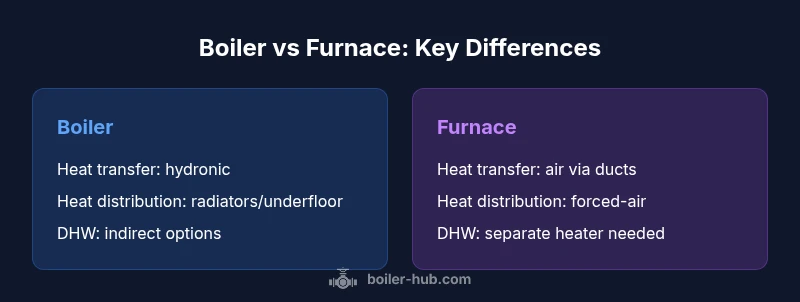
The core distinction between a boiler and a furnace is how they generate and move heat through your home. According to Boiler Hub, boilers heat water to circulate through radiators or underfloor radiant systems, while furnaces push hot air through ducts to warm rooms. This fundamental difference shapes comfort patterns, energy efficiency, and long-term maintenance. Boilers excel in radiant heating scenarios and can be paired with indirect water heaters for domestic hot water; furnaces shine when you need rapid space warming and flexible air distribution. Your home’s layout, insulation, and whether you have or plan for hydronic DHW will largely determine which approach fits best.
In practice, the decision hinges on existing or planned infrastructure, regional climate, and personal preferences for indoor air feel. If you already have or want radiant surfaces or a hot-water loop, a boiler is often the natural fit. If your priority is fast, bulk space heating and straightforward zoning through ducts, a furnace could be preferable. The following sections unpack these differences with details and decision prompts.
Heat delivery methods and comfort implications
A boiler distributes heat by circulating hot water or steam in a closed loop. Radiant floors, baseboard radiators, or radiant panels absorb the heat gradually, delivering even warmth with fewer temperature swings. A furnace heats air and distributes it via ductwork; the sensation is immediate as the blower stirs air in the living spaces. If a home has good insulation and minimal duct loss, a boiler-based system can feel more consistent, whereas poorly insulated homes may experience draftiness or uneven temperature with forced air. The choice also influences humidity, air filtration, and overall indoor comfort throughout seasons.
For homes with existing radiators or underfloor heating, the boiler option tends to pair naturally with comfortable, low-temperature operation. In contrast, houses built around a centralized duct network often benefit from a furnace as a straightforward upgrade path, especially when rapid air-driven warmth is desired.
Energy efficiency and performance factors
Efficiency is not a fixed attribute of boiler versus furnace; it depends on model, maintenance, and climate. Condensing boilers and high-efficiency furnaces reclaim energy from exhaust, delivering greater annual fuel utilization. Hydronic systems can maintain comfortable temperatures with smaller temperature differences, reducing cycling losses. When evaluating options, consider the entire system's efficiency—boilers with well-insulated piping and correctly sized radiators, or furnaces paired with proper duct sealing and smart thermostats. Boiler Hub guidance emphasizes modeling your home’s heat load to avoid oversizing and to select appropriate controls, insulation upgrades, and zoning that maximize real-world performance.
Environmental impact and fuel choice matter as well; even a high-efficiency unit loses efficiency if there are leaks, poor insulation, or oversized components that drive unnecessary cycling. A careful, site-specific design yields the best energy savings over the system’s life.
Installation footprint and upfront costs
Installing a boiler typically involves piping, circulator pumps, and radiators or underfloor components, which can require more space and skilled labor. Furnaces install in a closet or utility room with ductwork linking to the living spaces, which is often simpler if the home already has a ducted system. In both cases, costs vary with fuel type, efficiency, and local labor rates. A high-efficiency boiler or furnace can reduce operating costs over time, but the initial investment is higher, and long-term savings depend on proper sizing, professional installation, and ongoing maintenance. The decision should weigh not just equipment price but lifecycle costs, including potential rebates and service plans.
If your home has space constraints, consider how much room is available for boilers (piping and radiators) versus furnaces (air handlers and ducts). Existing infrastructure can strongly influence installation cost and timeline. Boiler-specific accessories, such as expansion tanks and indirect water heaters, may add to upfront costs but improve long-term value when DHW is a priority.
Maintenance, reliability, and common failures
Boilers require annual service to inspect the heat exchanger, pressure, energy seals, and circulating pumps; corrosion and leaks are common concerns in older hydronic systems. Furnaces demand regular filter changes, blower motor checks, and combustion safety tests. Both systems benefit from a maintenance plan and annual professional inspection. Reliability often hinges on installation quality and the availability of trained technicians in your area. Regular attention to seals, venting, and fuel supply is critical for both options to maintain safe, efficient operation.
From the homeowner perspective, investing in a robust maintenance contract can reduce the likelihood of unexpected downtime and extend system life. Boiler systems benefit from descaling and corrosion prevention, while furnaces require careful duct sealing and venting checks to prevent backdrafts and carbon monoxide risks.
Domestic hot water integration and DHW options
If you want hot water alongside space heating, boilers often support indirect water heaters or integrated combi configurations in some markets. Furnaces typically rely on a separate water heater, though hybrid setups exist in modern homes. When selecting a boiler or furnace, plan for DHW needs early in the design so you can size the indirect tank or consider a dedicated water heater with appropriate recovery rates. The DHW strategy can tip the decision toward a boiler if you want a streamlined, all-in-one solution, or toward a traditional separate water heater when you want flexible recovery and service options.
It’s common to pair a high-efficiency boiler with an indirect DHW tank to maximize hot-water supply while keeping space heating efficient. For homes with modest DHW demand, a small-capacity or combi boiler might suffice, though such configurations can limit future expansion. Boiler Hub emphasizes aligning DHW strategy with the heating system for optimal energy use.
Sizing, heat load, and zoning considerations
A mismatch between system size and home heat load leads to uncomfortable cycles or high energy bills. Both boilers and furnaces require proper load calculations. Zoning can boost comfort in larger homes: radiant zones with a boiler may be paired with thermostatically controlled loops, while multi-zone furnaces rely on dampers and zone thermostats. A professional energy audit can help determine the right size and zoning plan. Oversizing increases standby losses in boilers and can overtax the furnace, while undersizing reduces comfort and forces longer run times.
Accurate heat-load calculations should account for insulation quality, window performance, infiltration, occupant behavior, and future expansion plans. A well-dimensioned system reduces short cycling and improves response to setpoint changes. The result is steadier comfort, lower operating costs, and longer equipment life, especially when paired with controls like outdoor reset, smart thermostats, and zone dampers.
Climate fit: when climate drives the choice
In very cold climates with significant cold snaps, hydronic heating commonly yields steadier comfort and can reduce heat losses from ducts. In temperate regions or homes without extensive insulation, forced-air furnaces can deliver rapid warmth and easier integration with air filtration and humidification. The decision also depends on existing equipment, local fuel costs, and service availability. In many cases, homeowners opt for a hybrid approach: a high-efficiency boiler for base load and radiant comfort, plus a furnace or heat pump for rapid supplemental heating during peak cold days.
Boiler Hub notes that climate-responsive design often yields the best long-term performance. By calculating the balance between peak demand and steady-state loads, you can select the system that minimizes comfort trade-offs while aligning with budget realities. Climate data, building envelope performance, and local incentives all play supporting roles in the final choice.
Noise, air quality, and indoor environment
Ducted furnaces produce a background hum and air movement noise, especially when the blower runs at higher speeds. Boilers tend to be quieter because there is no centralized air-moving equipment in the living spaces, though pumps and circulators add minor noise. Indoor air quality depends on system design; furnaces benefit from proper filtration, while hydronic systems are less prone to dust dispersion but may require zone-level controls for humidity and comfort. The presence of a modern high-efficiency furnace with good filtration can improve perceived air quality, while a boiler-based system emphasizes thermal comfort with less air movement across rooms.
Important accessories include filters, air purifiers, and humidity management devices. When evaluating options, consider how room-to-room temperature consistency interacts with filtration and humidity targets to support overall indoor air quality. A well-integrated system reduces dust, pollen, and other irritants while maintaining comfortable living conditions.
Longevity, warranties, and total cost of ownership
Both boiler and furnace options can last many years with proper maintenance, but longevity is heavily influenced by installation quality and ongoing service. Warranties vary by brand and model, as do maintenance requirements. When budgeting, consider not only the purchase price but also the annual energy costs, potential rebates, and the expected lifetime of heat exchangers, pumps, and burners. Proactive maintenance and periodic system reviews can prevent expensive failures and preserve efficiency over time.
Understanding total cost of ownership means factoring in seasonal energy use, maintenance contracts, and replacement cycles. Boilers may require more frequent component replacement in older homes, while furnaces often incur higher ductwork maintenance costs if not properly sealed. Boiler Hub’s recommendations emphasize a lifecycle view: plan for upgrades, maintain proper airflow, and verify warranty coverage to maximize long-term value.
Case studies: real-world scenarios
A 2,000-square-foot home in a cold climate with existing hydronic pipes benefits from a high-efficiency boiler paired with a well-designed indirect water heater, delivering steady comfort and efficient DHW. A 3,500-square-foot home in a milder climate with existing ductwork can achieve rapid space heating with a high-efficiency furnace, provided ducts are well-sealed and insulated. A historic home with limited space may prefer a compact boiler system with radiant panels, avoiding the structural changes required by large ductwork. These scenarios illustrate how climate, home layout, and water-heating needs shape the boiler versus furnace decision. The Boiler Hub Team notes that tailoring the solution to your home’s unique characteristics yields the best results rather than adopting a one-size-fits-all approach.
Quick, actionable decision checklist
- Evaluate your climate and insulation quality to determine the stability of internal temperatures. Strong insulation reduces the load and can favor heat distribution through water or air depending on other factors.
- List hot-water needs and whether you want DHW from the heating system. If DHW is essential, boilers often offer indirect water heating; if DHW is minimal, a combi boiler can fit.
- Consider existing infrastructure: if you already have ductwork and baseboard radiators, it might guide your choice; adding radiators for a boiler is a larger project than upgrading a furnace.
- Compare efficiency ratings for models you’re considering. Look for DOE efficiency ratings and potential rebates; keep in mind real-world performance varies with maintenance.
- Factor in installation complexity, space, and local labor costs; a high-efficiency option may require more upfront investment but lower operating costs.
- Get a load calculation and a professional opinion. The Boiler Hub Team recommends a professional assessment to tailor a solution to your home’s unique needs.
Comparison
| Feature | Boiler | Furnace |
|---|---|---|
| Heat transfer method | Hydronic (water/steam) heat distribution | Forced-air (ducted) heat distribution |
| DHW compatibility | Often paired with indirect water heater; DHW via boiler | Typically uses a separate water heater or combi systems option |
| Typical efficiency options | Condensing/high-efficiency boilers | Condensing/high-efficiency furnaces |
| Installation footprint | Piping and radiators/underfloor components | Ductwork and furnace closet |
| Best climate / use case | Cold climates with radiant heating or DHW focus | Warmer climates with rapid space warming and air distribution |
| Noise level | Low/noise (pump and water movement) | Moderate to high (blower and fan) |
| Upfront cost range | Mid-to-high installation and equipment costs | Mid installation and equipment costs |
| Maintenance focus | Boiler tune-ups, corrosion control, pumps | Filter changes, blower/heat exchanger checks |
| Lifespan expectations | Longer lifecycle with proper maintenance | Comparable lifecycle with maintenance |
| Best for | Radiant comfort and DHW integration | Fast space heating and air filtration |
Advantages
- Better efficiency with condensing models
- Excellent comfort with radiant hydronics
- Can integrate DHW with indirect tank
- Quieter operation in many setups
- Longer lifespans when properly maintained
The Bad
- Higher upfront installation cost and complexity
- Duct-based losses if ducts are leaky or poorly insulated
- Slower to respond to quick temperature changes (boilers)
- DHW setups can add equipment and maintenance burden
Boiler systems suit radiant comfort and hydronic DHW needs; furnaces excel at rapid space heating with ducted air.
Choose a boiler when you prioritize steady, even warmth and integrated hot water. Pick a furnace if you want fast, flexible space heating and easier installation in ducted homes. A tailored design—taking climate, insulation, and DHW goals into account—offers the best long-term value, according to Boiler Hub Team guidance.
Questions & Answers
What is the fundamental difference between a boiler and a furnace?
A boiler heats water to circulate through radiators or radiant floors, while a furnace heats air that is distributed through ducts. The resulting heat delivery method shapes comfort, efficiency, and maintenance needs. In many homes, the decision hinges on climate, space, and whether radiators or ducts are already installed.
Boiler heats water for radiant heat; furnace heats air via ducts for quick warmth.
Which system is generally more energy efficient?
Efficiency depends on the model and installation rather than the technology alone. Condensing boilers and high-efficiency furnaces reduce energy use, but performance depends on proper sizing, insulation, and airflow. A well-designed hydronic or forced-air system can outperform a poorly planned alternative in almost any climate.
Efficiency depends on model and installation, not just boiler or furnace type.
Can a boiler provide domestic hot water?
Yes. Boilers commonly pair with indirect water heaters to supply domestic hot water efficiently. Some systems offer integrated DHW options, but many homes rely on a separate water heater. Plan DHW needs early in design to size tanks and recovery rates appropriately.
Most boilers can supply hot water when paired with an indirect tank or separate heater.
Is a furnace better for rapid heating of large spaces?
Furnaces heat air and push it through ducts, which can warm up spaces quickly, especially in well-sealed homes. However, this can lead to higher temperature swings if the ducts are leaky or poorly insulated. A well-designed furnace system can still deliver fast comfort with proper zoning and airflow.
Furnaces heat spaces quickly through ducts, great for quick warmth when ducts are tight.
What climate should drive my boiler vs furnace choice?
In very cold climates or homes prioritizing radiant warmth and DHW, a boiler setup often provides steadier comfort with lower air movement. In milder climates or homes with existing ductwork, a furnace can offer fast warmth and simpler upgrades. Climate, insulation, and energy costs all influence the best match.
Climate, insulation, and existing systems guide the decision.
What maintenance differences should I expect?
Boilers require annual inspections of the heat exchanger and pumps, with attention to corrosion. Furnaces need filter changes, blower checks, and combustion safety tests. Regular professional service for either system helps prevent failures and maintains efficiency.
Boilers need annual checks; furnaces need regular filter and safety checks.
Key Points
- Prioritize climate and insulation to guide heat delivery choice
- Consider DHW needs when deciding between boiler and furnace
- Evaluate existing infrastructure (ducts vs radiators) to minimize retrofit costs
- Aim for high-efficiency models and proper installation for real-world savings
- Involve a professional load calculation to avoid oversizing or undersizing