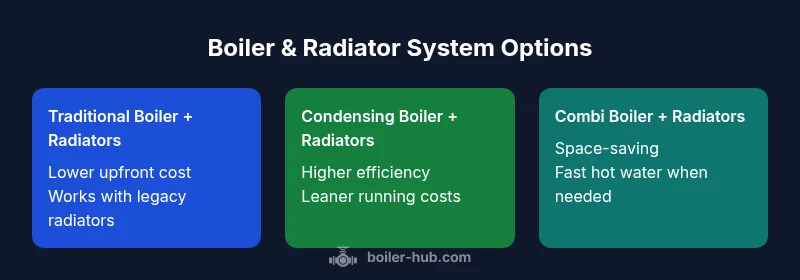
Boiler and Radiator Systems: Side-by-Side Comparison
A practical, objective comparison of boiler and radiator systems, covering traditional, condensing, and combi boilers with radiators, and guidance on efficiency, sizing, and installation for homes and facilities.


According to Boiler Hub, choosing between boiler and radiator systems hinges on efficiency, space, and operating costs. For most homes, a condensing boiler paired with traditional radiators offers high efficiency with familiar plumbing. Older non-condensing boilers are cheaper upfront but waste heat, while combi boilers save space but may struggle with large radiator networks. Assess your heat load, zoning needs, and existing radiators before making a final choice.
Overview of boiler and radiator systems
Boiler and radiator systems form a classic approach to hydronic heating, widely used in homes and facilities. In these setups, a boiler heats water, which is pumped through a network of pipes to radiators or baseboard emitters. As the water cools, it returns to the boiler to be reheated, creating a continuous loop that warms spaces. Radiators act as heat exchangers, transferring thermal energy to room air. The thermal characteristics of the system depend on boiler type, radiator design, pipe routing, and controls. According to Boiler Hub, the core goal is to deliver comfortable warmth with minimal energy waste while keeping safety and reliability front and center. This article compares traditional, condensing, and combi boiler configurations with radiators to help homeowners and facility managers choose the best fit for their heat loads, space constraints, and budget.
- Key concepts: heat source (boiler), heat emitters (radiators), distribution network (pipes), and controls (thermostats, zone valves).
- The term “boiler and radiator systems” encompasses several configurations, each with distinct advantages and trade-offs.
- Audience relevance: homeowners upgrading older systems, facility managers planning scalable heating, and property renovators seeking efficiency gains.
Understanding these building blocks will make it easier to evaluate options without getting lost in jargon. Boiler Hub emphasizes clarity: match system design to the building’s heat load and occupancy patterns, and choose components with durable parts and accessible service.
How radiators and boilers work together
In a typical boiler and radiator setup, a heat source (the boiler) heats water to a target temperature. A circulating pump moves the heated water through a closed loop of pipes to radiators located throughout the building. Each radiator acts as a heat sink, transferring most of its heat to the room via convection and radiation. As the water cools, it returns to the boiler for reheating, continuing the cycle. The efficiency and comfort level depend on and should be optimized by several intertwined factors:
- Boiler type and efficiency: modern condensing boilers extract extra heat from exhaust gases, improving overall performance.
- Radiator layout and sizing: properly sized radiators ensure even heat distribution and prevent cold spots.
- Piping routes and insulation: minimizing heat loss in unheated spaces lowers energy waste.
- Controls: programmable thermostats, room sensors, and zoning valves fine-tune comfort and reduce waste.
When planning, consider whether your radiators’ output aligns with room volumes and whether a single boiler can satisfy peak demand across the building. In many cases, upgrading controls and balancing radiators yields meaningful gains even without changing the entire boiler lineup.
Traditional vs condensing vs combi: Key differences
The three main boiler-and-radiator configurations differ primarily in how they recover energy, how much hot water they provide, and how they fit the building’s layout. Traditional boilers (older non-condensing models) heat water and push it through radiators with standard efficiency. Condensing boilers recover additional heat from exhaust gases, delivering higher efficiency and lower running costs over the equipment life. Combi (combination) boilers mix water on demand, supplying heating and hot water from a single, compact unit.
- Traditional boiler + radiators: good for existing pipe networks and large radiant zones; often upgrade-friendly for simple controls but may be less efficient than modern condensing models.
- Condensing boiler + radiators: typically the best overall efficiency, especially when paired with well-sized radiators and modern controls; requires a proper venting and condensate drainage setup.
- Combi boiler + radiators: space-saving and cost-effective for small to medium homes with moderate hot-water needs; can struggle with high simultaneous heating and hot-water demand in larger homes.
Choosing between these options involves evaluating the building’s heat load, hot-water requirements, and space for equipment. The right match balances upfront costs with long-term energy savings, service availability, and compatibility with existing radiators.
Space and installation considerations for boilers and radiators
Installation considerations are often as important as the boiler choice itself. A successful upgrade or initial install requires thoughtful planning of space, ventilation, and ducting or piping layouts. Key factors include:
- Space requirements: boilers and radiators require room for the unit, expansion and maintenance access, and adequate clearance for safe operation.
- Piping and routes: retrofitting may involve running new pipes, which can impact walls, floors, and ceilings. Efficient routing reduces disruption and heat loss.
- Ventilation and combustibles: combi or traditional gas boilers need appropriate clearance, venting, and, where required, combustion air.
- Accessibility for service: frequent maintenance helps prevent surprises; plan components and access panels accordingly.
- Boiler room vs utility closet: many residential upgrades succeed by reclaiming space in a utility closet or small boiler room, if ventilation and clearance standards are met.
For facility managers, large installations require a more formal approach: engineering calculations, professional venting, compliance with local codes, and a robust service contract. Boiler Hub emphasizes coordinating with licensed installers to ensure the system integrates with building management practices and safety standards.
Efficiency and running costs: what matters (without numbers)
Efficiency is a core driver of life-cycle costs for boiler and radiator systems. Two broad concepts govern energy use: the boiler’s efficiency in converting fuel to heat, and the system’s ability to minimize heat loss through pipes and radiators. Condensing boilers excel by reclaiming energy that would otherwise escape through exhaust streams, while traditional non-condensing units can incur higher operating costs over time.
- Seasonal efficiency: the ratio of useful heat delivered to the building versus fuel consumed, which improves with well-insulated pipes, properly sized radiators, and modern controls.
- Heat loss management: good insulation, sealed rooms, and reduced air leakage lower the amount of energy needed to maintain comfort.
- Controls and zoning: smart thermostats, TRVs (thermostatic radiator valves), and zone controls help target heat where it’s needed, reducing wasted energy.
- Maintenance and performance: regular service, valve balancing, and clean heat exchangers keep a system operating near its design efficiency.
The upshot is that investing in condensing technology, paired with proper radiator sizing and modern controls, typically yields the best long-run value. Brand reliability, service availability, and local energy prices influence the payoff, which is why homeowners and facility managers should evaluate options with a clear view on total cost of ownership.
Sizing, controls, and zoning for comfort
Sizing a boiler and radiator network correctly is essential for comfort and efficiency. Oversized boilers can short-cycle, providing abrupt heat bursts and unnecessary wear, while undersized units struggle to maintain warmth during cold periods. A methodical approach includes:
- Load calculation: performing a room-by-room heat load assessment to determine the radiator count and size needed to meet comfort targets.
- Radiator balancing: ensuring each room receives the intended heat by adjusting valve openings and flow rates.
- Controls: central thermostats, zone valves, and smart thermostats help fine-tune temperature across spaces and times of day.
- Outdoor reset and weather compensation: some modern systems adjust boiler flow based on outdoor temperatures, improving efficiency without sacrificing comfort.
- Hydronic system health: check for air in the system, ensure pumps operate smoothly, and verify that expansion tanks maintain proper pressure ranges.
With proper sizing and control strategies, boiler and radiator systems can deliver steady warmth with predictable energy use. The goal is reliable comfort with minimal manual intervention while maintaining the ability to adapt to changing occupancy patterns.
Maintenance, reliability, and safety considerations
Maintenance is a foundation of reliability for boiler and radiator systems. Regular service helps prevent failures, reduces energy waste, and preserves safety. Key maintenance tasks include:
- Annual service: a qualified technician inspects the burner, heat exchanger, controls, and safety devices, and tests pressure and leak integrity.
- Valve and pump checks: ensure circulating pumps run smoothly and zones balance as intended.
- System flushing and clean heat exchangers: removing sludge and debris improves heat transfer and efficiency.
- Leak monitoring: detect and repair leaks early to avoid water damage and energy losses.
- Safety checks: ensure CO detectors are functioning and ventilation remains adequate for gas-fired units.
Reliability also depends on choosing proven components with available replacement parts and a service network that can respond quickly when issues arise. Boiler Hub encourages homeowners to schedule proactive inspections and to maintain records that simplify future upgrades or troubleshooting.
Choosing the right system for your home or facility
Selecting the right boiler and radiator configuration requires weighing heat load, space, budget, and long-term energy goals. Start with a practical framework:
- Define usage: heating load patterns, occupancy, and hot-water needs determine whether conventional radiators or space-saving solutions suit you best.
- Compare efficiency and cost: condensing boilers generally offer superior efficiency, but upfront costs and installation considerations matter.
- Assess existing infrastructure: homes with extensive radiator networks may benefit most from upgrading boilers and controls rather than replacing emitters.
- Plan for expansion: if you anticipate future renovations or a larger space, choose a modular approach that accommodates growth and changes in energy use.
- Engage professionals: licensed heating engineers can perform accurate load calculations and design a system that minimizes heat loss and supports reliable operation.
In practice, many homeowners and facility managers find that condensing boilers paired with well-sized radiators and modern controls deliver the strongest overall performance. However, the best choice depends on the building’s specifics, so a structured evaluation is essential.
Implementation checklist and next steps
To move from theory to action, use a structured implementation plan:
- Audit your current system: document boiler type, age, radiator network, and existing controls.
- Define goals: improve efficiency, upgrade safety, or simplify maintenance.
- Obtain professional assessments: request load calculations and a preliminary design from licensed installers.
- Compare options: traditional, condensing, and combi boilers in relation to radiator networks.
- Plan installation logistics: install in a suitable space with proper venting and service access.
- Prepare a budget and timeline: include potential downtime and permits if required.
- Schedule maintenance: set a regular service schedule and keep records for warranty and future upgrades.
A thoughtful, staged approach minimizes disruption and maximizes the long-term benefits of your boiler and radiator system upgrade or installation. The goal is reliable comfort, safety, and efficient operation across seasons.
Feature Comparison
| Feature | Traditional boiler + radiators | Condensing boiler + radiators | Combi boiler + radiators |
|---|---|---|---|
| Efficiency (typical) | Moderate to high (older non-condensing) | High (condensing) | High (condensing with modest loads) |
| Space requirements | More space for boiler and piping | Compact; condensing unit often smaller | Usually compact; needs radiator network |
| Price Range (installation) | Lower upfront | Higher upfront but lower operating cost | Moderate upfront |
| Maintenance | Baseline maintenance | Annual servicing recommended | Simple service pattern with modern components |
| Best For | Homes with existing radiators; older homes | New installs or renovations seeking efficiency | Smaller homes or heat-dated layouts |
Advantages
- Reliable central heating solution
- Works with existing radiators and piping
- Good for long-term value with durable components
- Wide service network and parts availability
- Judicious use with modern controls enhances comfort
The Bad
- Older non-condensing models can be less efficient
- Condensing systems require proper venting and condensate management
- Combi boilers may struggle with high simultaneous heating and hot-water demand in large homes
Condensing boiler + radiators is the recommended baseline for most homes.
A condensing boiler paired with radiators typically delivers the best balance of efficiency, comfort, and compatibility with existing radiators. Traditional systems may be cheaper upfront but incur higher operating costs over time, while combi boilers excel in space-saving scenarios but can underperform in larger homes with many radiators or high hot-water demand. The choice should be guided by heat load, space, and long-term energy goals.
Questions & Answers
What is the difference between traditional, condensing, and combi boilers in boiler and radiator systems?
Traditional boilers heat water directly and push it to radiators; condensing boilers recover more heat from exhaust and are usually more efficient; combi boilers supply hot water on demand and can save space but may require careful sizing for larger radiators. The right choice depends on heat load, hot-water demand, and space.
Traditional boilers push hot water to radiators; condensing models are more efficient; combi boilers save space but need proper sizing for hot water. A professional assessment helps decide.
Can I reuse my existing radiators with a new boiler?
Yes, in many cases you can reuse existing radiators with a new boiler, provided their heat output and piping connections match the new system requirements. A professional will verify radiator sizing and balance, ensuring compatibility and comfort.
You can reuse radiators if they match the new boiler's output; a pro can confirm sizing and balance.
Is a combi boiler suitable for large homes with many radiators?
Combi boilers work well in smaller homes with moderate hot-water demand. In larger homes with many radiators, a system with a separate hot water cylinder or a larger boiler may be better to maintain consistent heat and water supply.
Combi boilers are great for small spaces, but large homes often need a bigger system.
How often should boiler and radiator system be serviced?
Annual servicing by a licensed technician is generally recommended to ensure safe operation, maintain efficiency, and catch leaks or wear early.
Most boilers should be serviced once a year by a professional.
What maintenance reduces boiler and radiator failures?
Regular checks on the boiler, heat exchanger, pumps, valves, and controls, plus radiator balancing and occasional system flushes, help reduce failures and maintain warm, even heat.
Keep up with annual servicing and balance radiators for smooth operation.
Key Points
- Assess heat load before selecting a boiler type
- Prefer condensing boilers for efficiency gains
- Ensure radiator sizing matches room volumes
- Invest in modern controls to maximize savings
- Budget for professional installation and ongoing maintenance