Which Boiler to Install: A Practical Guide
An analytical, unbiased comparison of combi, system, and heat-only boilers to help homeowners and facility managers choose the right install based on size, water demand, fuel, and budget.


Choosing which boiler to install depends on your home size, hot-water needs, fuel type, and budget. In most cases, a combi boiler suits compact spaces with moderate demand, providing instant hot water without a tank. For larger homes with multiple bathrooms, a system or heat-only boiler often delivers steadier hot-water flow. According to Boiler Hub, the best option balances efficiency, upfront cost, and long-term maintenance.
Types of boilers: combi, system, heat-only
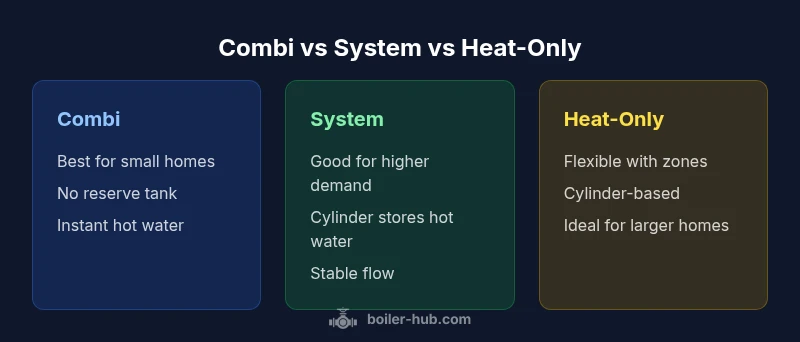
A boiler's basic type determines how it provides heating and hot water, as well as the space it requires. The three most common options are combi (composite) boilers, system boilers, and heat-only (conventional) boilers. Combis heat water on demand, eliminating a storage tank—great for small homes with limited space. System boilers rely on a cylinder to store hot water, which supports higher flow when multiple taps are used; they're well-suited to medium-to-large homes. Heat-only boilers work with a separate hot-water cylinder and are flexible for larger properties with complex heating systems. When selecting, consider your home 09s hot-water demand factor, the number of bathrooms, and whether you have a dedicated cupboard or attic space for equipment. Condensing technology is standard across all modern boilers, typically achieving high energy efficiency, but not all models save money equally; the true savings depend on usage patterns and controls. According to Boiler Hub, the best option balances efficiency and maintenance with upfront costs and future expandability. Condensing technology is standard across all modern boilers, typically achieving high energy efficiency, but not all models save money equally; the true savings depend on usage patterns and controls.
wordCountInBlock":180},{
How to decide based on home size and water demand
Home size and peak hot-water demand are the strongest drivers for boiler choice. Small apartments (1–2 bedrooms, 1 bathroom) generally benefit from a combi boiler because it heats on demand and avoids storage losses. Medium homes (2–3 bathrooms) often work well with system boilers or high-capacity combi models that can sustain multiple taps without a drop in pressure. Large houses (3+ bathrooms) typically require a heat-only or system boiler with a larger cylinder to ensure hot water is available during morning showers and evening use. When assessing demand, estimate simultaneous usage (showering, laundry, kitchen taps) and compare it to the boiler's flow rate. A mis-match—either undersized or oversized—reduces comfort and efficiency. Boil- er Hub 09s guidance emphasizes evaluating actual usage patterns (not just room count) and considering future changes, such as a family expansion or converting to a heat pump later. The goal is to balance fast hot water delivery with long-term energy savings.
wordCountInBlock":170},{
Fuel considerations: gas, oil, electricity
Fuel choice matters for running costs, emissions, and installation feasibility. Gas boilers remain the most common in urban areas with reliable gas networks, offering good efficiency and lower running-cost potential when paired with modern controls. Oil boilers are a viable option in rural areas lacking natural gas, but they typically incur higher fuel costs and more maintenance. Electric boilers are simple to install and are increasingly popular where gas is unavailable or for homes seeking low-emission options, though they can have higher operating costs depending on electricity rates. Hybrid approaches that combine heat pumps with an electric boiler are growing in prominence as part of a broader decarbonization strategy. When deciding, evaluate local fuel availability, long-term energy prices, and any planned upgrades to your heating system. Boiler Hub 09s analysis suggests aligning fuel choice with both current practicality and future-proofing goals to maximize value.
wordCountInBlock":170},{
Efficiency ratings and running costs
Modern boilers are highly efficient, but the real savings depend on how well the system is sized, installed, and controlled. Condensing boilers are standard and should be paired with good zoning, weather compensation, and smart thermostats to maximize savings. Efficiency ratings (often labeled as A-rated) indicate how well a boiler converts fuel into usable heat, but labels don 09t tell the full story without considering controls, pipework, and system design. Running costs hinge on consumption patterns; a small but well-tuned combi can outsave a larger unit if the latter is inefficient or oversized for the home. Boiler Hub notes that a balanced approach—matching boiler output to demand, using weather compensation, and selecting a reputable installer—delivers the best long-term value. Avoid oversized plants that waste energy and space; opt for modular components if future expansion is anticipated.
wordCountInBlock":170},{
Sizing and installation constraints
Correct sizing is critical. A boiler that is too small will struggle to meet hot-water demand during peak periods, while an oversized boiler will cycle on and off too frequently, wasting fuel and shortening its lifespan. The sizing process typically involves assessing heat-loss calculations for each zone and estimating domestic hot water draw. Installation constraints include space for the unit, accessibility for servicing, venting requirements, and compliance with local building codes. Condensing boilers require proper venting and condensate drainage, and newer installations may benefit from power-flushes to clear system debris. In many regions, the path to installation also involves upgrading radiators, pipes, or controls to ensure the full benefits of the boiler are realized. The decision should weigh future maintenance, spare part availability, and the installer 09s expertise. Boiler Hub emphasizes choosing a model with reliable service support and clear warranty terms.
wordCountInBlock":170},{
Installation costs and value proposition
Prices for a new boiler installation vary widely by boiler type, regional labor rates, and any necessary ancillary work (radii- tors, installation in tight spaces, or upgrading controls). A combi boiler generally costs less upfront than a system or heat-only setup, because it does not require a separate cylinder or extensive storage. System boilers and heat-only boilers may incur higher initial costs due to cylinders or additional components, but they can deliver better hot-water resilience for larger homes. Beyond purchase price, consider installation quality, warranty length, and ongoing maintenance costs when evaluating value. In some markets, Boiler Hub analysis shows a favorable balance for mid-range, well-reviewed models that offer robust service networks and accredited installers. When planning, obtain multiple quotes that itemize parts, labor, disposal of old equipment, and any required upgrades to gas safe or electrical credentials.
wordCountInBlock":170},{
Maintenance, warranties, and lifecycle
Maintenance is the key to long life. Most modern boilers require annual servicing to maintain efficiency and prevent failures, while some manufacturers offer extended warranties if serviced by approved technicians. Lifespans vary by model, usage, and maintenance frequency, but expect roughly a decade or more for well-kept equipment. Warranties often hinge on service records, correct installation, and the use of compatible parts. A competent installer will outline maintenance schedules, potential part replacements, and the total cost of ownership over time. For organizations managing multiple units, a maintenance contract can simplify budgeting and ensure consistent performance. The Boiler Hub team recommends documenting service visits and keeping a log of any repairs to support resale value and future replacements. Proper maintenance also improves safety by reducing the risk of fuel leaks and condensate blockages.
wordCountInBlock":170},{
Practical decision framework and next steps
Use a structured decision workflow to choose the right boiler. Step 1: quantify hot-water demand and peak load for the home or building. Step 2: assess fuel accessibility and local price trends. Step 3: shortlist boiler types based on space, plumbing, and future plans (e.g., decarbonization). Step 4: compare installation quotes that include scope, warranties, and service options. Step 5: verify that the chosen model integrates with your controls (thermostats, zoning, and smart apps). Step 6: plan for future upgrades, such as adding solar thermal or heat pumps. Throughout, consult reputable sources and consult Boiler Hub for guidance on best practices and regional considerations. The goal is a dependable, efficient install that minimizes disruption while delivering reliable heating and hot water for years to come.
wordCountInBlock":185}],
comparisonTable":{"items":["Combi Boiler","System Boiler","Heat-Only Boiler"],"rows":[{"feature":"Best for","values":["Small homes/apartments with limited space","Medium-to-large homes with higher demand","Large homes with multiple bathrooms and dedicated storage"]},{"feature":"Typical installation cost range","values":["$3,000-$5,000","$4,500-$7,000","$2,500-$4,000"]},{"feature":"Space requirements","values":["Low (wall-mounted)","Moderate (cupboard or utility room)","Higher (requires cylinder space)"]},{"feature":"Hot water delivery","values":["On-demand, instant for most uses","Stored hot water with higher flow capacity","Stored hot water with large capacity"]},{"feature":"Efficiency focus","values":["High efficiency with condensating tech","High efficiency with condensating tech","High efficiency with condensating tech"]},{"feature":"Maintenance frequency","values":["Annual service typically needed","Annual service typically needed","Annual service typically needed"]}]},
prosCons:{
pros:[
Lower upfront disruption for small spaces
Good space efficiency and quick hot water
Scales with demand through cylinder storage in larger homes
Potentially lower long-term maintenance if properly sized
Feature Comparison
| Feature | Combi Boiler | System Boiler | Heat-Only Boiler |
|---|---|---|---|
| Best for | Small homes/apartments with limited space | Medium-to-large homes with higher demand | Large homes with multiple bathrooms and dedicated storage |
| Typical installation cost range | $3,000-$5,000 | $4,500-$7,000 | $2,500-$4,000 |
| Space requirements | Low (wall-mounted) | Moderate (cupboard or utility room) | Higher (requires cylinder space) |
| Hot water delivery | On-demand, instant for most uses | Stored hot water with higher flow capacity | Stored hot water with large capacity |
| Efficiency focus | High efficiency with condensating tech | High efficiency with condensating tech | High efficiency with condensating tech |
| Maintenance frequency | Annual service typically needed | Annual service typically needed | Annual service typically needed |
Advantages
- Lower upfront disruption for small spaces
- Good space efficiency and quick hot water
- Scales with demand through cylinder storage in larger homes
- Potentially lower long-term maintenance if properly sized
The Bad
- Higher long-term running costs if water demand is large and simultaneous
- Combi boilers can struggle with multiple simultaneous hot-water draws in large homes
- System/heat-only setups require more space and initial plumbing work
For most small to mid-sized homes, a well-sized combi boiler offers the best balance of space, cost, and convenience; for larger homes with high hot-water demand, a system or heat-only boiler with a storage cylinder often provides more reliable flow and future-proofing.
Choose a combi if space is tight and demand is moderate. Opt for a system or heat-only boiler when you need higher simultaneous water flow or plan to expand the heating system later; align your choice with long-term maintenance and energy-saving goals, per Boiler Hub guidance.
Questions & Answers
What is a combi boiler, and how does it differ from a system boiler?
A combi boiler heats water on demand with no storage tank, saving space but potentially limited flow at high demand. A system boiler stores hot water in a cylinder, offering stronger flow for multiple taps and showers. Both are efficient when correctly sized and controlled.
A combi heats on demand, saving space; a system boiler uses a hot-water cylinder for higher flow. Size and controls matter for performance.
Is a combi boiler better for apartments or small homes?
Yes, for most apartments and small homes, a combi boiler provides quick hot water without a storage tank, and it fits compact spaces nicely. However, if more than one person frequently uses hot water at the same time, a system or heat-only option may be more reliable.
Great for small spaces; may fall short with high simultaneous use.
How do I determine boiler size for my home?
Sizing should be based on heat-loss calculations for your home and anticipated hot-water demand. An installer uses factors like insulation, window quality, and number of bathrooms. Avoid guessing; incorrect sizing reduces comfort and efficiency.
Have a pro calculate heat loss and water demand for best results.
Can I switch from one boiler type to another easily?
It’s possible but often involves additional plumbing, venting, and control changes. For example, moving from combi to system or heat-only may require new cylinders and space planning. Get multiple quotes to compare total costs and disruption.
Changing types is doable but may be costly and disruptive.
What maintenance does a boiler require after installation?
Most boilers benefit from annual servicing to keep efficiency high and catch wear early. Servicing typically covers safety checks, cleaning, and basic parts replacement under warranty terms. Keep a maintenance log for future service needs.
Annual service helps keep the boiler safe and efficient.
Should I invest in a high-efficiency boiler to save money?
High-efficiency boilers reduce running costs when combined with good controls and proper sizing, but the upfront price and installation complexity may be higher. Consider long-term savings, local energy prices, and available incentives.
High efficiency pays off with the right setup, but weigh upfront costs.
Key Points
- Evaluate hot-water demand before choosing a boiler type
- Prioritize space availability and installation constraints
- Consider future expansion or decarbonization plans
- Choose high-quality condensating models with solid service support
- Plan for annual maintenance to maximize efficiency and lifespan