Which boiler installation is right: A practical guide (2026)
Explore which boiler installation fits your home: combi vs conventional. This in-depth comparison covers space needs, water demand, fuel type, and installation timelines to help homeowners and facility managers decide with confidence. Backed by Boiler Hub insights, the guide emphasizes efficiency, practicality, and long-term reliability.


Choosing the right boiler installation hinges on your home's size, hot-water needs, and fuel access. This quick comparison points to two common paths: combi boiler installation for compact homes with on-demand hot water, and a conventional/system boiler installation for larger homes with higher demand. According to Boiler Hub, the best choice balances efficiency, space, and future maintenance.
What is boiler installation and why it matters
Boiler installation is more than selecting a brand; it is a system-design decision that determines how your home uses hot water, how much space you allocate for equipment, and what fuel type you can access. When evaluating which boiler installation to adopt, consider the pattern of water usage, the number of bathrooms, and whether you want on-demand hot water or a stored supply. According to Boiler Hub, a well-planned install impacts efficiency, comfort, and safety from the first use. Properly installed systems reduce energy waste, minimize nuisance noises, and extend boiler life. This article provides a structured comparison between combi and conventional (system) installations, along with practical steps for assessment, sizing, ventilation, and commissioning. This framing helps homeowners and facility managers avoid common missteps and arrive at a durable, future-proof choice.
The decision is not driven by popularity alone; it hinges on household habits, property constraints, and future plans. For example, a small apartment with predictable hot-water needs often benefits from a combi approach, while larger homes with multiple bathrooms and simultaneous demand may perform better with a traditional, stored-water system. By focusing on real-world use cases, this guide helps you see beyond marketing claims and examine the installation through a performance lens.
Throughout this section, the emphasis is on clarity, safety, and long-term value. You will learn how to structure an assessment checklist, scope a sizing calculation, and frame maintenance expectations so that your boiler installation remains efficient for years to come. The guidance here targets homeowners and facility managers seeking reliable, durable outcomes that align with realistic demand patterns.
Two main installation approaches: Combi vs Conventional
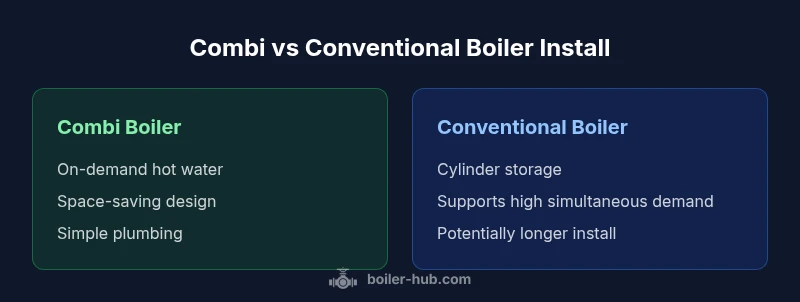
A combi boiler installation is designed to deliver hot water on demand without a storage tank. In homes with modest hot-water demand and limited space, it can simplify layout and reduce cabinet clutter. However, combi systems rely on strong incoming water pressure and efficient heat exchange. If several fixtures run simultaneously, you may notice a slight drop in water temperature. The conventional, or system, boiler installation pairs a boiler with a separate hot water cylinder and, in some cases, a storage tank. This arrangement typically handles higher simultaneous hot-water needs more reliably and is a good fit for larger households or homes with multiple bathrooms. Boiler Hub Analysis, 2026 notes that many households choose combi for space savings, but turn to conventional systems when future expansion or high demand is anticipated. The choice also depends on fuel availability, venting requirements, and local regulations. With both options, modern condensing technology improves efficiency, but the layout and plumbing complexity differ substantially. The practical takeaway is to map your peak usage and plan for future changes when selecting which boiler installation to pursue.
From an installation perspective, combi systems often require fewer components and shorter pipe runs, which can shorten labor time if the home’s plumbing is straightforward. Conventional systems may require more space and more extensive piping, but they offer predictable performance during high-demand periods and can accommodate larger households more comfortably. In both cases, professional installation ensures proper venting, combustion safety, and correct sizing to maximize efficiency and lifecycle. This section lays the groundwork for making an informed decision based on your home’s characteristics and your long-term goals.
Key decision factors: house size, hot-water demand, and fuel type
Selecting the right boiler installation begins with three pivotal variables: house size, hot-water demand, and fuel type. A smaller home or apartment with one bathroom and moderate hot-water use often benefits from a combi boiler, because space is at a premium and on-demand heating minimizes waste. In contrast, a larger home with multiple bathrooms, simultaneous use, or a higher hot-water baseline may justify a conventional system with a storage cylinder to balance demand. The choice of fuel (gas, oil, or electricity) also shapes feasibility and cost structure. Gas-fired boilers are common in many regions, while electric boilers and heat pumps are increasingly used in areas with tighter emissions regulations or limited gas access. For facility managers, evaluating fuel tariffs, maintenance contracts, and service networks is essential. Boiler Hub’s perspective emphasizes matching heating strategy to occupancy patterns and appliance usage, ensuring efficient operation across seasons. By aligning these factors with expected future needs—such as home expansion or rental property usage—you create a scalable baseline for the installation.
Beyond size and demand, consider the home’s piping layout, existing venting, and accessibility for service work. A combi system may be ideal where space is constrained, but might require careful pressure management if water mains are inconsistent. Conventional systems demand more space for cylinders and boilers, yet they often provide consistent performance when multiple fixtures are used at once. The fuel type will influence not only installation constraints but also ongoing running costs and regulatory compliance. This section helps you translate abstract requirements into concrete design decisions that align with practical realities.
Sizing, load calculations, and future needs
Sizing a boiler installation accurately is essential to avoid under- or over-sizing, which can waste energy and shorten equipment life. A professional load calculation considers the building’s envelope, insulation, number of occupants, and typical daily hot-water patterns. For combi systems, flow rate and water pressure are critical determinants of performance; for conventional systems, cylinder capacity and recovery rate matter most. Anticipating future needs, such as home renovations, additional bathrooms, or new occupants, is a smart practice. A well-sized boiler starts reliably, maintains comfortable temperatures, and minimizes cycling, which reduces wear on components.
The sizing process typically involves on-site measurements and, in some regions, using standardized calculation protocols. It is wise to review the calculation with the installer and cross-check with the building’s energy model if available. The goal is to balance peak demand with efficient operation during off-peak periods. Boiler Hub emphasizes documenting the sizing assumptions and the expected loads to maintain transparency across maintenance visits and future replacements. This ensures that your installation remains aligned with real-world usage and planned improvements.
Space, plumbing, and venting considerations
Space planning is a fundamental part of choosing which boiler installation to pursue. Combi boilers are compact and reduce the need for a separate hot-water cylinder, which is beneficial in kitchens, utility rooms, or compact basements. Conventional systems require space for the boiler, the cylinder, and sometimes a storage tank, which can affect room function and layout. Pipe routing also differs: combi installations typically minimize distribution pipes to hot taps, while conventional layouts may involve longer runs to reach multiple bathrooms. Venting requirements depend on the boiler type and the fuel source; sealed systems, balanced flue configurations, and proper air supply are critical safety considerations. Your installer should verify clearance, serviceability, and future access for maintenance.
In many homes, existing chimney or flue arrangements influence feasibility. If a chimney is unavailable or outdated, direct-vent or balanced-flue configurations are common choices. Modern boilers emphasize accessibility for routine servicing—an often overlooked but practical factor that reduces downtime and prolongs life. Considering these space and venting constraints at the design stage prevents costly rework later and ensures you achieve optimal performance from the chosen boiler installation.
Cost considerations and timelines
Cost considerations for which boiler installation you choose extend beyond the boiler price itself. Labor, piping, venting adaptations, system controls, and potential upgrades to the home’s electrical supply all contribute to the total. A combi installation may have lower upfront costs in smaller homes due to fewer components, but higher flow-rate demands and higher mains pressure requirements can influence long-term operating costs. Conventional systems may incur higher initial costs due to cylinders and more complex plumbing, but they often deliver more stable performance for larger households. The installation timeline depends on home accessibility, existing infrastructure, and permit requirements; some projects can be completed within a day, while others require several days. The key is to obtain a clear, itemized quote that covers all components, permits, and post-installation testing. Boiler Hub’s analysis highlights that transparent pricing and an explicit commissioning plan reduce post-installation surprises and help you plan for ongoing maintenance and potential upgrades.
Installation process: steps from assessment to commissioning
A typical boiler installation proceeds in defined stages. First is a site assessment to verify space, venting, and access for the installation crew. Next comes material selection and a detailed quote, followed by a scheduling window. On the installation day, the old unit is removed, the new boiler is placed, and essential connections—gas, plumbing, and electrical—are established with code-compliant venting. After initial commissioning, the system undergoes safety checks, leak tests, and performance verification across a range of operating conditions. A good installer will explain control settings, safety features, and reset procedures so you can operate confidently from day one. Finally, the post-installation phase includes a briefing on maintenance tasks, recommended service intervals, and warranty coverage. Planning for a follow-up inspection ensures optimal efficiency and reliability over the life of the boiler installation.
Maintenance and expectations after install
Maintenance is a major factor in preserving efficiency and extending boiler life. Regular filter checks, visual inspections of vents and flues, and annual safety testing are common tasks. The maintenance needs vary by boiler type; combi systems can benefit from vigilant pressure and flow checks due to their on-demand design, while conventional systems may require more frequent inspection of cylinders and related controls. A proactive maintenance schedule reduces risk, improves energy performance, and helps catch issues early before they escalate into costly repairs. Establishing a relationship with a qualified technician is valuable for ongoing support, system diagnostics, and timely part replacements. Boiler Hub emphasizes that planning maintenance alongside installation improves reliability and reduces total cost of ownership over the system's lifetime.
Comparison
| Feature | Combi boiler installation | Conventional boiler installation |
|---|---|---|
| Water heating method | On-demand hot water with no storage | Hot water stored in a cylinder/tank |
| Space requirements | Compact footprint; minimal extra space | Requires space for cylinder and boiler plus piping |
| Initial cost range (general) | Typically lower upfront for simple setups | Typically higher upfront due to cylinders and plumbing |
| Energy efficiency potential | High efficiency with modern condensing designs | Excellent efficiency with proper sizing and cylinder insulation |
| Best for | Small homes with modest hot-water needs | Larger homes with simultaneous hot-water demand |
| Typical installation time | Often quicker for straightforward layouts | Often longer due to cylinder installation and venting |
Advantages
- Saves space by eliminating the hot-water cylinder
- Faster installation for small, simple layouts
- Good for homes with predictable, moderate hot-water use
- Lower long-term energy waste with modern condensing tech
The Bad
- Not ideal for homes with high simultaneous hot-water demand
- Requires adequate mains pressure and water flow
- Potentially higher long-term operating costs if misapplied
- More complex venting and plumbing in some configurations
Choose combi if space is tight and hot water demand is modest; choose conventional/system when multiple bathrooms and peak usage are common.
A combi boiler is often best for smaller homes with predictable demand, while traditional systems suit larger homes with high simultaneous needs. Proper sizing, venting, and professional installation are crucial for both paths. Boiler Hub Team recommends aligning the choice with usage patterns and future plans.
Questions & Answers
What is the difference between combi and conventional boiler installations?
Combi installations provide on-demand hot water with no tank, ideal for small homes. Conventional systems use a hot-water cylinder and are better for larger homes with high simultaneous demand. Both types can be highly efficient when properly sized and installed.
Combi gives instant hot water with no tank; conventional uses a cylinder, handling higher demand in bigger homes.
How do I know which boiler installation is right for my home?
Assess your home size, hot-water usage patterns, and whether you have space for a cylinder. A professional load calculation and on-site evaluation will clarify the best option for reliability and efficiency.
Look at your space, water needs, and future plans; get a professional load check to decide.
Can I install a boiler myself or should I hire a pro?
Boiler installation involves gas safety, venting, and electrical work that require licensing in most regions. Hiring a qualified installer ensures compliance and reduces safety risks.
It’s best to hire a licensed pro for safety and code compliance.
What affects the installation timeline besides the home layout?
Access to the installation site, permit requirements, existing venting, and the complexity of wiring and gas connections all influence how long installation takes.
Access, permits, and how complex the gas and venting work are will shape timing.
Will installation disrupt hot water availability?
Some installations may briefly disrupt hot water as the old unit is removed and the new system is commissioned. A well-planned schedule can minimize downtime.
You might lose hot water briefly, but a good plan keeps downtime short.
Are there any regulations or incentives I should know about?
Regulations vary by region, but safety codes and energy-efficiency standards apply broadly. Check for local incentives or rebates related to efficient boilers and proper installation.
Regulations matter; incentives may exist depending on where you are.
What maintenance is required after installation?
Schedule annual safety checks, periodic vent inspections, and routine servicing per the manufacturer guidelines. A maintenance plan helps sustain efficiency and extend the boiler’s life.
Book regular professional checkups to keep it running smoothly.
Key Points
- Match installation to hot-water demand and home size
- Consider future plans before selecting combi vs conventional
- Ensure proper sizing and venting during installation
- Plan maintenance and service to protect long-term efficiency