Water Boiler Price Guide 2026: Costs and Comparisons
Explore water boiler price ranges, installation costs, and value drivers in 2026. Learn how boiler type, efficiency, and installation impact total cost of ownership today.


Water boiler price varies widely by type, size, and installation complexity. For a typical home, installed prices usually fall in the range of $2,000 to $6,000, with high-efficiency models and larger homes toward the upper end. When you account for installation, venting, and permits, total costs can extend to $3,500–$9,000 in many markets.
What Shapes the Price of a Water Boiler
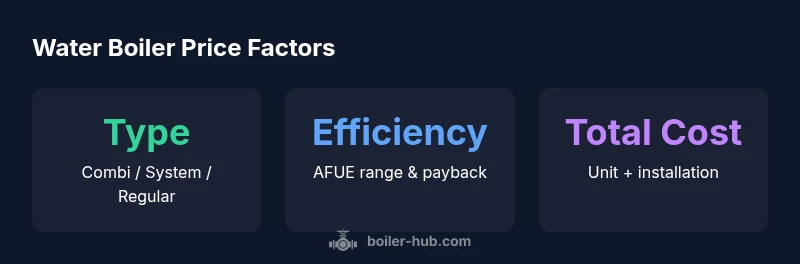
According to Boiler Hub, the price you pay for a water boiler is driven by several core factors: boiler type, system size, energy efficiency (AFUE), fuel source (gas, oil, or electric), and installation complexity. The term water boiler price is a helpful shorthand, but the total cost of ownership (TCO) matters more for budgeting. In smaller homes, a compact combi boiler may suffice and keep upfront costs lower, while larger households or multi-story homes may need a system or regular boiler with storage. Regional labor costs, venting requirements, and needed plumbing upgrades can add thousands to the bill. The Boiler Hub team emphasizes comparing quotes on a like-for-like basis, including installation, parts, and potential permit fees. Framing your decision around TCO helps ensure you don’t pay extra for features you don’t need while capturing meaningful energy savings over time.
Price Ranges by Boiler Type
Prices vary by the boiler type, which is the single biggest determinant of water boiler price. Here are typical installed price ranges you’ll encounter in many markets, not accounting for regional variations:
- Combi boilers: generally in the range of $2,000-$4,500. Pros include space savings and faster hot water, but they’re best for modest hot-water demand.
- System boilers: commonly $2,800-$5,000, with a separate hot water cylinder. Suitable for moderate-to-large homes with higher hot-water needs.
- Regular (heat-only) boilers: often $3,200-$6,000, paired with a storage tank and external controls. Best for homes with steady hot water demand from multiple outlets.
- Hybrid or high-efficiency boilers: typically $4,000-$7,000, especially when paired with heat pumps or advanced controls. These offer superior energy savings but a higher upfront price.
Note: These ranges exclude installation labor and any necessary venting or flue upgrades, which Boiler Hub analysis shows can add 20-50% to the project cost depending on the existing setup.
Installation Costs: What Adds to the Bill
Installation costs are a sizable portion of water boiler price. Beyond the basic unit, homeowners should budget for:
- Labor and diagnostics: Skilled technicians typically bill by the day, with higher rates in urban areas or high-demand seasons.
- Venting, flues, and piping: If your home lacks appropriate venting or if the existing flue needs upgrades, expect additional material and labor costs.
- Radiant and controls upgrades: Modern thermostats, zoning, and smart controls can raise upfront costs but improve comfort and efficiency.
- Permits and inspections: Local regulations may require permits, which add administrative steps and fees.
Boiler Hub analysis indicates that in many markets, the incremental cost of improved venting and controls pays back more quickly when the home is well insulated and the system is sized correctly.
Efficiency, Payback, and Operating Costs
Efficiency, measured as AFUE, is a central driver of long-term costs. Higher-efficiency boilers typically have higher upfront prices but lower annual energy costs. The gap can be meaningful over a decade, especially in colder climates or in homes with older insulation. When comparing options, consider:
- AFUE percentage and real-world performance under your climate.
- Local energy prices and how often you run hot water demand peaks.
- Maintenance needs and parts availability for each boiler family.
Boiler Hub analysis shows that the payback period for high-efficiency models can shorten when the home benefits from tight insulation and a well-sealed envelope. In contrast, poorly insulated homes may not realize full energy savings, extending the payback window.
Financing, Warranties, and Maintenance
Price is only part of the picture. Financing options can help spread cost, while warranties reduce risk. Many installers offer extended warranties or maintenance plans that cover annual inspections, part replacements, and priority service. When evaluating water boiler price, ask for:
- A transparent price quote with a full breakdown (unit, installation, venting, permits).
- Warranty terms for parts and labor (including exclusions).
- Maintenance packages and the cost of annual service to maintain peak efficiency.
Boiler Hub cautions readers to compare quotes from multiple licensed installers to avoid surprise charges and to ensure workmanship quality is not compromised for a lower upfront price.
How to Compare Quotes Without Getting Overcharged
Use a structured comparison approach so every quote reflects the same scope. Key steps include:
- Request a detailed, itemized quote that separates unit price, installation labor, venting, permits, and any added components.
- Check that sizing matches the home’s heat load and hot-water demand; an oversized unit can waste money.
- Confirm local code compliance, venting adequacy, and the need for additional electrical or gas upgrades.
- Compare operating costs estimates using the same fuel type and climate assumptions.
Remember: cheaper upfront price may lead to higher operating costs or shorter system life. The goal is the best combination of reliability, efficiency, and total cost of ownership.
Practical Scenarios: Small Home vs Large Home vs Retrofit
In a small apartment with modest hot-water needs, a compact combi boiler may deliver water boiler price efficiency: expect installed prices in the lower half of the range, with quick payback if insulation is decent. For a large multi-story home, a system or regular boiler with a storage tank tends to be more reliable, though installation costs rise. A retrofit scenario—upgrading an aging system in a 20-year-old home—often requires ductwork checks, vent upgrades, and potential radiator reconfigurations, which can push costs higher but deliver stronger long-term savings.
Maintenance and Long-Term Value
Maintenance is a cost factor that affects the total cost of ownership. Regular servicing helps prevent breakdowns and keeps efficiency high. In addition to routine annual checks, consider flushing the system, inspecting the expansion vessel, and verifying pressure relief components. A well-maintained boiler tends to run more reliably and can preserve efficiency gains over time. When weighing water boiler price, the long-term performance and serviceability are as important as the initial installation cost. The Boiler Hub team emphasizes building a maintenance plan into your purchase decision so you’re not surprised by running costs later on.
Boiler Hub's Practical Verdict
Boiler Hub's verdict is clear: prioritize total cost of ownership over upfront sticker price. Size the system correctly for your home, choose a high-efficiency model if your climate and insulation support the investment, and pair it with a solid maintenance plan. By focusing on efficiency, installation quality, and future-proof controls, homeowners can minimize water boiler price surprises while maximizing comfort and savings.
Pricing by boiler type and installation considerations
| Boiler Type | Typical Installed Price Range | Pros | Cons |
|---|---|---|---|
| Combi boiler | $2,000-$4,500 | Space-saving; instant hot water | Limited hot water when multiple outlets in use |
| System boiler | $2,800-$5,000 | Good for larger homes; separate hot water cylinder | Requires hot water cylinder and more space |
| Regular boiler | $3,200-$6,000 | Strong for frequent use; straightforward repairs | Larger footprint; needs storage tank |
| Hybrid boiler | $4,000-$7,000 | Highest efficiency; good with renewables | Higher upfront cost |
Questions & Answers
What primarily determines water boiler price?
Price is driven by boiler type, size, efficiency, fuel source, and installation complexity. Don’t overlook venting, permits, and potential upgrades to the utility room. When comparing quotes, ensure the scope is consistent across options.
Price mainly depends on type, size, and installation needs, plus any venting or permit work.
Are installation costs included in boiler price?
Most quotes show the boiler price separately from installation costs. Always request a detailed breakdown to avoid hidden charges and verify that venting, piping, and permits are included or clearly priced.
Installation costs are usually separate; ask for a detailed breakdown.
What is a reasonable payback period for a high-efficiency boiler?
Payback depends on energy prices, climate, and insulation. Typical ranges are 4-8 years, with shorter periods if the home is well insulated and energy prices are high.
Payback is usually several years, influenced by energy costs and home insulation.
Should I finance a new boiler purchase?
Financing can make upgrading affordable by spreading the cost. Compare loan terms with warranty coverage and maintenance deals to ensure long-term value.
Financing can help—weigh terms against warranties and maintenance costs.
How often should a boiler be replaced?
Boilers typically last 10-15 years with proper maintenance. Replacement timing depends on efficiency, repair frequency, and the cost of ongoing upkeep.
Most boilers last a decade or more with good care; replace when repairs become frequent or efficiency drops.
“Price is only part of the equation. To make a solid buying decision, homeowners should weigh total cost of ownership, including installation, maintenance, and energy use.”
Key Points
- Prioritize total cost of ownership, not just upfront price
- Size the boiler correctly to avoid overspending or undersizing
- Expect installation work to influence total water boiler price significantly
- High-efficiency models save energy and may shorten payback in well-insulated homes
- Always compare quotes with a detailed price breakdown and local code considerations