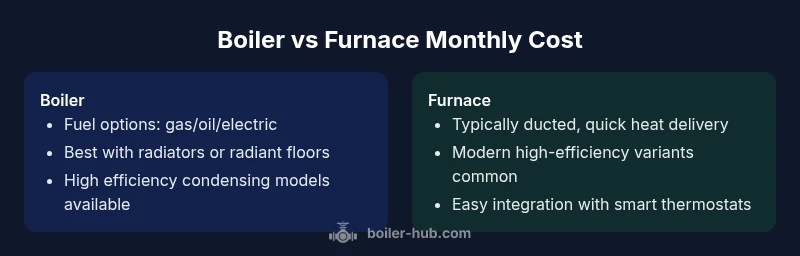
Boiler vs Furnace Monthly Cost: A Side-by-Side Analysis
Explore boiler vs furnace monthly cost to understand which heating system saves you more each month. Learn about fuel effects, efficiency, and maintenance, with practical steps to estimate costs for your home.


Boiler vs furnace monthly cost depends on fuel type, system efficiency, and how you heat your home. In practice, high-efficiency boilers or furnaces can trim bills, but local energy rates and climate often determine the final amount. This quick comparison helps you grasp which option tends to cost less per month in common scenarios.
Total Cost Framework
Cost for heating isn't a single line item; it's a framework. When comparing boiler vs furnace monthly cost, you must account for three primary components: energy or fuel bills, maintenance and service, and investment costs amortized over time. The monthly cost is the sum of ongoing energy consumption plus fixed charges and occasional repairs. For homeowners, the simplest approach is to separate variable energy costs from fixed, maintenance-related costs, then compare how each system influences those components. In this context, the boiler vs furnace monthly cost depends on factors like climate, home airtightness, and occupancy patterns. According to Boiler Hub, climate and energy rates often trump the choice of equipment when you look at month-to-month spending. That means an efficient unit isn't automatically cheaper if you live in an area with high electricity costs or if you run the system excessively. This section sets the stage for a practical, math-informed comparison that you can apply to your home.
Fuel Types and Their Impact
Fuel choice is a primary driver of boiler vs furnace monthly cost. Boilers can run on natural gas, oil, electricity, or in some cases propane, and the fuel choice interacts with heat distribution (radiators or radiant floor vs air). Furnaces are typically gas or oil powered, with electric heat pump-fused options in some setups. The monthly cost implications arise from fuel price volatility and conversion efficiency at the point of use. In practice, a gas boiler may cost less to run than an electric furnace in regions with cheap natural gas, while an electric furnace can be cheaper in areas with inexpensive electricity and good heat pump integration. Boiler Hub analysis shows that local utility tariffs, the availability of district heating, and seasonal demand pattern largely determine which path yields a lower monthly cost for a given home.
Efficiency Metrics Without Getting Lost in Numbers
Efficiency is the decisive lever in boiler vs furnace monthly cost. Look for high-efficiency designs and clearly stated AFUE (for boilers) or HSPF/COP (for heat pumps paired with furnaces). Rather than chasing a single percentage, compare how well each unit converts fuel into usable heat, how well it reduces standby losses, and how the control system responds to changing loads. A highly efficient boiler or furnace can reduce your monthly energy consumption, but gains hinge on proper installation, good insulation, and a thermostat strategy that avoids overheating or overcooling. Boiler Hub confirms that efficiency matters most when energy prices are volatile or when your home is well insulated but poorly sealed.
Climate, Insulation, and Usage Patterns
Climate determines how many months per year you actually heat the home and how aggressively you need to run the system. A cold climate with long heating seasons usually magnifies monthly cost differences between boiler vs furnace options, especially if your home has poor insulation. The thermostat strategy matters too: a programmable or smart thermostat can shave a significant portion off monthly bills by smoothing demand. Occupancy patterns—whether people are home during the day, at night, or away on weekends—also influence cost. In practice, boiler-based hydronic systems often pair well with well-sealed envelopes and radiators, whereas forced-air furnaces gain from zoned heat control and modern air-sealing practices. As Boiler Hub notes, climate and usage profile shape the final monthly cost more than the raw equipment label.
Installation, Maintenance Costs, and Hidden Fees
Beyond ticket price, the ongoing monthly cost is affected by maintenance cycles, parts availability, and service contracts. Boilers may require periodic pressure checks and boiler-water treatment, while furnaces need burner cleanings and vent maintenance. Older equipment tends to cost more to run and fix, which raises the monthly burden over time. If you budget for annual tune-ups and potential replacements, you’ll avoid surprise spikes in your heating bill. In some regions, unions or local regulations influence maintenance frequency and required inspections, subtly shaping monthly costs over the years. Boiler Hub highlights that maintenance quality and timely repairs can swing the monthly expense by a meaningful margin.
Real-World Scenarios: When One Typically Wins
In practice, the boiler vs furnace monthly cost story often hinges on home layout and existing infrastructure. Homes with hydronic systems and radiators tend to see cost advantages from boilers, especially when high-efficiency condensing models are installed and climate demands are moderate. In older homes with forced-air ducts, a modern, well-sealed furnace can deliver lower monthly costs when paired with efficient filtration and zoning. Large homes with uneven heat distribution can favor boilers for uniform comfort and fewer temperature swings, while smaller, well-insulated residences may benefit from a furnace with smart zoning. The takeaway is to map your home’s layout and local prices to identify the better value over a heating season.
A Step-by-Step Guide to Estimating Your Monthly Cost
Estimating your monthly cost begins with a mechanical frame and ends with a practical budget. Follow these steps: 1) determine your desired heat load in BTU per year, 2) select an option’s efficiency rating (AFUE, HSPF, COP) and note any seasonal deratings, 3) estimate monthly energy consumption by applying the load to the efficiency curve, 4) multiply by your local energy price, and 5) add fixed maintenance and service costs divided by 12. Use the general formula: Estimated monthly cost ≈ (Seasonal heating load) × (1 / system efficiency) × (price per unit of energy) + monthly maintenance. Boiler Hub recommends running this calculation for several climate scenarios to capture worst-case and typical months.
Smart Upgrades and Practices to Lower Monthly Costs
If you want to reduce boiler vs furnace monthly cost, consider focused improvements: install a programmable or learning thermostat, add zoning to avoid heating unused spaces, seal leaks around ducts or radiators, and schedule annual tune-ups. For boilers, consider condensing models that maximize heat extraction from exhaust gases and pairing with radiant or hydronic distribution for efficiency gains. For furnaces, ensure proper duct sizing, high-quality filters, and sealed combustion units. These upgrades often pay for themselves through lower monthly bills and improved comfort, a claim Boiler Hub supports with practical field guidance.
Common Pitfalls and Misconceptions
Many homeowners misinterpret efficiency ratings as monthly savings. In reality, efficiency is one factor among many, including climate, insulation, and thermostat behavior. Don't neglect standby losses, maintenance intervals, or the cost of fuel switching when evaluating boiler vs furnace monthly cost. Another frequent error is ignoring the cost of duct or radiator retrofits necessary to realize efficiency gains. Finally, be wary of marketing claims that promise dramatic savings without addressing installation quality or proper system commissioning.
Professional Guidance and Next Steps
The decision between boiler vs furnace monthly cost should be guided by a professional assessment. A qualified HVAC contractor can perform a heat-load calculation, inspect insulation and ductwork, and propose a solution tailored to your climate and utility rates. When you compare quotes, ask for a long-term energy use projection, a maintenance schedule, and potential rebates or incentives. The Boiler Hub team recommends starting with a home energy audit and an itemized cost model to avoid overpaying for features you do not need.
Comparison
| Feature | Boiler | Furnace |
|---|---|---|
| Fuel flexibility | Gas/oil/electric options; radiators or radiant floors | Gas/oil; ducts and forced-air |
| Efficiency focus | High-efficiency condensing variants common | Modern high-efficiency variants common |
| Monthly cost drivers | Fuel price, thermostat behavior, standby losses | Fuel price, thermostat behavior, duct efficiency |
| Best for | Hydronic systems, radiant heating, quiet spaces | Cold climates with good ductwork and zoning |
| Typical upfront costs | Higher upfront for high-efficiency systems | Higher upfront for complete ductwork or modernized furnace |
Advantages
- Potential lower monthly energy costs with efficient units
- Compatibility with hydronic or radiant systems
- Strong service networks and long-term reliability
- Ability to zone heat for targeted comfort
The Bad
- Higher upfront costs and installation complexity
- Maintenance varies by fuel type and system age
- Ductwork or radiator retrofits may be required
- Efficiency gains depend on proper sizing and commissioning
Neither option is universally better for every home
Choose boiler if you have radiators or radiant heat and climate favors a hydronic approach; choose furnace if you rely on ducts and want fast heat; base your choice on climate, home layout, and energy rates.
Questions & Answers
Which is typically cheaper to run: a boiler or a furnace?
There is no universal answer. Running costs depend on fuel prices, efficiency, and how you heat your home. In some regions a high-efficiency boiler saves more per month, while in others a well-insulated furnace may be cheaper.
Costs depend on fuel and efficiency; there's no one-size-fits-all answer.
How should I estimate monthly costs for my home?
Start with your heating load, select an efficiency rating, and apply local fuel prices. Add a fixed monthly maintenance cost and adjust for climate. Use a simple formula to compare boiler vs furnace monthly cost.
Estimate with a simple heat-load model and local prices.
Can switching from a boiler to a furnace save money?
Often yes, if your ducts are efficient and your home heats quickly with ducted air. However, installation costs and potential ductwork upgrades can offset monthly savings.
Switching can save money if ducts and climate align.
Do electric alternatives always cost more to run?
Not always. Electric options can be cheaper in areas with very low electricity rates or when paired with heat pumps. Evaluate local tariffs and seasonal demand before deciding.
Electric can be cheaper where rates are low and heat pumps perform well.
How do thermostats and zoning affect costs?
Smart thermostats and zoning can dramatically reduce monthly costs by avoiding heat in unused spaces and optimizing heat delivery. Properly sized equipment also matters for efficiency.
Smart thermostat and zoning reduce costs.
Are there rebates or incentives that impact monthly costs?
Yes. Rebates and incentives for high-efficiency upgrades can lower upfront costs and improve long-term monthly savings. Check local programs and utility offerings.
Rebates can improve both upfront and monthly costs.
Key Points
- Assess climate and fuel prices before deciding
- Use a cost-model to compare monthly running costs
- Prioritize zoning and insulation to maximize savings
- Plan for maintenance in monthly budget
- Consult a pro for a tailored assessment