Boiler or Furnace: Which Is More Efficient?
A practical, in-depth comparison of boiler and furnace efficiency to help homeowners decide which heating system delivers better long-term value.


According to Boiler Hub, the question 'boiler or furnace more efficient' hinges on design, fuel, and climate. In most modern setups, high-efficiency boilers outperform older boilers, and furnaces with ECM blowers and good duct insulation can rival boiler performance in very cold areas. For homeowners, the best choice depends on your home's heating load, fuel availability, and maintenance habits.
Why 'boiler or furnace more efficient' matters for homeowners
Heating efficiency is more than a label on a spec sheet. For homeowners, choosing between a boiler or a furnace shapes comfort, energy costs, and long-term reliability. The phrase boi ler or furnace more efficient often surfaces in cold climates where a fast, even heat is desirable, but it also matters when you have radiant heat or ducted air to consider. According to Boiler Hub, the decisive factors are climate, insulation, and how heat is distributed in the home. A modern, well-sized system can deliver substantial comfort with modest energy waste, while a mismatched setup—such as an oversized furnace in a well-insulated house or a boiler paired with leaky radiators—erodes efficiency and raises costs. The goal is to maximize heat output relative to fuel input, not merely to chase peak efficiency ratings. This requires evaluating the whole home and its heating pattern, not just the equipment label.
How Efficiency Is Measured in Boilers and Furnaces
Efficiency in home heating is typically described using fuel utilization metrics that compare input energy to usable heat. For boilers and furnaces, this is often expressed as a form of AFUE, with higher values indicating less fuel wasted per unit of heat. Condensing boiler technology, heat exchanger design, and burner controls can all push efficiency higher, while a low-efficiency setup loses more heat through venting and standby losses. In practice, the best-performing units achieve the least waste for a given climate, but real-world results depend on proper installation, routine maintenance, and correct sizing. This section explains how AFUE, heat distribution, and equipment controls translate into tangible energy savings in everyday use.
Key Design Differences that Impact Efficiency
- Heat distribution method: Boilers deliver heat through water-based systems (radiant floors, baseboard) that can minimize heat losses, while furnaces rely on warmed air distributed via ducts, which can lose energy through ductwork if not sealed.
- Heat source and exchanger design: Condensing systems recover extra heat from exhaust and improve efficiency, especially when paired with effective venting and proper vent condensation management.
- Burner technology and controls: ECM motors and modulating burners allow closer matching of heat output to demand, reducing waste and cycling losses. PSC vs ECM blowers in air-handling equipment influence air stratification and comfort.
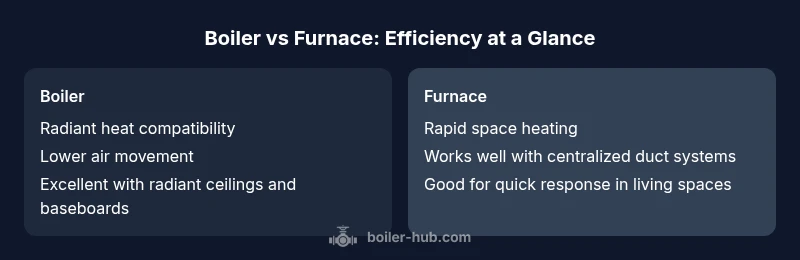
- System integration: Boilers often pair with radiant or baseboard heating, reducing air movement and noise, whereas furnaces are optimized for rapid space heating via forced-air distribution. The choice affects not just efficiency numbers but daily comfort and noise levels.
- Venting and insulation: Good venting, tight ducts, and well-insulated pipes reduce standby losses and improve overall efficiency, especially in older homes undergoing retrofit.
Climate and Home Configuration: When a Boiler Shines vs When a Furnace Excels
In very cold climates, furnaces with high-efficiency blowers can deliver quick heat to living spaces, which some homeowners value for rapid comfort. However, boilers excel where radiant heat is practical, such as homes with hydronic systems, radiant floors, or baseboard heating. Boilers also minimize air movement, reducing dust circulation and temperature swings. If your home has an established radiator or underfloor system, a properly sized boiler often produces steady comfort with lower energy waste. Conversely, if you rely on central air for cooling and prefer fast room-by-room control, a furnace paired with a well-sealed duct system can be advantageous. The climate, plus insulation and air leakage, ultimately determines which option achieves higher real-world efficiency.
Fuel Type and Its Role in Efficiency
Fuel availability and cost influence the practical efficiency of either option. Gas-fired units generally offer reliable efficiency and easy fuel access in many regions, while electric heat can be highly efficient at the point of use but might incur higher operating costs depending on off-peak pricing. Oil-fired systems, though less common in residential settings, also provide robust heat but come with different maintenance and fuel price dynamics. The key is to match the fuel type to local cost structures and to ensure the system is designed for that fuel with appropriate combustion efficiency, venting, and safety measures. An efficient boiler or furnace depends on proper conversion, venting, and combustion control more than the fuel label alone.
Maintenance, Sizing, and Installation: Hidden Factors That Change Real-World Efficiency
Even the most efficient boiler or furnace can underperform if it is not correctly sized for the home or if the ducts and radiators are leaky. Sizing mistakes lead to short cycling, heat losses, and uneven temperatures—each eroding efficiency. Regular maintenance—fuel checks, burner tuning, filter replacement for air-handling units, duct sealing, and inspecting hot-water piping—helps preserve energy performance. A well-trained technician should verify that pipes, valves, expansion tanks, and heat exchangers stay within design parameters. In addition, zoning and thermostats should be configured to minimize temperature swings and optimize energy use across different areas of the home.
Real-World Scenarios: Case Comparisons
- Scenario A: A multi-story home with old but well-sealed ducts and radiant heating in a cold climate may achieve higher apparent efficiency with a modern condensing boiler because the radiant system minimizes duct losses and provides consistent warmth.
- Scenario B: A single-family home with an open floor plan and a central-air cooling system could benefit from a high-efficiency furnace; the duct network is used for both heating and air distribution, making the furnace a practical choice when ducts are well-sealed and insulated.
- Scenario C: A retrofit where radiant heat is introduced or expanded may justify a boiler with compatible distribution, but only if the installation includes thorough insulation and minimal radiation losses. In all cases, correct sizing, proper venting, and system balancing are central to achieving the best efficiency.
Economic Considerations: Upfront Costs, Operating Costs, and Payback
Upfront costs for boilers and furnaces vary by size, installation complexity, and existing infrastructure. In many markets, boilers may require more extensive retrofits if there is no existing hydronic loop, while furnaces may trigger ductwork upgrades or replacements. Operating costs hinge on fuel prices, system efficiency, and usage patterns. Long-term value comes from a combination of initial investment, reliability, maintenance needs, and the ability to maintain consistent comfort at reasonable energy use. Homeowners should factor in potential tax incentives, local rebates, and the expected lifespan of equipment when evaluating the overall cost-to-value equation.
How to Decide: A Step-by-Step Checklist to Choose Between Boiler or Furnace
- Assess your heating distribution: Radiant or hydronic systems favor boilers; forced-air systems favor furnaces.
- Evaluate climate and comfort priorities: If you want even comfort with low noise, consider boiler-based radiant solutions; if you value quick heat delivery to multiple rooms, furnace may be preferable.
- Inspect ductwork and insulation: Leaky ducts reduce furnace efficiency and can tilt the balance toward a boiler with radiant heat.
- Compare fuel costs and availability: Choose the unit that aligns with local fuel economics and your reliability of supply.
- Plan for maintenance and upgrades: Ensure proper sizing, venting, and regular service to maintain efficiency.
- Get a professional load calculation: A detailed assessment helps select the most efficient option for your home.
Comparison
| Feature | Boiler | Furnace |
|---|---|---|
| Primary heat distribution | Hydronic/radiant-based systems (radiators/baseboard) | Forced-air through ducts (central heating) |
| Efficiency potential (AFUE/tech) | High potential with condensing boiler and radiant design | High potential with high-efficiency furnace and ECM blower |
| Ductwork requirement | Less dependent on ducts (if radiant heat exists) | Dependent on well-sealed, efficient ducts |
| Sound and comfort | Quiet operation; no air movement noise | Air movement and blower noise possible |
| Maintenance considerations | Fewer moving parts; boiler maintenance focused on heat exchanger and controls | More moving parts (blower, filter, ducts) requiring regular service |
| Best for climate | Best with radiant heat, good for areas with low duct losses | Best for homes needing rapid, uniform space heating via ducts |
Advantages
- Potential for long-term energy savings with proper sizing
- Flexible fuel options in some regions
- Good compatibility with radiant heating systems
- Quiet operation and stable comfort in well-insulated homes
The Bad
- Higher upfront installation costs for boilers or radiant systems
- Ductwork integrity heavily affects furnace efficiency
- Maintenance costs can be higher if equipment is older or mismatched
- Complex retrofits may be required for radiant systems
Boiler and furnace efficiency are context-dependent; the better choice is the system that minimizes heat loss for your home.
Choose a boiler if you have or plan radiant heating and minimal duct losses; choose a furnace if you prioritize fast, uniform heat and a well-sealed duct network. Accurate sizing and professional installation are key to achieving the best efficiency in either path.
Questions & Answers
What does AFUE stand for and why does it matter when comparing boilers and furnaces?
AFUE stands for Annual Fuel Utilization Efficiency. It measures how efficiently a heating system converts fuel into heat over a typical year. A higher AFUE indicates less fuel waste, but real-world results depend on installation quality, maintenance, and climate.
AFUE means Annual Fuel Utilization Efficiency. It tells you how well the unit uses fuel over a year, so higher AFUE usually means lower fuel bills if the system is sized and installed correctly.
Can a furnace be more efficient than a boiler in very cold climates?
In extremely cold conditions, a high-efficiency furnace can feel more responsive due to rapid space heating, especially if the ducts are well insulated. However, boilers with radiant heat can deliver steady warmth with less heat loss through air movement. The efficiency outcome depends on proper sizing and system matching to climate and home design.
In very cold climates, a furnace can feel quicker to heat rooms, but a well-designed boiler with radiant heat can keep heat steady with less waste.
Are boilers better for radiant heating than furnaces?
Boilers are inherently suited to radiant heating systems, delivering consistent warmth through water-filled pipes and radiators. This often translates to steady comfort and reduced air movement. Furnaces can provide radiant heat indirectly in some setups, but their strength lies in forced-air distribution rather than radiant warmth.
Boilers work great with radiant heat; they’re built for it and keep things comfortable with less air movement.
Is it cheaper to install a boiler or a furnace?
Installation costs vary by home and existing infrastructure. Boilers may require additional piping or radiant components, while furnaces may need ductwork improvements. Either path can be cost-effective with proper sizing and contractor choice, and potential rebates should be explored.
Installation costs depend on your home setup; boilers may need radiant components, furnaces may need duct upgrades.
How does ductwork affect furnace efficiency?
Leaky or poorly insulated ducts waste energy and can dramatically reduce furnace efficiency. Sealing and insulating ducts, plus zoning controls, help realize closer-to-rated performance. Proper duct design is essential for achieving the best results from a central-air furnace.
Bad ducts waste energy and make furnaces seem less efficient; seal and insulate for best results.
Should I consider a heat pump instead of a boiler or furnace?
Heat pumps can be a compelling alternative in moderate climates or as a supplement in very cold climates with a heat pump, depending on electricity costs and climate. They often pair with mechanical systems to provide both heating and cooling efficiently, but site-specific factors and energy prices matter.
A heat pump can be a great option in milder climates or with supplemental heating in very cold spots, but check local costs.
Key Points
- Assess heat distribution first: radiant vs. air-based systems
- Prioritize proper sizing and professional installation
- Maximize duct and pipe insulation to protect efficiency
- Consider climate and fuel costs when choosing between options