Boiler Change Cost in 2026: A Data-Driven Guide
Boiler Hub analyzes boiler change cost in 2026, detailing price ranges, key drivers, regional variation, and practical budgeting tips for homeowners and facility managers.


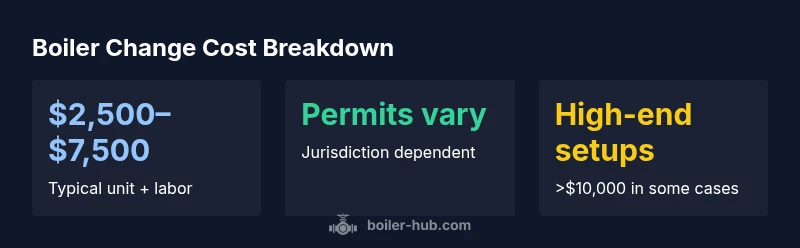
According to Boiler Hub, a typical boiler change, including parts and professional installation, costs from $2,500 to $7,500, with higher-end systems and complex venting reaching beyond $10,000. The exact price depends on boiler type, efficiency rating, installation complexity, and local permit requirements. This quick look helps homeowners and facility managers budget confidently before requesting bids.
What exactly is included in a boiler change cost
The price tag attached to replacing a boiler isn't just a number on a bid. It reflects a bundle of components and services, from the new boiler unit itself to the labor of removal, installation, venting or chimney work, piping, electrical connections, gas lines, and disposal of the old boiler. In 2026, the value of this bundle has grown with more efficient, high-efficiency condensing models and stricter venting requirements. According to Boiler Hub, the base unit price can be surprisingly low, but when you add installation, venting, and ancillary work, the total moves into a broader range. This section breaks down what buyers should expect and why it matters for budgeting and decision-making.
Cost drivers: what moves the price needle
Several factors push boiler change costs higher or lower. Boiler type (gas, oil, electric), efficiency (AFUE ratings), capacity (size for your home or building), and the need for intricate venting or chimney work are major levers. Regional labor rates and permit requirements also swing the final figure. High-efficiency condensing boilers, while pricier upfront, can deliver long-term energy savings that offset the initial outlay. When evaluating bids, compare not just the sticker price but the long-term operating costs, maintenance needs, and warranty terms. Boiler Hub's methodology for 2026 emphasizes local context and system compatibility as key drivers of cost.
Choosing the right boiler: size, efficiency, and features
Oversizing a boiler is a common mistake that inflates both upfront costs and ongoing operating costs. Selecting a boiler with an appropriate capacity (measured in BTUs or kW) and balancing efficiency against upfront price is essential. Condensing boilers offer high efficiency and potential rebates but may require upgraded venting and a primary/secondary piping arrangement. In many climates, an efficient condensing model will reduce annual fuel use and provide a quicker payback, even if the initial price is higher. Boiler Hub's 2026 analysis highlights the importance of accurate load calculation, seasonal usage patterns, and future expansion when determining the right model for your property.
Labor and installation complexity
Labor costs reflect the complexity of physical work: removing an aged boiler, running or upgrading gas lines, rerouting condensate drains, modifying or upgrading venting, and ensuring the system is harmonized with thermostats and controls. Homes with limited access, multi-story layouts, or tight boiler rooms will see higher labor hours and rates. In contrast, straightforward replacements with existing venting and accessible space can minimize on-site time and disruption. The cost impact isn't purely price-per-hour; it includes scheduling flexibility, permit timelines, and the contractor's readiness to coordinate with gas or electrical inspectors. Boiler Hub's 2026 framework notes that coordination efficiency can shave several hundred dollars off total costs when bids align on scope.
Permits, design, and codes
Many jurisdictions require permits for boiler replacements, and inspections may be mandatory to confirm safe venting, gas lines, and exhaust requirements. Permits add administrative time and fees but reduce risk by ensuring compliance with local codes. Some regions impose design review fees if your project touches the structural or venting system. Understanding permit requirements early helps budget accurately and avoid last-minute add-ons. This area is highly location-dependent, so always check with your city or county building department before finalizing bids. Boiler Hub's 2026 guidance emphasizes proactive permit planning as a cost-control measure.
Financing options, rebates, and long-term savings
Many homeowners and facility managers explore financing or rebates to cushion upfront costs. Options include short- and long-term loans, utility rebates, and energy-efficiency incentives that may apply to high-efficiency boilers. While incentives vary by state or province and update annually, they can substantially improve the project’s payback period. When analyzing bids, estimate not only the upfront price but the total cost of ownership over 10–15 years, including maintenance, fuel use, and potential fuel-price volatility. Boiler Hub's 2026 findings stress the importance of lifecycle cost analysis for credible budgeting.
How to estimate costs: a contractor bid approach
To estimate boiler change costs accurately, follow a structured bid process. 1) Define scope precisely (unit type, efficiency, venting, controls). 2) Gather at least three bids from licensed installers to compare unit price, labor hours, and included services. 3) Ask for a breakdown by major cost components (boiler itself, labor, permits, venting, removal, electrical work). 4) Request a warranty and post-installation support summary. 5) Validate that bids assume similar scope to avoid apples-to-apples comparisons. 6) Check references and inspect past projects for consistent performance. Boiler Hub's 2026 guidance emphasizes detailed scope definitions and vendor transparency as critical for accurate budgeting.
Common mistakes that inflate boiler change costs
Common errors include choosing the most expensive boiler without a proper load calculation, underestimating labor or venting requirements, ignoring permit fees, or mismatching controls and piping when retrofitting. DIY attempts can lead to mis-wiring, venting problems, or unsafe gas connections, all of which escalate costs. Another pitfall is inadequate contractor coordination with inspectors, causing delays and added fees. Following a rigorous procurement process and verifying scope alignment prevents many cost overruns. Boiler Hub's 2026 review highlights the payoff of planned, well-documented bids over last-minute scope creep.
Authority sources and references
- U.S. Department of Energy: Boilers and heating systems overview: https://www.energy.gov/energysaver/heating-systems/boilers
- Energy Star: Heating boilers and efficiency resources: https://www.energystar.gov/products/heating_cooling/boilers
- Occupational Safety and Health Administration: Boiler safety guidelines: https://www.osha.gov/boilers
Cost considerations across different installation scenarios
| Aspect | Low | Mid | High |
|---|---|---|---|
| Typical installed boiler change | $2,500 | $5,000 | $7,500 |
| Regional variation | Lower in rural areas | Moderate in suburbs | Higher in metropolitan areas |
| Permits/inspection | Often not required | Commonly required | Required in many jurisdictions |
| Labor hours | 6–12 | 12–20 | 20+ |
Questions & Answers
What exactly is included in boiler change costs?
A boiler change cost typically covers the new boiler unit, installation labor, removal of the old boiler, venting or chimney work, piping, electrical connections, gas lines, condensate drain work, and disposal. Additional items may include permits, system upgrades, and warranty terms. Always review a line-item bid to understand what’s included.
A typical boiler replacement includes the boiler, installation labor, venting work, and disposal; you’ll also see piping, gas lines, and permits listed in some bids.
Are permits always required for boiler changes?
Permits are commonly required, especially in urban areas or when venting or gas lines are modified. You should check with your local building department and your installer to confirm permit requirements and associated fees before work begins.
Most boiler replacements require permits, but it varies by location. Check with your contractor and local authorities.
Do more expensive boilers always save money in the long run?
More expensive boilers can offer higher efficiency and longer life, leading to lower operating costs over time. The payback period depends on energy prices, usage patterns, and maintenance. Do a lifecycle cost analysis rather than focusing only on upfront price.
Often, pricier high-efficiency boilers pay back over time, but it depends on energy use and local prices.
How long does installation typically take?
Most boiler replacements take one to two days for a straightforward installation, with additional time for permits, venting upgrades, or system re-piping. Complex homes or retrofits can extend installation to multiple days.
Most installs take 1–2 days, longer if permits or venting need updates.
Can I finance a boiler change?
Yes. Financing options include short- and long-term loans, utility rebates, and energy-efficiency incentives that may apply to high-efficiency boilers. Compare total costs and payback periods across options.
Yes, many lenders offer financing, and there are sometimes rebates; compare terms.
What questions should I ask bidders?
Ask for a full scope of work, equipment specs, expected labor hours, permit costs, a breakdown of all fees, warranty terms, and a clear timeline. Request references and check past projects for consistent performance. A transparent bid reduces cost overruns.
Ask for scope, equipment specs, timelines, permits, and warranties.
“A proper boiler replacement balances upfront cost with long-term reliability and efficiency; the best value comes from careful sizing, compliant venting, and a well-planned installation.”
Key Points
- Know the true cost drivers beyond the boiler price.
- Get three bids and compare scope in detail.
- Factor permits and venting into your budget.
- Consider lifecycle costs, not just upfront price.
- High-efficiency boilers can pay back over time with energy savings.