Why Does My Boiler Stop Heating? A Practical Troubleshooter
Discover why your boiler stops heating and follow a clear, safe troubleshooting flow with practical fixes, fault-code guidance, and prevention tips from Boiler Hub for homeowners and facility managers.


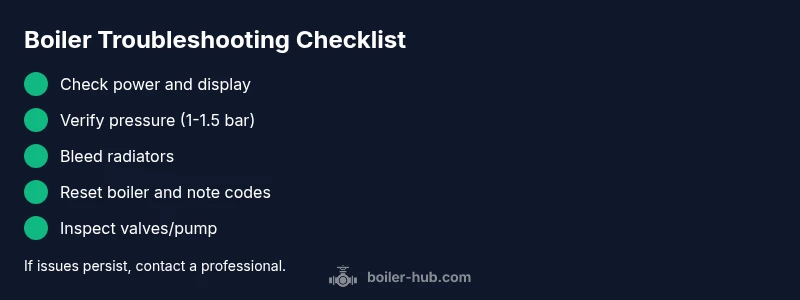
Most likely, the boiler stops heating due to low system pressure or a blocked/air-filled circuit. Start by checking the pressure gauge (aim for 1-1.5 bar when cold), bleed radiators to remove air, and top up pressure if needed. If heat still won’t return, note fault codes and consult the boiler manual or a pro.
Why does my boiler stop heating? A brand-backed overview
Boilers fail to heat for a handful of repeatable reasons, and fixing them quickly saves money and cold nights. According to Boiler Hub, the most common culprits are low system pressure, air trapped in the radiators or heat exchanger, a faulty thermostat, a diverter valve that won’t switch to heating, or a failing circulating pump. In many cases, the root cause is a routine maintenance item rather than a major component failure. Recognizing the pattern lets you act decisively and safely. The guidance here follows a methodical, symptom-to-solution flow to avoid guesswork. If you notice fault codes on the control panel, write them down before you begin work. Boiler Hub Analysis, 2026, emphasizes that small pressure changes or air pockets can masquerade as bigger faults, so test systematically.
This article targets homeowners and facility managers who want reliable, actionable steps to restore heating quickly and safely. Always prioritize safety: don’t touch live electrical terminals beyond your comfort level, and never ignore gas-safety warnings.
Check the basics first: pressure, power, and temperature
Before you dive into deeper diagnostics, confirm three basics. First, ensure the boiler is powered and the display is active. Second, check the pressure gauge; most systems want to sit around 1-1.5 bar when cold. If the pressure is too low, you’ll typically see a warning light or code. Third, feel radiators: they should heat from bottom to top, not just the surface. If radiators stay cold, the issue is often pressure or air. While you test, take note of any error codes (for example E1 or F on some models) as these point to a specific subsystem. After confirming these basics, you’ll be ready to perform targeted fixes with confidence and minimal risk.
Diagnostic flow: symptom → diagnosis → solutions
Symptom: No heat or very slow heating across the house.
Diagnosis: Start with the simplest checks (pressure, air, reset) and consult fault codes. If pressure is low, you likely need to top up. If air is trapped, bleeding will help. If a code points to the diverter valve or pump, that becomes the focus. If the boiler is cycling on/off without producing heat, thermostat wiring or ignition faults may be involved.
Solutions: Top up pressure if needed, bleed radiators, reset the boiler, replace or repair a faulty diverter valve, or service the pump. If none of these steps restore heat, you should contact a professional—especially if gas supply and ignition are involved.
Step-by-step: fix the most common cause
- Power down the boiler and allow it to cool slightly. 2) Check the pressure gauge and compare with the manufacturer’s range. 3) If pressure is low, locate the filling loop and carefully top up to the recommended level. 4) Bleed radiators starting with the highest ones to release trapped air. 5) Recheck pressure after bleeding and restart the boiler. 6) If heat is still absent, note any fault codes and perform a soft reset. 7) Inspect the thermostat settings and wiring for loose connections. 8) If the fault code persists, the diverter valve or pump is a common next target. 9) Call a professional if you smell gas, see a persistent leak, or if you’re unsure about any step.
Estimated time: 45-60 minutes.
Safety tips and common mistakes
- Always switch off the boiler and isolate the electricity before opening any panels.
- Do not force valves or remove pressure juggle attempts if you’re unsure of the system’s required pressure range.
- Never bleed radiators when the system is hot; hot water can scald you.
- If you smell gas, evacuate and call the gas emergency line immediately.
- Avoid repeated, unmonitored pressure top-ups; over-pressurizing can cause damage and leaks.
Prevention and maintenance to avoid future no-heat issues
Routine maintenance prevents many no-heat problems. Schedule an annual gas safety check, have the expansion vessel inspected, and bleed radiators as part of seasonal service. Keep a log of fault codes and maintenance actions so a technician can diagnose faster next time. Regularly check the pressure gauge, especially after long stretches of inactivity, and address any small pressure drops promptly. A well-maintained boiler heats more efficiently and lasts longer.
When to call a professional and how to choose one
If you identify dangerous symptoms (gas smell, sustained water leakage, or persistent fault codes after basic fixes), stop troubleshooting and contact a qualified heating engineer immediately. For non-emergency issues, compare two or three local Boiler Hub-approved technicians based on licenses, recent reviews, and transparent pricing. Ask about boiler service history and whether they offer a fixed-price diagnostic visit.
Steps
Estimated time: 45-60 minutes
- 1
Power down and cool the boiler
Turn off the boiler at the switch and disconnect the power supply. Allow 5-10 minutes for the system to cool before touching any components. This reduces the risk of burns and electrical shock.
Tip: Always double-check that the circuit is dead using a non-contact tester. - 2
Check boiler pressure
Look at the pressure gauge. If it’s below 1 bar when cold, you’ll need to top up with the filling loop according to the manual. Do not exceed the recommended maximum.
Tip: Use a clean container to catch any drips during top-up. - 3
Top up pressure if needed
Open the filling loop slowly to add water until the gauge reaches the target range. Close the loop firmly to prevent leaks, then restart the boiler and observe heat return.
Tip: Stop immediately if you see unusual hissing or leaking from connections. - 4
Bleed radiators
Starting with the highest radiator, use a radiator key to release trapped air until water comes out. Have a cloth ready to catch drips and monitor pressure as you go.
Tip: Bleed in a clockwise sequence from top floors down. - 5
Reset the boiler
After bleeding, reset the boiler using the reset button or according to the manual. Allow a full cycle to confirm heat returns to all radiators.
Tip: Note any error codes displayed during reset. - 6
Inspect controls and sensors
Check the thermostat settings and wiring for loose connections. If your system uses a smart thermostat, verify it’s communicating with the boiler.
Tip: Firmware updates can affect performance; ensure both devices are up to date. - 7
Assess moving parts
If heat remains spotty, the diverter valve or circulating pump may be faulty. Signs include uneven heating or noises. This typically requires professional service.
Tip: Don’t try to disassemble pumps or valves beyond basic inspection. - 8
Call a professional if unresolved
If fault codes persist or you smell gas, stop immediately and contact a qualified heating engineer. Gas safety is paramount.
Tip: Request a fixed-price diagnostic to avoid surprises.
Diagnosis: No heat or insufficient heating from the boiler
Possible Causes
- highLow system pressure
- mediumAir trapped in the system
- mediumFaulty thermostat or diverter valve
- lowFaulty circulating pump
- lowIgnition or flame sensor fault
Fixes
- easyTop up boiler pressure to the recommended range and re-test
- easyBleed radiators to remove air pockets
- easyReset boiler and check fault codes; consult manual
- mediumInspect thermostat wiring or replace diverter valve/pump if codes indicate
- hardCall a professional if gas safety is involved or if valves/pumps fail
Questions & Answers
Why is my boiler not heating even though it's on?
Common causes include low boiler pressure, air trapped in the system, a faulty thermostat, or a stuck diverter valve. Start by checking pressure, bleeding air, and fault codes. If unresolved, follow the step-by-step guide or seek a pro.
Common causes are low pressure, trapped air, or thermostat issues. Start with pressure and bleeding, then check fault codes, and call a pro if needed.
What does low boiler pressure mean and what should I do?
Low pressure usually means the system needs topping up. Check the pressure gauge (aim for 1-1.5 bar when cold) and use the filling loop as per the manual. If pressure drops again, there may be a leak.
Low pressure means you need to top up using the filling loop, then recheck. If it keeps dropping, there could be a leak.
Can air in the heating system cause no heat?
Yes. Air pockets prevent warm water from circulating. Bleeding radiators is typically the quickest fix and can restore heat in minutes if pressure is correct after bleeding.
Air can block circulation. Bleed radiators, then check pressure and test heat.
Is it safe to bleed radiators myself?
Bleeding radiators is safe if you follow proper steps and the system is cold. Avoid bleeding when the boiler is hot, wear gloves, and keep a cloth handy for drips. If you’re unsure, call a pro.
Bleeding is usually safe when cold and careful, but don’t hesitate to call a pro if unsure.
When should I call a professional?
Call a professional if you detect gas smells, major leaks, persistent fault codes, or if basic fixes don’t restore heat. A qualified technician can safely test gas, valves, and controls.
Call a pro for gas smells, leaks, or persistent faults after basic checks.
Is it safe to work on a boiler myself?
Boilers involve gas, electricity, and high pressure. Only perform non-hazardous tasks you’re comfortable with and consult a professional for anything beyond basic bleeding or reseating covers.
Boilers can be dangerous; do only simple tasks and contact a pro for complex work.
Watch Video
Key Points
- Check pressure first; it's the most common cause.
- Bleed radiators to remove air pockets.
- Note fault codes and reset before escalating.
- Call a professional for gas/safety issues or persistent faults.