What to do if your boiler stops working
Urgent, practical steps to diagnose and fix a boiler that stops working. Safe checks, pressure readings, fault codes, and when to call a professional—Boiler Hub's guide to keep you warm.


Most likely, your boiler stopped due to a power issue or a simple thermostat fault. First, ensure the boiler is on, check the trip switch and fuses, and reset if needed. Check the pressure gauge (aim for about 1 bar). If the fuel source or pilot is involved, avoid risky steps—call a pro if it doesn’t reset.
Immediate safety and quick checks
According to Boiler Hub, safety is the first and most important step when your boiler stops working. Before touching any heating equipment, ensure you and your household are safe. If you smell gas or hear a hissing gas sound, leave the area immediately, call the gas emergency number, and do not re-enter until professionals say it’s safe. For non-emergency scenarios, start with the basics: locate the boiler’s power switch or wall thermostat, confirm the circuit breaker is on, and check that the boiler is receiving power. Then, perform a quick reset if your model supports it and verify the display or status lights indicate normal function. Finally, check the pressure gauge; most boilers require a pressure around one bar when cold. If the gauge reads very low or very high, proceed with the steps below, but do not force components or open gas lines. The goal is to restore safe operation while avoiding dangerous improvisation.
Why boilers stop working: common causes
Boilers stop for a handful of predictable reasons. A power issue or tripped circuit breaker is the most common, followed by a faulty thermostat or controller. Low boiler pressure is another frequent trigger, especially in systems that haven’t been topped up in a while. Air trapped in the loop, a blocked condensate pipe, or ignition problems can also prevent firing. In winter, frozen pipes and vent blockages are practical culprits. Understanding these causes helps you prioritize checks: start with power and pressure, then move to controls, and finally inspect the fuel system with caution. According to Boiler Hub analysis, most calls for service begin with simple power and pressure problems that homeowners can identify and often fix themselves.
How to read pressure, heat, and status indicators
Your boiler communicates status through a pressure gauge, lights, and sometimes error codes on a small display. A typical healthy cold boiler sits around 1 bar; when hot, pressure may rise slightly but should not exceed about 2 bar. If the gauge drops significantly, you have a low-pressure issue that often requires repressurization. Look for fault codes on the display and refer to the manual or trusted guides; common codes often indicate issues with ignition, pumps, or sensors. For wireless thermostats, ensure batteries are fresh and that the thermostat is linked to the boiler. Keeping a small notebook of readings and codes helps when you call for service, as it saves time diagnosing the problem.
Diagnostic flow: symptom to diagnosis (overview)
Start with the symptom you observe: no heat, no hot water, or odd noises. Check basic power and pressure as the first two steps. If power and pressure are fine, inspect controls and the gas supply if applicable. Record any error codes and cross-check them with the boiler manual. If you can’t resolve the symptom after moving through these checks, you’ll want to escalate to professional service. This flow keeps safety first and helps you identify whether a DIY fix is feasible or not.
Step-by-step repair path: address the most common issue
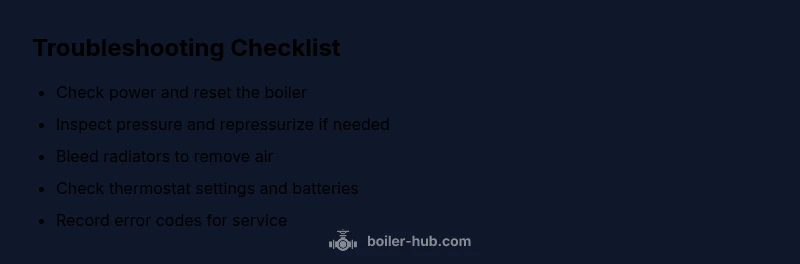
For the most common causes—power issues and low pressure—follow these steps with care. Step 1: verify the main power switch and reset the boiler if a reset option exists. Step 2: confirm the circuit breaker hasn’t tripped and that the fuse is intact. Step 3: check the boiler pressure gauge and repressurize if needed using the manufacturer’s guidance. Step 4: bleed radiators to release trapped air and improve circulation. Step 5: inspect the thermostat and replace batteries or re-sync the device. Step 6: test the boiler again. If the issue persists, proceed to professional intervention. Pro tips: never force components or attempt gas-related fixes unless you are trained and authorized to do so.
When to call a professional and safety concerns
If you notice gas smells, hissing sounds, or your own attempts at resetting do not restore heat or hot water, it’s time to call a professional. Gas work and combustion safety require licensed technicians. For electrical concerns, a qualified electrician should inspect exposed wiring or a tripped main breaker. Your safety and that of your household come first; never bypass safety devices or operate a boiler that shows signs of a dangerous fault. Regular maintenance is a key prevention measure that reduces the likelihood of unexpected breakdowns.
Maintenance tips to prevent future boiler failure
Preventive upkeep reduces emergency breakdowns. Schedule an annual boiler service with a qualified technician. Regularly check the expansion tank, pressure, and safety valve. Bleed radiators at the start of the heating season to maintain effective circulation. Keep an up-to-date list of error codes and model numbers for quick references. Use high-quality, compatible replacement parts and keep the area around the boiler clear of clutter. These proactive steps help you stay warm with fewer surprises.
Common mistakes and how to avoid them
Don’t skip safety checks or bypass any safety devices. Avoid adjusting gas valves without professional training. Don’t ignore unusual noises or temperature fluctuations; these signals may indicate air in the system, a failing pump, or a blocked vent. Finally, never attempt to diagnose or repair high-voltage or gas-related components without proper certification. Staying within the scope of your skills keeps you safe and preserves the boiler’s lifespan.
Preparing for winter and staying warm
Winter planning means having a robust contingency plan for boiler failure. Keep a temporary space heater for short-term warmth if it’s safe and permissible by local regulations, and ensure you have adequate dry, warm clothing for cold spells. Consider upgrading to a more reliable boiler or adding a secondary heating option if your climate is particularly harsh. A proactive maintenance schedule reduces the risk of an unexpected outage when you need heat most.
Steps
Estimated time: 60-90 minutes
- 1
Check power and reset
Begin by locating the boiler power switch and any reset button. If the display is dark, verify the wall outlet, power cord, and circuit breaker. Press reset if your model supports it and observe whether indicators return. This step eliminates simple power faults.
Tip: If the boiler doesn’t respond, check another appliance on the same circuit to confirm power at the outlet. - 2
Inspect breakers and fuses
Examine the electrical panel for a tripped breaker or a blown fuse. If you reset a breaker or replace a fuse, wait a minute and recheck the boiler. Reoccurring trips or blown fuses indicate a fault that requires an electrician.
Tip: Do not replace a fuse with a higher amperage to bypass a problem. - 3
Check boiler pressure
Look at the pressure gauge; if it’s below 1 bar when cold, you need to repressurize. Use the filling loop as per the manual to bring pressure up gradually. Do not overfill beyond 2 bar.
Tip: Slow, incremental adjustments prevent over-pressurization and potential damage. - 4
Bleed radiators
Air in the radiator circuit can prevent heat transfer. Use a radiator key to bleed at the top valve until a steady flow of water emerges. Close the valve promptly and recheck pressure after bleeding.
Tip: Bleed only when the system is cool to avoid scalding steam. - 5
Check thermostat and control settings
Confirm heat demand is set correctly, and the thermostat matches your home's needs. If it’s wireless, verify the receiver is paired with the boiler. Replace batteries if the display is erratic.
Tip: Compare actual room temperature to thermostat setting to avoid chasing ghost readings. - 6
Test the boiler after adjustments
Power the system back on and monitor for heat delivery. If you still have no heat, record any error codes and consult the manual or a professional. This step confirms whether DIY fixes resolved the issue.
Tip: Take photos of error codes for future service calls.
Diagnosis: Boiler won't fire or provide heat
Possible Causes
- highPower issue (tripped breaker or blown fuse)
- highLow boiler pressure
- mediumThermostat or controller fault
- lowGas supply or ignition fault
- lowAir trapped in the system
Fixes
- easyReset the breaker and replace a blown fuse; ensure the boiler is connected to power
- easyRepressurize the boiler following the manufacturer’s instructions
- easyCheck thermostat settings and replace batteries or re-link the thermostat
- hardIf ignition or gas supply issues persist, call a licensed professional; do not attempt risky fixes
- easyBleed radiators to remove air and improve circulation
Questions & Answers
What should I check first when my boiler stops working?
Start with safety, then verify power and the circuit, followed by pressure. If these basics don’t restore heat, check for error codes and consult the manual. Many fixes are simple and DIY-friendly.
First check safety, power, and pressure. If that doesn’t work, look at error codes and the manual before calling a professional.
Why is boiler pressure often the culprit?
Low pressure prevents the boiler from circulating water properly. Repressurizing with the filling loop, following the manufacturer’s steps, is a common DIY fix when safe to do so.
Low pressure can stop the heat. You can often repressurize safely with the filling loop per the manual.
Can I relight the boiler's pilot light myself?
If your boiler has a pilot light, follow manufacturer instructions. If you smell gas or cannot light it after several attempts, call a professional—gas work requires training and safety precautions.
Relighting may be possible with proper instructions, but if you smell gas or can't light it after a few tries, contact a pro.
Is it safe to bleed radiators when the boiler is off?
Bleeding is safest when the system is cool. Use a radiator key and catch any escaping water in a container. If you must bleed while hot, follow the boiler’s instructions and wear gloves to avoid burns.
Bleed only when the system is cool and follow the instructions to avoid burns or scalding water.
When should I service my boiler?
Annual servicing by a licensed technician is recommended. Regular checks help spot wear and corrosion, improve efficiency, and reduce the risk of sudden breakdowns.
A yearly service is best to keep the boiler reliable and efficient.
What if I smell gas after working on the boiler?
If you smell gas, leave immediately and call the gas emergency line. Do not operate electrical switches or flames near the area.
If you smell gas, leave the area and call the emergency line right away.
Watch Video
Key Points
- Start with safety and power checks before anything else.
- Check pressure; a cold gauge near 1 bar is typical.
- Waste no time with gas/ignition issues—call a pro.
- Bleed radiators to remove air and restore efficiency.
- Document fault codes for efficient service.