What to Do If Boiler Pressure Keeps Dropping: Troubleshooting Guide
Learn how to diagnose and fix boiler pressure drops safely. Step-by-step checks, common causes, and when to call a pro to restore reliable heat and hot water.


Most likely, your boiler pressure drops because of a small leak, a faulty expansion tank, or a failing filling valve. Start by inspecting visible leaks, then check the pressure gauge and top up to the recommended level. If pressure falls again, shut the boiler off and call a qualified technician.
Why boiler pressure drops occur and why it matters
Understanding what to do if boiler pressure keeps dropping starts with recognizing the warning signs and the risks. When pressure is too low, your boiler may cycle on and off, fail to heat water, or trigger safety lockouts. A drop can be caused by a small leak somewhere in the system, a faulty expansion tank, or a worn filling valve. In all cases, acting quickly protects your equipment and reduces the risk of radiator cold spots and uneven heating. According to Boiler Hub, 2026 analysis shows that homeowners who address pressure drops promptly are far less likely to suffer expensive repairs later. Start with the simplest checks: look for visible leaks, verify the gauge matches the boiler's paperwork, and keep a log of pressure readings to spot patterns. If you're uncomfortable with inspecting fittings or if you see signs of corrosion, postpone manipulation of heat settings and call a pro. In this article we walk through a safe, methodical approach to diagnose and fix common causes, so you can restore reliable heat and hot water as soon as possible.
Immediate checks you can perform before you touch any fittings
Before touching any valve or pipe, perform a quick safety scan: turn off the boiler and let it cool, wear gloves, and avoid touching hot surfaces. Start with visually inspecting for leaks around the boiler, pipes, radiators, and the expansion-tank area. Check the filling loop and any isolation valves for leaks or kinks. Then check the pressure gauge reading when the boiler is cold; compare it to the manufacturer's recommended range in your manual (often a specific psi range). If the reading is too low, you may need to top up. If you spot a stubborn leak or if topping up does not hold pressure, do not continue—this indicates a more serious fault that requires professional assistance.
Steps
Estimated time: 45-60 minutes
- 1
Power off and cool down
Shut off the boiler and allow it to cool for at least 30 minutes. This reduces the risk of scalding or accidental burns and makes valve manipulation safer.
Tip: Use protective gloves and a flashlight to inspect connections without rushing. - 2
Inspect for visible leaks
Carefully examine the boiler, connections, valves, radiators, and the expansion tank for damp patches or dripping water. Leaks are the most common cause of pressure loss and should be fixed or routed to professional service if you cannot locate or repair them safely.
Tip: Check under floors and behind panels where water might travel before showing up as damp around a valve. - 3
Check the expansion tank and air charge
A defective expansion tank or a low air charge can cause pressure fluctuations. If you have a fill line, ensure it is properly connected and not blocked. If you are unsure how to test the air charge, contact a professional.
Tip: If the tank is waterlogged, it will feel heavy and may need replacement. - 4
Top up pressure safely
With the boiler cool, open the fill valve slowly and monitor the pressure gauge. Stop as soon as the gauge reaches the recommended range noted in your manual. Do not overfill.
Tip: Open valves slowly to avoid a surge that could stress seals. - 5
Bleed radiators to remove air pockets
Use a radiator key on each radiator bleed valve to release trapped air until water flows steadily. Wipe spills immediately and recheck the system pressure after bleeding.
Tip: Work from the lowest radiator upward for best results. - 6
Test the system and monitor
Turn the boiler back on and let it heat the house. Recheck the pressure after a few hours of operation and again the next day to confirm stability.
Tip: Keep a simple log of readings to spot patterns.
Diagnosis: Boiler pressure drops after heating or during operation
Possible Causes
- highVisible or hidden leaks in pipes, radiators, or boiler casing
- mediumFaulty expansion tank or incorrect air charge
- lowMalfunctioning filling valve or pressure relief valve
Fixes
- easyTighten or repair leaking joints and seals; repair or replace damaged radiators; fix leaks promptly
- easyInspect expansion tank; recharge or replace as needed; adjust air charge according to boiler manual
- mediumTest and potentially replace filling valve or relief valve; pressure-test the system
Questions & Answers
Why does boiler pressure drop after heating?
During heating, metal expansion can cause small leaks or release air pockets; if pressure falls, check for leaks and expansion tank faults. Recurring drops require service.
Pressure can drop during heating due to leaks or air in the system; check expansion tank and leaks, and seek service if it repeats.
Is a leaking radiator a common cause of pressure loss?
Yes, even small radiator leaks can cause steady pressure loss. Look for damp patches and test each radiator connections. Repair or replace as needed.
Radiator leaks can cause pressure loss; inspect radiators and repair promptly.
Can I repressurize the boiler myself?
Repressurizing is possible if you follow the boiler manual and safety steps. If you are unsure, avoid continuing and contact a professional to avoid damage or scalding.
You can repressurize if you follow the manual, but if unsure, call a pro for safety.
What pressure should the boiler be when cold?
Most boilers specify a cold-start pressure within a small range noted in the manual. If you’re unsure, contact the manufacturer or a technician to confirm.
Cold-start pressure is usually specified in the manual; verify with the manual or a pro.
What is expansion tank and how does it affect pressure?
The expansion tank absorbs water volume changes. If it loses charge or fails, pressure can swing or drop. Test and replace if necessary.
Expansion tanks smooth out pressure; if faulty, pressure can drop or surge.
When should I call a professional?
Call a professional if pressure drops repeatedly, leaks are present, or safety devices trigger. A pro will diagnose leaks, test valves, and ensure safe operation.
If pressure keeps dropping or leaks are present, get a pro to diagnose and fix it.
Watch Video
Key Points
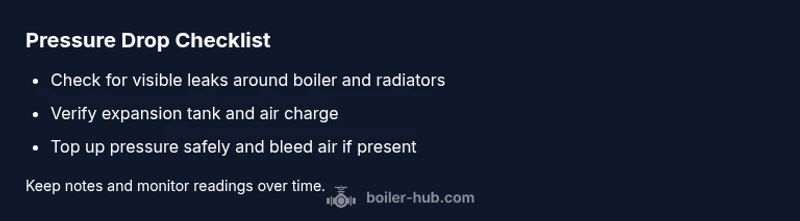
- Check for leaks first and fix them promptly
- Understand expansion tank status and air charge
- Recurring drops indicate a fault needing pro help
- Bleed radiators to remove air pockets when needed