What Happens When Boiler Overheats: A Practical Guide
Learn what happens when a boiler overheats, the risks involved, and practical steps to diagnose, fix, and prevent overheating. Expert guidance from Boiler Hub to keep your home safe.


When a boiler overheats, the water inside the heat exchanger can boil, creating excessive pressure that strains seals and vent paths. A relief valve may trip, steam can escape, or a system lockout may occur. Immediate steps: shut off power, cut power if safe, reduce thermostat demand, and call a qualified technician. Do not ignore warning signs or attempt risky DIY repairs.
What happens when boiler overheats
What happens when boiler overheats is a cascade of heat, pressure, and safety-system responses. The core problem is that water is unable to circulate and vent fast enough, so it reaches near-boiling temps inside the heat exchanger. When water becomes steam, pressure climbs, straining gaskets, seals, and joints. The boiler’s relief valve may vent; control logic may shut the unit off to prevent an explosion. In practice, you might notice banging, a rising pressure gauge, steam escaping from vents, or a hot-metal smell. If the system trips out or vents release, do not reset or bypass safety controls. Overheating signals a safety-critical condition that warrants professional inspection. Acting quickly protects people, equipment, and the building. Boiler Hub emphasizes that regular maintenance can reduce the likelihood of these events, but even a well-maintained system can overheat if flow is blocked or a valve fails. As of 2026, the safest course is to treat any overheating as urgent and contact a licensed technician.
Common causes of overheating
Several common causes can drive overheating. Air trapped in the piping or radiators prevents proper water circulation, which lets heat build up in the boiler. A faulty circulator pump or a blocked/dirty heat exchanger reduces flow and raises temperatures. The pressure control or safety relief valve can fail, failing to relieve pressure when needed. Low water level or improper feed water can also leave the system short of cooling capacity. Expansion-tank issues, such as a waterlogged tank, create pressure imbalances that push the system toward dangerous levels. Finally, scale buildup, sediment, or debris can insulate heat transfer surfaces, making the boiler work harder and overheat. The Boiler Hub team notes that even small blockages or weak controls can trigger overheating under load. If you notice unusual noises, frequent cycling, or unexpected high pressure measurements, schedule a professional inspection promptly.
Immediate safety steps to take
If you detect overheating signs, act with safety as the priority. First, turn off the boiler at the thermostat and, if safe, switch off the power to the unit. Do not attempt to open valves or vent the system yourself. A released steam jet or hot water spray can cause burns. If you smell gas or notice smoke, evacuate and call emergency services. Open doors to improve ventilation only after you’ve ensured the area is safe. Do not restart the boiler until a licensed technician has inspected the appliance and verified safe pressure and temperature levels. If a relief valve has vented, do not reseat it; tell the technician to evaluate the valve during service. Keep children and pets away from the boiler area until it’s inspected. By following these steps, you reduce the risk of injury and minimize potential property damage while you wait for professional help.
Diagnostic basics for homeowners
Diagnosing overheating is best left to professionals, but homeowners can observe and document symptoms to aid the technician. Note the pressure gauge reading and whether the relief valve has vented. Document noise, erratic cycling, and any unlocks or lockouts. Check for visible leaks on the boiler and nearby pipes, and verify that the expansion tank is not waterlogged (a pro will confirm with a pressure test). If the boiler uses an automatic feed, ensure the feed valve is open and not clogged. Finally, check that the thermostat and control wiring are intact and that there are no obvious gas supply issues if you have a gas-fired boiler.
Prevention and maintenance to avoid future overheating
Effective prevention combines regular professional service with simple home checks. Schedule an annual service with a licensed technician who will inspect safety devices, test the relief valve, verify expansion tank charge, flush the heat exchanger if needed, and check combustion efficiency. Between visits, monitor the system pressure, aiming for the typical residential range of 1-1.5 bar (or as specified by your boiler’s manual). Bleed air from radiators and ensure there are no invisible leaks. Replace worn gaskets and inspect piping for corrosion. For homes with radiant or hydronic systems, ensure pump operation is reliable and that pipes are sized to prevent flow restrictions. Proper venting and correct fuel-air ratio reduce the risk of overheating under heavy load.
When to call a pro and replacement considerations
Only a licensed technician should repair overheating problems that involve safety devices or internal components. If the unit continues to overheat after basic checks, if the relief valve keeps venting, or if there are signs of corrosion, cracks, or persistent leaks, plan service or replacement. A technician will assess whether the boiler is undersized for the home, whether pipework is misconfigured, or if the heat exchanger is failing. In some cases, replacing aging equipment with a modern, high-efficiency model may be more cost-effective than repeated repairs. The Boiler Hub team recommends evaluating long-term operating costs, energy efficiency, and safety features before deciding on replacement. Schedule proactive maintenance to extend life and prevent overheating.
Steps
Estimated time: 60-90 minutes
- 1
Prioritize safety and power down
Shut off the boiler at the thermostat and, if safe, cut the electrical supply. Do not touch hot surfaces. This prevents accidental ignition or burns while you inspect basic conditions.
Tip: Verify power and fuel supply are off before touching any boiler components. - 2
Check pressure and water level
Read the pressure gauge and ensure it is within the manufacturer’s safe range (generally around 1-1.5 bar for residential boilers). If pressure is too high, do not reset; wait for instructions or help from a pro.
Tip: Keep a note of the exact gauge reading for the technician. - 3
Bleed air from radiators
Starting at the highest radiator, open the bleed valve slightly with a radiator key to release trapped air. Close the valve once water appears instead of air. This improves circulation and cooling.
Tip: Only bleed when the system is cool; scalding steam can occur only if hot. - 4
Inspect the expansion tank and pump
Check for a visually waterlogged expansion tank or a noisy/failed circulating pump. A malfunction here reduces cooling capacity and raises boiler temperatures.
Tip: Listen for humming from the pump; a failed pump is a common overheating culprit. - 5
Refill and test restart
If safe, restore water to the recommended pressure and restart the boiler. Observe whether it cycles normally and monitor the pressure gauge for stability.
Tip: Do not exceed the recommended pressure; too high pressure can trigger relief valve again. - 6
Call a professional for a full service
If overheating recurs or you cannot verify the safety devices, call a licensed boiler technician. They will inspect safety controls, valves, and heat transfer surfaces.
Tip: Avoid DIY fixes for safety-critical components.
Diagnosis: Boiler overheats; pressure gauge climbs; relief valve trips; steam release
Possible Causes
- highAir trapped in system or poor water circulation
- highFailing pressure relief valve or pressure control
- mediumBlocked heat exchanger or restricted flow
- lowExpansion tank failure (waterlogged)
Fixes
- easyBleed air, check pump, replenish water, and recheck pressure to 1-1.5 bar
- mediumInspect/replace relief valve and controls by a professional
- mediumClean/flush heat exchanger; verify flow paths are clear
- hardReplace expansion tank or correct system balance
Questions & Answers
What causes boiler overheating?
Overheating is usually caused by restricted water flow, air in the system, or a faulty safety valve. A professional will diagnose which part is failing and how to fix it safely.
Overheating is usually caused by blocked flow, air in the system, or a faulty valve. A professional will diagnose the exact cause.
Is overheating dangerous for my home?
Yes. Overheating can lead to leaks, damaged components, or in rare cases a dangerous pressure buildup. Keep clearances and follow safety steps and call a pro.
Yes, it can cause leaks and damage, so call a pro as soon as safe.
Can I fix overheating myself?
DIY repairs on safety devices are not advised. You can perform non-invasive checks like bleeding air or verifying readings, but major work should be done by a licensed technician.
DIY fixes on safety devices aren’t advised. Leave major work to a pro.
What should I do if the pressure relief valve trips?
If the relief valve trips, shut off the boiler and call a professional promptly. Do not attempt to reseat or bypass the valve.
If the relief valve trips, shut the boiler down and call a pro.
How can overheating be prevented?
Schedule annual professional maintenance, monitor pressure, bleed air, check expansion tank, and ensure proper venting and safe operation under load.
Regular maintenance and listening for warning signs helps prevent overheating.
Watch Video
Key Points
- Act quickly when overheating signs appear.
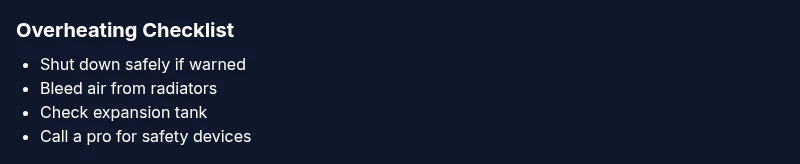
- Shut down safely and call a pro—do not DIY safety-critical parts.
- Regular maintenance reduces the risk of overheating.
- Monitor pressure and bleeding to maintain proper circulation.