Red Light on Boiler: Urgent Troubleshooting Guide for Home
Urgent guide to diagnosing and fixing a red light on your boiler. Learn safety steps, common causes, diagnostic flow, and when to call a professional. Boiler Hub analysis informs practical, trusted tips for homeowners and facility managers.


Immediate red lights on a boiler usually signal a safety fault. In most homes, the first steps are to cut power, shut off the gas valve if safe, and ventilate the area, then check pressure and reset if instructed in your manual. According to Boiler Hub, if the light persists, avoid DIY gas work and call a licensed technician.
Understanding red light indicators on boilers
A red light on a boiler is not just a decorative LED. It is a fault indicator that can signal a range of safety and operational issues, from pressure problems to ignition faults. Lighting patterns—steady, flashing, or pulsing—often map to different fault codes provided by the manufacturer. These codes help technicians pinpoint the likely cause without disassembling major components. For homeowners, recognizing that a red light is a fault, not a savings feature, is the first step toward a safe resolution. The Boiler Hub team emphasizes that red indicators should always be treated as urgent signals, especially if the light is accompanied by no heat, unusual noises, or burning smells.
If your boiler has a digital display, a fault code will usually appear alongside the red light. If there is no display, note the light’s pattern and consult the user manual or the manufacturer’s website for a code reference. Keep a log of any other symptoms—frost on pipes, visible leaks, or pilot flame behavior—as this helps a professional assess the issue more quickly.
Brand guidance from Boiler Hub suggests that most red-light events fall into a few broad categories: pressure issues (too low or too high), ignition or flame sensing faults, circulation problems, and safety interlocks triggered by a fault in one of the boiler’s subsystems. Understanding these categories helps you communicate clearly with a service technician and reduces diagnostic time.
Immediate safety steps to take
- If you smell gas or hear a hissing sound, leave the area immediately and call emergency services from a safe location.
- Turn off the boiler at the mains power switch if accessible and safe to reach; then shut off the gas supply valve only if you can do so without risk.
- Open windows or doors to ventilate the area and avoid creating a hazardous build-up of any gas or fumes.
- Do not attempt permanent DIY repairs on gas-fired equipment. Red lights can indicate dangerous conditions that require professional service.
When in doubt about gas safety, treat the situation as urgent. If the space is not safe, evacuate and call for help. Boiler Hub emphasizes safety-first decisions—they prevent needless injuries and costly damage to equipment.
Common causes behind a red light with or without heat
- Low or high water pressure: Modern boilers rely on a stabilized pressure range to ignite and circulate water. A red light can appear when pressure is outside the safe band.
- Ignition or flame failure: Faulty ignition electrodes, gas supply interruptions, or a dirty burner can prevent flame sensing, triggering a red alert.
- Sensor or control board fault: Corrosion, loose connections, or aging components on the control board can misreport status and illuminate a red light.
- Safety interlock or condensate issues: A blocked condensate line or safety switch can trip an interlock, preventing normal operation and flashing the red light.
Boiler Hub analysis notes that while some red-light events are recoverable with simple steps (like repressurizing), others point to deeper issues that require an inspection by a licensed technician. Categorizing the symptom helps determine whether you can safely perform a quick check or if professional service is required.
Diagnostic approach: what to check first
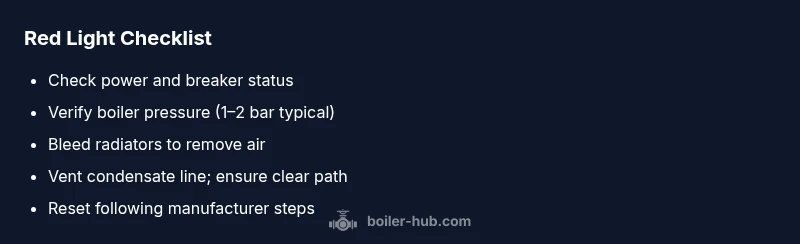
- Verify power and breaker status: a tripped circuit can cause the boiler to reset and trigger an alert even if nothing else is wrong.
- Check the pressure gauge: most boilers operate safely within a defined range (commonly around 1–2 bar when cold). If the pressure is outside this range, don’t attempt risky adjustments; consult the manual before proceeding.
- Inspect the venting and condensate pipe: blockages or frost on the vent can generate alarms. Ensure the vent is clear and the condensate line is unobstructed.
- Listen for noises and observe leaks: banging, hissing, or puddles near the unit indicate water or gas issues that demand professional evaluation.
- Review recent changes: new thermostats, recent power outages, or upside-down wiring can trigger fault conditions. Document any recent changes to tell a technician exactly what happened.
Using a structured approach streamlines the process and minimizes guesswork. If the red light persists after these checks, prepare for a step-by-step diagnostic and, if needed, service from a Boiler Hub–trusted professional.
Step-by-step fix for the most common cause: low pressure or air in the system
- Confirm the symptoms and safety: ensure the area is safe, no smell of gas, and power is accessible.
- Check the boiler pressure gauge: if the needle sits below the recommended range, the system needs repressurization.
- Repressurize per the manual: locate the filling loop, slowly open the valve(s), and watch the pressure rise to the safe range. Close valves once the target is reached.
- Bleed radiators to remove trapped air: use a radiator key to release air at each radiator until a steady stream of water emerges.
- Reset the boiler: after repressurizing and venting, follow the manufacturer’s reset procedure to clear faults.
- Test operation: reassemble any access points, turn the boiler back on, and observe whether the red light reappears.
- If the light returns or you face difficulties repressurizing, stop and call a professional. Persisting red lights often require a service call to check for leaks, valve faults, or sensor issues.
Tip: Keep a fault-code log and any brand-specific steps on hand for your technician. This helps reduce diagnostic time and ensures the correct parts are checked.
Estimated safety note: If you cannot safely repressurize, vent, or reset, do not continue. Call a licensed technician immediately.
Prevention and maintenance to avoid future red lights
- Schedule annual boiler service with a qualified technician to catch wear and corrosion before they trigger faults.
- Regularly check and maintain system pressure within the recommended range; low pressure is a frequent trigger for red lights.
- Keep air vents clear and radiators bled to prevent air locks and circulation issues.
- Install and maintain carbon monoxide detectors near the boiler and in occupied rooms. A red light might indicate a safety hazard beyond the unit itself.
- Maintain a simple log of any fault codes and service dates to support future diagnostics and warranty claims.
Ongoing maintenance reduces the chance of unexpected red lights and extends the life of your boiler. Boiler Hub’s guidance supports proactive inspection and prompt action when a red light appears, safeguarding both property and occupants.
Steps
Estimated time: 45-60 minutes
- 1
Check power and safety first
Power off the boiler at the wall switch if accessible. Confirm the outlet or circuit hasn’t tripped and that there’s no gas smell. This initial check prevents unsafe conditions from escalating.
Tip: Keep a clear path to the boiler panel and a flashlight ready for quick inspection. - 2
Assess the pressure and repressurize if needed
Look at the pressure gauge. If the reading is below the manufacturer’s safe range, follow the manual to repressurize using the filling loop, watching the gauge closely to reach the correct pressure.
Tip: Use a towel to catch any drips; small inaccuracies can cause pressure spikes. - 3
Bleed radiators to remove air
With the system off, use a radiator key to bleed air from each radiator until water appears steadily. This eliminates airlocks that can trigger faults.
Tip: Bleeding may release hot water; wear gloves and turn off the boiler before starting. - 4
Reset the boiler and test operation
Follow the reset procedure in your manual. After a reset, re-energize the boiler and observe the display for any fault codes or reoccurrence of the red light.
Tip: If a fault code reappears, write it down for the service technician. - 5
Inspect for gas supply and ignition issues
If you still see red after steps 1–4, avoid opening gas lines yourself. A professional should check the gas valve, ignition electrodes, and flame sensing.
Tip: Do not bypass safety components or perform temporary fixes. - 6
Call a licensed technician if the issue persists
Persistent red lights indicate a possible safety hazard or mechanical fault. A qualified technician can diagnose sensors, boards, and ignition subsystems safely.
Tip: Document symptoms, codes, and times you observed the red light to share with the technician.
Diagnosis: Red or flashing red light on boiler control panel
Possible Causes
- highLow or high water pressure
- mediumIgnition or flame sensing fault
- lowSensor or control board fault
Fixes
- easyCheck the pressure gauge and repressurize to the recommended range if safe to do so
- easyReset the boiler after repressurizing and bleed radiators to remove air
- mediumIf the red light persists, contact a licensed technician to inspect gas supply, ignition, sensors, and control board
Questions & Answers
What does a flashing red light mean on my boiler?
A flashing red light typically indicates a fault that should be diagnosed using the boiler’s fault code or by following safety procedures. Consult the manual and Boiler Hub guidance for the specific meaning of the flash pattern.
A flashing red light usually signals a fault code that needs checking. See your manual for the exact meaning and follow safety steps.
Is a red light always dangerous?
Not always dangerous, but it signals a fault that could become dangerous if ignored. Treat any red light as urgent and begin safe checks. If unsure, call a professional.
A red light isn’t always a disaster, but it is a warning. Don’t ignore it—check safety steps or call a pro.
Can I reset the boiler to clear the red light myself?
Resetting can clear some faults after addressing the underlying cause (like low pressure). If the light returns, the fault likely persists and needs professional inspection.
You can reset after basic checks, but if it comes back, don’t keep trying—get a technician.
When should I call a professional for a red light?
Call a professional if the red light persists after basic checks, if you smell gas, or if you feel unsafe performing checks. A licensed tech will inspect gas, ignition, and electronics.
Call a professional if the red light sticks around or if gas is involved.
What safety steps should I take if I smell gas?
Leave the area immediately, call emergency services, and do not operate switches or valves. Do not re-enter until authorities say it’s safe.
If you smell gas, exit quickly and call for help right away.
Can low water pressure cause a red light?
Yes, low pressure is a common trigger for red lights. Repressurize following the manual’s guidance and recheck the system.
Low pressure can trigger a red light. Repressurize per the manual and test again.
Watch Video
Key Points
- Identify the red light as a safety fault and act fast
- Check power, gas, and pressure before DIY repairs
- Repressurize and bleed radiators as common fixes for low pressure
- Persisting lights require professional inspection