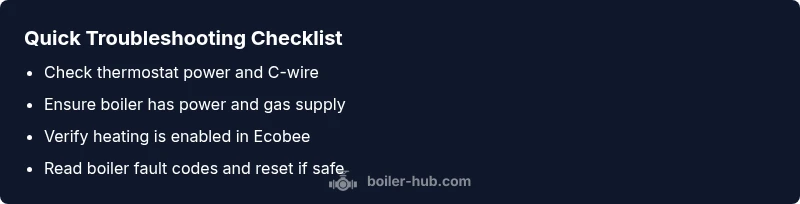
Problem with furnace boiler heating ecobee: Urgent Troubleshooting Guide
Urgent, step-by-step guide to diagnose and fix a problem with furnace boiler heating ecobee, including safety tips, diagnostic flow, and professional thresholds.


The most likely causes are thermostat misconfiguration or wiring issues between the ecobee thermostat and the boiler control. Start with power checks, confirm the thermostat is set to heat, and verify the C-wire continuity. If heat still won’t run, follow the diagnostic flow and step-by-step fixes below; if safety or gas concerns arise, contact a professional immediately.
Why the problem with furnace boiler heating ecobee happens
When a furnace boiler stops heating or behaves unpredictably after a call from the ecobee thermostat, the root cause is almost always thermostat communication, power supply, or boiler safety interlocks. The problem with furnace boiler heating ecobee is commonly linked to wiring or C-wire concerns, power loss to the thermostat, or scheduling conflicts in the Ecobee app. The ecobee thermostat relies on a continuous power and a reliable signal to the boiler control. If there is no common wire or if the thermostat has lost power due to a blown fuse or tripped breaker, the boiler may not fire even though the display indicates heat demand. Environmental factors such as a weak battery in the thermostat or a rate of heat loss in a poorly insulated home can also cause sensor misreads. In most cases, a careful, methodical approach can resolve the issue quickly, but it is essential to know when professional help is needed, especially if gas safety or electrical work is involved.
Boiler Hub analysis, 2026, shows that thermostat communication faults are among the most common reasons a system fails to heat when ecobee is involved. Understanding how the thermostat and boiler talk to each other helps you target the right component first, saving time and reducing risk.
Steps
Estimated time: 60-90 minutes
- 1
Verify safety and power
Before touching any components, switch off power at the boiler and the main breaker. If you smell gas, evacuate and call emergency services. Do not attempt repairs while gas is present. Confirm that the boiler and thermostat have a stable power source.
Tip: Take photos of any wiring before you disconnect anything to help reassembly. - 2
Check thermostat status and wiring
Inspect the Ecobee display to confirm it is actively requesting heat. Open the wiring compartment and ensure R and C are securely connected, with W (heat) and G (fan) properly seated as needed. Re-seat connectors if they appear loose.
Tip: Use a digital multimeter to verify the C-wire has continuity if you have one. - 3
Review Ecobee settings and schedules
In the Ecobee app or control panel, verify that heat is enabled, the system is set to heat mode, and that schedules aren’t overriding an active heat call. Temporarily disabling away mode can help you observe immediate responses.
Tip: Document any app or schedule changes you make for future reference. - 4
Test boiler control safely
If you have safe access to the boiler panel, ensure the boiler switch is on and look for a visible fault code. Do not bypass safety limits or tamper with gas lines. Observe whether the boiler ignites after a heat call from the thermostat.
Tip: Never bypass safety devices; a fault code should guide your next action. - 5
Check boiler pressure and fault codes
Read the boiler display for pressure readings and fault codes. Compare against the boiler manual and reset if the procedure is approved. A persistent fault code often points to ignition or sensor problems that need professional attention.
Tip: Record the fault code and pressure reading to share with a technician. - 6
Plan next steps and professional help
If heat does not return after these steps, or you feel unsure about any step, contact a licensed technician. Provide the fault codes, thermostat model, and recent changes to speed up diagnosis.
Tip: Prepare a service window and have your model numbers ready for the technician.
Diagnosis: Ecobee signals heat but boiler does not ignite or heats inconsistently
Possible Causes
- highMissing or failed C-wire/thermostat not powered
- highPower loss to thermostat or boiler (tripped breaker, blown fuse)
- mediumBoiler safety interlock or pressure/low-water cutoff engaged
- lowGas supply interruption or ignition fault code
Fixes
- easyRestore thermostat power and verify C-wire continuity; replace blown fuse or reset breaker
- easyRe-seat thermostat wiring, ensure R, C, W, G are correctly connected
- easyCheck boiler pressure and safety interlocks; clear fault codes per boiler manual
- hardIf gas supply or ignition fault persists, contact a licensed professional immediately
Questions & Answers
Why does the Ecobee show heat but the boiler won't ignite?
That typically means thermostat signaling is not reaching the boiler, or a safety interlock has tripped. Check the thermostat wiring, power, and boiler fault codes. If unresolved, a professional should inspect gas safety and electrical connections.
If the Ecobee shows heat but the boiler won’t ignite, the issue is usually thermostat signaling or a safety interlock. Check wiring and power, and review boiler fault codes.
What safety checks should I perform before calling a professional?
Ensure power is off when handling wiring, check for gas odors, and do not bypass safety devices. Note any fault codes and plan to share them with the technician.
Before calling a pro, turn off power if you’re touching wiring, check for gas odors, and note fault codes. Do not bypass safety devices.
Can I fix thermostat wiring myself safely?
Basic reconnection can be safe if you have power isolated and follow the manufacturer instructions. If you are unsure or the wiring involves line voltage, contact a licensed technician.
Some basic reconnections are possible if power is off, but don’t attempt complex wiring or high-voltage work—call a pro.
How long should I wait after resetting for heat to return?
Give the system 5 to 15 minutes after a reset for the boiler to recheck conditions and ignite, though some models may take longer depending on the setup.
Wait about 5 to 15 minutes after resetting to see if heat returns, depending on your boiler model.
When should I replace the boiler or thermostat?
If troubleshooting doesn’t restore heat and fault codes persist, a professional can determine whether the boiler needs service or replacement, or if the thermostat itself is failing.
If troubleshooting fails, a pro can decide whether to replace the boiler or thermostat.
What is the role of boiler pressure in this issue?
Incorrect boiler pressure can prevent ignition or cause short cycling. Check the pressure gauge, ensure it’s within the recommended range, and follow manual reset procedures if provided.
Boiler pressure matters; incorrect pressure can stop ignition, so check the gauge and follow the manual’s guidance.
Watch Video
Key Points
- Check basics first: power, wiring, and settings.
- Ensure thermostat and boiler communicate via C-wire.
- Do not bypass safety limits or gas safety devices.
- Document fault codes to speed up professional diagnosis.