How to Reset a Boiler: Step-by-Step Guide
Learn safe, practical steps to reset your boiler. This guide covers safety checks, locating the reset control, and troubleshooting common restart issues for quick, secure results.


By the end, you’ll know how to safely reset a typical residential boiler, including when to reset, where to find the reset switch, and how to verify operation after a reset. You’ll learn essential safety steps, what to check if the boiler won’t restart, and when to call a pro. Gather your boiler manual, flashlight, and basic personal protective gear before you begin.
Why resetting a boiler works and when to use it
A boiler reset is a first-aid maneuver for certain faults that interrupt normal operation. When control boards detect a temporary hiccup, a reset can clear fault codes and restore automatic cycling without replacing components. According to Boiler Hub, many residential issues stem from minor sensor glitches, air pockets in the lines, or brief pressure fluctuations that a simple reset can resolve. If your boiler restarts normally after a reset and runs without repeating faults, it’s often a sign the issue was temporary. However, if faults reappear or warning lights stay illuminated, that signals deeper problems that require service. This article guides you through safe reset practices, measurement of safety protocols, and decision points to avoid unsafe operation. By following these steps, homeowners and facility managers can manage quick fixes with confidence while knowing when professional help is needed. Boiler Hub Analysis, 2026 notes that most non-persistent faults respond to a correctly performed reset, but persistent faults call for professional evaluation.
Safety first: prerequisites before you reset
Safety is the priority when working with boilers. Before you touch any control, turn off the boiler at its wall switch or circuit breaker and, if you can access it safely, shut off the gas supply. Ensure the area is well-ventilated and free of flammable materials. Use a flashlight to inspect the cabinet for signs of corrosion, water leakage, or loose wiring. Wear heat-resistant gloves and avoid touching hot surfaces. Do not reset the boiler if you notice a gas smell, hissing sound, or obvious signs of a gas leak. In those cases, leave the area immediately and call the gas emergency number. Keeping the area clear helps you perform the reset accurately and reduces the risk of accidental ignition. This guidance aligns with Boiler Hub’s safety principles and general industry best practices.
Understanding boiler types and reset controls
Modern homes use several boiler configurations—combination (Combi), system, and regular boilers. The reset control can live on the front panel, inside a service panel, or within the digital control keypad. Some models use a dedicated reset button; others require a combination of a button and a sequence. If you have a gas-fired boiler, always follow the manufacturer’s safety instructions and avoid bypassing safety interlocks. A reset is not a cure for a faulty heat exchanger, a water leak, or low gas pressure. Boiler Hub Team suggests always cross-checking fault codes in the manual and using the correct reset procedure for your model to avoid damage.
Locating the reset control on common boiler models
Take time to locate the reset mechanism before attempting a reset. For many wall-mounted combi boilers, the reset control is near the bottom of the front panel or behind a small access cover. System boilers and heat-only boilers may place the reset on the main control board or within a menu on the digital display. If your unit has a red reset button, press it with a gentle press; if it uses a recessed reset switch, you may need a small nonconductive tool to trigger it. Always refer to the owner’s manual for the exact location and recommended press duration. In some cases, the reset is not a single action but a sequence that includes holding a key or navigating to a particular menu.
Step-by-step reset approach for common boiler types
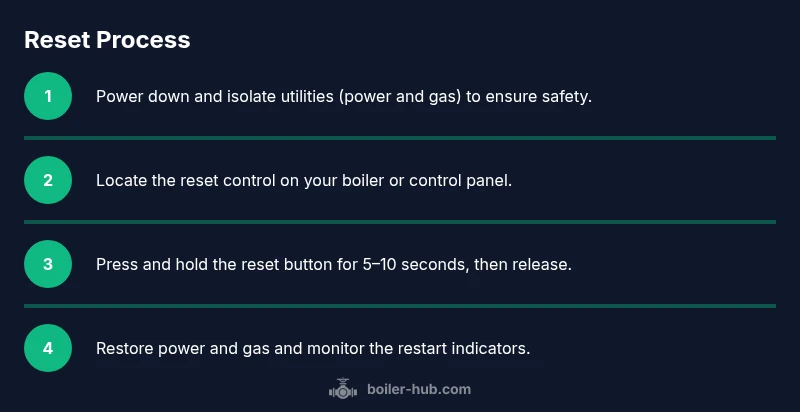
To reset, perform the following actions in a calm, controlled sequence: first, ensure power and gas are safely isolated; second, locate the reset control; third, press and hold the reset button for 5–10 seconds (or as the manual directs); fourth, release and wait for indicators to signal a restart; fifth, restore power and gas supply and observe a normal cycling pattern. If your unit features status lights or a digital display, note any fault codes shown before you reset, and consult the manual to decode them. Throughout the process, avoid forcing components or using tools not intended for the device. The exact timing and method vary by model, so always prioritize the manual.
After the reset: testing and monitoring
Wait a few minutes after the reset to observe the boiler’s cycling. Check that the burner ignites, the fan runs smoothly, and the flame stabilizes with a consistent color depending on your boiler. If you have a smart thermostat, confirm it communicates properly with the boiler and that the temperature increase matches the setting. Listen for unusual noises or abnormal smells and watch for any indicator codes. If the boiler cycles on and off frequently after a reset, that could indicate a sensor problem, air supply issue, or water pressure that needs attention. Document any fault codes and time stamps to help diagnosis if you call a professional later.
Troubleshooting common issues after a reset
Sometimes a reset seems successful, but the boiler fails to stay on or re-enters fault mode. In that case, check common culprits: draft or venting obstructions, low water pressure, air locks in the system, and dirty flame sensors. For boilers with a pilot, ensure the pilot light is lit; for newer models, ensure the electronic ignition is functioning. If fault codes appear, consult the manual to interpret them. If no obvious cause exists, the problem may be more serious and require professional diagnosis. Boiler Hub Team emphasizes documenting codes and conditions to speed up service.
When resets won’t fix the problem or safety concerns arise
If, after one or more resets, the boiler continues to display fault codes or refuses to restart, do not persist with resets. Repeated resets can mask dangerous conditions such as gas leaks, clogged burners, or faulty pressure components. In these cases, contact a licensed technician promptly. Also, if you’re uncomfortable with any step or the boiler room has poor ventilation or proximity to combustibles, stop and call a professional. Remember that some issues require diagnostic tools beyond consumer-grade equipment.
Preventive maintenance to reduce future resets
Regular maintenance reduces the need for resets and extends boiler life. Schedule annual professional inspections, clean or replace air filters as needed, ensure vent pipes are clear, check for corrosion or leaks, and verify water pressure is within manufacturer specifications. Keep a log of servicing events and symptoms to help with future troubleshooting. A small investment in maintenance now can prevent larger problems later and improve overall efficiency.
Boiler Hub verdict: safety-first approach and responsible action
This article reflects Boiler Hub’s stance that safety and proper diagnostics come first. The Boiler Hub Team recommends adhering to the manufacturer’s reset procedure, staying vigilant for warning codes, and seeking professional help when faults persist. Resetting a boiler is a tool for temporary relief, not a substitute for professional assessment or replacement when faults indicate wear or hazard. Following these guidelines will keep your heating system reliable and safe for your property.
Tools & Materials
- Owner's manual(Model-specific reset location and instructions)
- Flashlight(Boiler room lighting for safety checks)
- Non-contact voltage tester(Verify power is truly off)
- Heat-resistant gloves(Protect hands when handling hot components)
- Gas shutoff lever or valve wrench(If accessible and safe to operate)
Steps
Estimated time: 15-25 minutes
- 1
Power down and safety check
Turn off the boiler at the wall switch and circuit breaker, and if safe, shut off the gas supply. Confirm there is no power to the boiler using a tester. This prevents accidental ignition and protects both people and equipment.
Tip: Always verify power is off at the boiler control before touching any wiring. - 2
Locate the reset control
Find the reset button or menu on the boiler front panel or control module. If you cannot locate it, consult the manual or manufacturer’s website for model-specific instructions.
Tip: If there is no obvious button, a reset may be accessible via the digital display menu. - 3
Press and hold reset
Press and hold the reset button for 5–10 seconds as recommended by the manual, then release. Watch for a signal such as a blinking light or display message indicating the reset took effect.
Tip: If nothing happens after the first attempt, wait a minute and try again once. - 4
Restore power and gas
Turn the circuit breaker and gas supply back on. Allow the boiler a few minutes to re-light and begin normal cycling. Do not rush this step; premature demands can confuse the control board.
Tip: Ensure the area remains clear of obstructions and protective gear is in place during restart. - 5
Observe restart indicators
Check for a healthy ignition, steady flame, and normal running sounds. If the status lights indicate an error code, note it for reference.
Tip: Document fault codes and conditions to speed up troubleshooting if a professional is needed. - 6
Test thermostat and cycle
Set the thermostat to heat and observe that the boiler cycles on and off as expected. If cycling is irregular, there may be a pressure, sensor, or venting issue.
Tip: If irregular cycling persists, stop and call a professional rather than persisting with resets.
Questions & Answers
What does resetting a boiler do and when should I try it?
Resetting clears temporary fault codes and can re-establish normal cycling for minor issues. It should be attempted only after safety checks and following the model’s manual. If faults persist, seek professional help.
A boiler reset clears temporary faults and can restore normal operation for minor issues. If faults persist, contact a professional.
Can I reset a boiler after a power outage?
After a power outage, ensure power and gas are safely restored and the unit isn’t showing warning signs before attempting a reset. If any gas concerns exist, do not reset and consult a professional.
After power is restored, check for warning signs before resetting. If in doubt, call a professional.
What should I do if the boiler won’t reset after multiple attempts?
If multiple resets don’t fix the issue, the fault is likely not a temporary glitch. Check for persistent fault codes and contact a licensed technician who can diagnose pressure, venting, or sensor problems.
If resets fail after several tries, call a licensed technician for diagnosis.
Is it safe to reset if I smell gas?
No. If you smell gas, evacuate the area immediately and call the gas emergency number. Resetting in a gas presence can cause ignition hazards.
Do not reset if you smell gas. Evacuate and call emergency services.
When should I call a professional for boiler reset issues?
Call a professional when resets repeatedly fail, fault codes persist, or you notice leaks, unusual flames, or gas odors. A technician can diagnose electrical, gas, or venting problems safely.
Call a professional if resets keep failing or you notice leaks or gas smells.
Watch Video
Key Points
- Prepare safety gear and manual before starting
- Power down safely before resetting
- Locate and use the proper reset control for your model
- Test operation after reset and monitor for abnormal signs
- Call a professional if faults persist or safety concerns arise