Why Does My Boiler Need Resetting? A Troubleshooting Guide
Urgent, practical guidance on when a boiler reset helps, how to perform it safely, and when to call a professional. Learn step-by-step checks, how resets affect safety and efficiency, and prevention tips.


Most boiler resets are needed after minor faults or after maintenance. If you notice error codes, irregular cycling, or no heat, a simple reset can clear faults and re-sync controls. Start by turning off the boiler, waiting 60 seconds, and performing a standard reset per your manual. If problems persist, contact a boiler technician.
Why does my boiler need resetting?
When a boiler triggers a fault or experiences a control hiccup, a reset can clear the issue and re-establish safe operation. The question "why does my boiler need resetting" is common among homeowners facing intermittent heat, erratic display codes, or a boiler that won’t stay on. In many cases, a simple reset reboots the controller, re-synchronizes safety interlocks, and clears temporary faults. However, resets are not a cure for a failing component, and improper resets can mask serious problems. This guide explains when resetting is appropriate, how to do it safely, and when to seek professional help.
Boiler resets are most effective when the fault is momentary or caused by a minor sensor hiccup or communication error between components. If the fault stems from gas supply, a failing heat exchanger, or a damaged control board, a reset may provide only a brief pause before the underlying issue recurs. Throughout this guide, Boiler Hub emphasizes safety first and avoidance of risky DIY actions on gas-fired equipment.
When reset helps vs when it won't
Resetting can be a quick way to restore basic operation after a momentary fault. It is not a substitute for professional diagnosis when the boiler shows repeated faults, leaks, unusual noises, or if the unit shuts down with a hard lockout. If a reset clears the fault code but the boiler returns to the same fault, or if you notice gas odors, scorched components, or water leaks, stop and call a licensed technician immediately. Remember that repeated resets can mask dangerous conditions and lead to wasted energy and higher bills.
Pre-reset safety checks you should perform
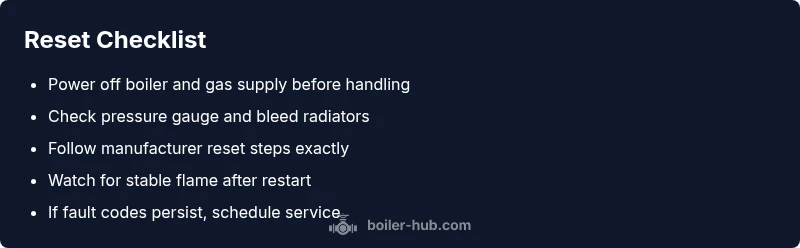
Before attempting any reset, power off the boiler at the switch or fuse, and if you have a gas boiler, ensure there is no gas smell or hissing at the appliance. Ventilate the room and remove any combustibles nearby. Check the boiler pressure gauge (typically between 1 and 2 bar when cold) and note any unexplained pressure changes. If you are ever uncertain about gas safety, evacuate and call the gas emergency line. These checks reduce the risk of injury and help prevent further damage to the system.
How to perform a safe boiler reset
Locate the reset control on the boiler or the control panel according to your owner’s manual. Press and hold the reset button for 3–10 seconds until the display indicates a restart or until you hear the burner re-ignition. If your boiler uses a thermostat-based reset, adjust the thermostat to a comfortable setting, wait for the system to cycle, and observe for normal operation. After resetting, monitor for 15–30 minutes for stable heat and normal flame. If you see a persistent fault code or abnormal flame, power off and contact a technician. Always follow the manufacturer’s instructions, as procedures can vary by model.
Troubleshooting common reset-related faults
Common issues after a reset include a temporary loss of heat while the boiler re-lights, short cycling, or intermittent ignition problems. If the boiler repeatedly locks out after restarting, there may be an improper gas supply, ignition problem, or sensor fault. Check the condensate trap and drain if present, ensure vents aren’t blocked, and verify that radiators are bled and filling correctly. If these steps don’t restore steady operation, it’s a sign to escalate to professional service.
What to do if the reset doesn’t resolve the issue
If a reset does not fix the problem, do not keep attempting resets in quick succession. Repeated resets can hide a serious fault and risk injury. Turn off the boiler and schedule a diagnostic with a qualified heating engineer. Document any fault codes, recent maintenance, or unusual noises to aid the technician. If you suspect a gas leak or hear a hissing sound, evacuate the property and call emergency services immediately.
Preventive steps after a reset to reduce future resets
After a reset, recalibrate your expectations: ensure the system is bled of air, check for cold spots, and verify that all safety devices are functioning. Schedule a boiler service every 12 months or per manufacturer recommendations. Maintain consistent water pressure, check for leaks around joints, and keep outdoor venting free of debris. Regularly replace filters and inspect the expansion vessel if your system uses one. Proactive maintenance minimizes unexpected resets and keeps the boiler running efficiently.
How resetting affects efficiency and safety
A reset can restore normal operation and improve energy efficiency when faults are intermittent. However, it can also mask deeper problems if relied on too often. Repeated resets typically indicate components wearing out or poor system balance. In terms of safety, never bypass safety interlocks or manipulate controls beyond the manufacturer’s guidance. If you’re ever unsure, seek professional assessment to protect occupants and avoid carbon monoxide risks.
Real-world scenarios and examples
Consider a homeowner whose boiler briefly cuts out during cold snaps. A one-time reset clears a temporary ignition fault and restores warmth. In another case, a boiler shows a recurring error code after a service visit; resetting provides no lasting fix, signaling a likely sensor or valve issue. In both scenarios, the prudent course is to monitor the system after a safe reset and then arrange professional diagnostic if issues persist. Boiler Hub’s guidance emphasizes safety and professional evaluation when faults persist.
Steps
Estimated time: 1 hour 15 minutes
- 1
Power down and vent
Turn off the boiler at the switch or fuse. If you have a gas boiler, ensure there is no gas smell. Allow the system to cool for a minute before proceeding.
Tip: A full minute is enough for microcircuits to reset in most models. - 2
Check pressure and safety basics
Look at the pressure gauge and ensure it’s within the normal range when cold. Check for visible leaks and ensure radiators are bled if needed.
Tip: Low pressure is a common reset trigger; topping up should follow the manual. - 3
Perform the reset
Press and hold the reset button for 3–10 seconds or follow the manual’s reset sequence. Listen for a burner re-light and watch the flame through the window if available.
Tip: If you don’t hear ignition within 90 seconds, stop and seek professional help. - 4
Observe post-reset behavior
Return power and allow the boiler to cycle. Check for heat in radiators and for stable flame. Note any persistent fault codes.
Tip: Keep a log of fault codes and times for the technician. - 5
Address obvious faults first
Bleed radiators, clear obstructions, or reseat filters as recommended by the manual. Recheck gas line and venting for safety.
Tip: Never bypass safety devices during any step. - 6
Call a professional if unresolved
If the boiler cycles irregularly, loses heat, or displays new fault codes, schedule a service visit promptly.
Tip: Document symptoms and codes to speed diagnosis.
Diagnosis: Boiler shows fault codes or won't ignite after a reset attempt
Possible Causes
- highPower supply or electrical fault (tripped breaker, blown fuse)
- highGas supply, ignition, or flame-sensing fault
- mediumLow boiler pressure or air in the system
- lowControl board or sensor failure
Fixes
- easyReset the boiler at the power supply and retry the reset procedure
- mediumVerify gas supply and open the gas valve; if you smell gas, evacuate and call emergency services; then contact a professional
- easyCheck boiler pressure and top up according to the manufacturer’s instructions
- hardIf faults persist after a safe reset, schedule a diagnostic service with a qualified technician
Questions & Answers
Is resetting a boiler dangerous?
Resetting a boiler is generally safe when you follow the manufacturer’s instructions and safety guidelines. Do not reset if you smell gas or notice leaks. If faults persist, seek professional help.
Resetting is usually safe if you follow the manual. Avoid resets if you smell gas or see leaks, and contact a professional if the fault continues.
Can resetting fix no-heat conditions?
A reset can restore heat if the issue was a temporary sensor fault or control hiccup. If heat remains absent after a reset, there may be a deeper issue such as ignition or gas supply problems.
A reset may fix no-heat if the fault was temporary, but if heat doesn’t return, you likely need a professional check.
How often should I reset my boiler?
Resets should be rare and only when required by fault codes or after maintenance. Frequent resets indicate underlying problems that need diagnosis.
Only reset when needed. If you’re resetting often, get a professional check.
What should I do after a reset?
After a reset, monitor for stable operation, bleed radiators if needed, and verify safe flame. If problems reappear, schedule a service.
Watch the boiler after reset and call a pro if issues come back.
When should I call a professional immediately?
Call immediately if you smell gas, notice water leaks, or hear unusual banging or creaking, which could indicate dangerous conditions.
If you smell gas or hear odd noises or see leaks, get help right away.
Do all boilers have the same reset procedure?
Reset procedures vary by model. Always consult the user manual for model-specific instructions and safety warnings.
Check your manual for the exact steps for your boiler model.
Can a reset affect energy efficiency?
A successful reset can restore efficiency if the fault caused extra cycling, but chronic faults will keep efficiency low until repaired.
A reset can help efficiency if the fault was temporary, but ongoing faults keep running costs high.
Watch Video
Key Points
- Reset safely only after safety checks.
- Persistent faults require professional service.
- Regular maintenance prevents frequent resets.
- Document fault codes for faster diagnosis.
- Never disable safety interlocks during DIY resets.