Do You Need to Reset Your Boiler After a Power Cut
Discover whether a boiler needs resetting after a power cut, how to safely restart, and when to call a pro. Clear steps, safety checks, and expert guidance for homeowners and facility managers.


According to Boiler Hub, most boilers reset automatically after a power cut when power returns. If the boiler doesn’t restart or shows fault codes, you may need a manual reset. Start by turning the boiler off at the wall, wait about 60 seconds, then switch it back on. If problems persist, consult the manual or a qualified technician.
Understanding what a power cut does to your boiler
Power outages can affect boilers in several ways, from momentary electrical resets to safety lockouts. When the electricity comes back, many modern boilers perform an automatic reboot of their control board. This reboot helps clear transient faults caused by the outage, but it can also trigger fault codes if sensors or safety devices detected anomalies. According to Boiler Hub, most boilers recover without user intervention, but there are caveats. If the boiler displays an error, or if there is no ignition or a loss of hot water after power is restored, you should proceed with caution. Never bypass safety devices or attempt to force ignition. Understanding the typical sequence after a blackout can help you decide whether a manual reset is necessary and what steps to take to regain reliable heat safely. In some systems, residual power in the network can cause a brief restart loop; if this occurs, document the fault code so a technician can verify proper operation later.
Boiler Hub analysis shows that automatic reset is common, but fault codes must be interpreted using the model’s manual. Different boiler families handle power restoration differently, and a misstep can disable safety circuits or trigger a lockout. Your first move after a power cut should always be safety-first: confirm there is no gas smell, ensure proper ventilation, and keep occupants away from the boiler room if you suspect gas issues. With that baseline, you can proceed to assess whether a reset is necessary or if broader service is warranted.
noteTypePathNoteOnly":null}
Quick safety checks to perform after power restoration
When power returns, you should perform a structured safety check before testing heat or hot water. Start by ensuring the boiler area is well-ventilated and free from flammable materials. If you detect a gas smell, exit the building immediately and contact emergency services. If the area is safe, verify that the main supply has restored power and that the boiler’s wall switch is in the ON position. Look for warning lights or fault indicators on the control panel and check that carbon monoxide alarms are functioning as expected. Do not attempt to restart the boiler if you notice irregular noises, persistent leaks, or steam coming from joints. In many homes, a flicker in the power circuit can leave exposed wiring in a compromised state, so it’s wise to inspect outlets and the dedicated boiler circuit for scorch marks or melted insulation.
Boiler Hub notes that after a power outage the safest course is careful inspection rather than quick ignition. If the fault indicators point to a safety system or a sensor fault, it’s prudent to pause and seek professional guidance. In the absence of warning signs, you can proceed with a controlled restart following the manufacturer’s recommendations. Keep a log of any fault codes or abnormal behavior for reference during service.”,
Tools & Materials
- Non-contact voltage tester(to verify power isolation at the boiler and nearby outlets)
- Flashlight(for dim boiler rooms or basements)
- Owner’s manual for the boiler(model-specific reset instructions and safety guidance)
- Gloves (heat-resistant)(protection when handling exposed components or pipes)
- Basic screwdriver set (Phillips and flat-head)(for access panels or cover screws if needed)
Steps
Estimated time: 40-60 minutes
- 1
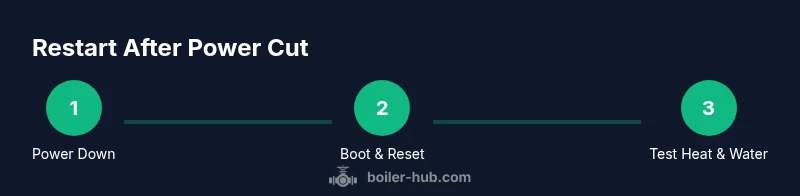
Power down the boiler at the wall switch
With your hands away from any exposed wiring, switch the boiler to the OFF position at the wall or service switch. This isolates the unit and helps reset any safety devices that may have been tripped during the outage. Waiting a few moments reduces the risk of a sudden restart that could trigger a lockout.
Tip: If the switch is difficult to reach, use a portable light to locate it and avoid fumbling in a dark boiler room. - 2
Verify the supply power at the boiler panel
Confirm that the boiler’s own isolation switch is ON and that any downstream breakers are restored. A quick voltage check with a non-contact tester can confirm there is no live voltage present before you touch the controls. This step protects you from accidental electrical shock and ensures you’re starting from a safe baseline.
Tip: If you’re unsure about the wiring or if the tester shows voltage, stop and consult a qualified electrician. - 3
Restore power and allow the boiler to boot
Turn the boiler back on at the wall switch and wait briefly for the control board to reboot. Listen for the initial ignition sequence and watch the display for any fault codes or pauses. Do not force ignition if the unit remains silent or shows a fault indication.
Tip: Observe for a full boot cycle; if the display remains blank, there may be an electrical or control fault that requires service. - 4
Reset the boiler from the control panel if needed
If fault codes appear, use the control panel or a dedicated reset button to perform a manual reset as described in the owner’s manual. Hold the reset for a few seconds if required by your model, then release and allow the unit to begin a normal startup sequence again.
Tip: Refer to the manual for the exact reset procedure for your model to avoid improper resets. - 5
Test heating and hot water function
Once the unit appears to start normally, set a heating call and run a hot water tap to confirm both heat and hot water return. Listen for the heating pump and observe that radiators warm evenly. If there’s inconsistency, there may be air in the system or a circulation issue.
Tip: If you notice cold spots or uneven heating, bleed radiators or check the pump as a next step. - 6
Create a quick post-restart check and plan ahead
Note any fault codes, service messages, or unexpected behavior. If issues persist, or you’re unsure about the safety of restarting, contact a gas-safe technician. Keeping a log will help a technician diagnose quickly and prevent repeated outages.
Tip: Boiler Hub recommends documenting codes and symptoms to speed up diagnostics.
Questions & Answers
Do most boilers auto-reset after a power outage?
Most modern boilers automatically reboot their control boards after power is restored. If fault codes appear or ignition fails, a manual reset or professional check may be needed.
Most boilers reboot on their own after power returns, but fault codes or ignition issues can require a manual reset or a call to a pro.
What should I do if my boiler won’t start after power restoration?
First, confirm power is restored and there are no gas smells. Check for fault codes and reset if instructed by the manual. If the boiler still won’t start, contact a qualified technician.
If it won’t start after power comes back, check power, look for fault codes, reset as directed, and call a professional if needed.
Can a power cut cause safety or CO risks?
Power cuts themselves don’t create gas leaks, but improper restarting can mask combustion issues. Ensure CO alarms are functioning and never ignore a gas smell or unusual odors.
Power outages don’t create leaks, but improper restarts can hide problems. Use CO alarms and call a pro if anything seems off.
When should I call a professional after a reset attempt?
If fault codes persist, the boiler doesn’t achieve heating or hot water, there’s a gas smell, or you’re unsure about steps, a licensed technician should assess the system.
Call a professional if codes persist or you’re unsure about the restart process.
Will restarting affect my boiler warranty?
Most warranties are not voided by a routine power-restoration restart when performed according to the owner’s manual. Check your specific warranty terms for model-specific conditions.
Resetting per the manual usually won’t affect your warranty, but double-check your terms.
What information should I have ready when requesting service?
Have your boiler model and serial number, a clear description of the fault, any fault codes, and the steps you’ve already taken. This helps technicians diagnose faster.
Know your model, serial, and what fault codes appeared before you call a pro.
Watch Video
Key Points
- Power down to reset safety devices after a power cut.
- Check for fault codes and follow the manual to reset.
- Call a pro if codes persist or there are gas/smoke concerns.
- Document symptoms to speed up professional service.