How to Put Boiler Pressure Back Up: A Homeowners Guide
Learn to safely restore boiler pressure with a practical, step-by-step approach. This Boiler Hub guide covers tools, safety checks, and troubleshooting to help homeowners and facility managers maintain efficient heating.


By following this guide you will safely raise boiler pressure using the filling loop, radiator bleed, and proper shut-off procedures. According to Boiler Hub, always verify the boiler’s manufacturer-recommended pressure before starting, check for leaks, and re-check pressure after heating cycles to ensure stable operation. This steps-based method minimizes risks and improves heating efficiency.
Understanding boiler pressure
Boiler pressure is a measure of how much force the water in your heating system exerts on the pipes and radiators. It influences boiler efficiency, heat output, and system safety. Too low pressure means the boiler cannot circulate hot water effectively; too high pressure can stress seals and cause leaks. According to Boiler Hub, most domestic boilers are designed to operate within a narrow band: roughly 1 bar when the system is cold and a higher range when hot. Always refer to the manufacturer’s manual for your exact numbers.
The pressure is read on a gauge, usually labeled with 'BAR'. A typical gauge shows a green safe zone, with red zones indicating danger. When you observe the gauge in the red, stop and reassess. In many homes, pressure changes gradually as the system heats and cools, so occasional small fluctuations are normal. If you notice frequent drops or rises, something may be wrong with the expansion vessel, pressure relief valve, or the filling loop. Regular checks help prevent cold spots and inefficient heating.
When to adjust pressure
Adjusting boiler pressure is appropriate when the gauge reads below the recommended level after the system has cooled, or after you’ve bled radiators and air remains. If the pressure is too low and you recently released air, repressurizing is often needed; if you overfill, you may need to vent slightly to reach the safe range. Knowing the threshold is important; avoid overfilling beyond the safe maximum, as this can cause leaks or seal damage. Boiler Hub Analysis, 2026 indicates that maintaining a stable pressure within the manufacturer’s range supports efficient heat cycling. If the gauge shows frequent fluctuations even after repressurizing, there may be a faulty expansion vessel or a leaky valve requiring professional service.
Note: Temperature affects readings. Cold start pressure is usually lower than hot run pressure. In older systems, expansion tanks can lose air, causing more frequent drops. A professional can test the tank’s air charge and replace or recharge as needed.
Before you start: safety and prerequisites
Safety first. Turn off the boiler and switch off the power at the mains if your model allows it. Allow the system to cool for at least 15–30 minutes to avoid scalding. Wear gloves and eye protection, and keep children and pets away from the work area. Have a bucket or towel ready to catch any splashes and a clean cloth to wipe valves. If your boiler has a sealed system, do not tamper with pressure relief valves or safety devices. Always consult your boiler manual for model-specific instructions and safe pressure ranges.
If you are unsure about turning off power or opening valves, contact a qualified technician. For most homeowners, repressurizing with care is doable, but aggressive adjustments or leaks require professional attention.
How pressure adjustment works: filling loop, expansion tank, and radiator bleed
Most domestic boilers use a filling loop to add water to the system and an expansion tank to accommodate thermal expansion. Bleeding radiators releases trapped air that can masquerade as pressure issues. The core idea is to bring the pressure reading into the safe range without forcing water into the system too rapidly. If your display shows abnormal spikes, a faulty valve or a damaged expansion vessel could be the culprit. In such cases, DIY fixes might provide only a temporary relief and could mask a larger problem.
Understanding these components helps you diagnose whether you can safely proceed or if you should call a pro. Regular checks and a calm, measured approach reduce the risk of leaks and equipment damage.
Common mistakes and quick fixes
Common mistakes include opening the filling loop too quickly, overfilling past the recommended range, and neglecting to bleed radiators after repressurizing. Overfilling can stress seals and trigger leaks, while trapped air keeps pressure readings unstable and reduces heating efficiency. If you notice a consistent drop in pressure even after repressurization, inspect for external leaks around joints or at the filling loop connections. A slow, methodical approach with careful valve control is far more effective than rapid adjustments.
Maintenance tips to prevent pressure drops
Regular maintenance helps prevent pressure-related problems. Schedule annual inspections to check the expansion tank, pressure relief valve, and circulating pump. Periodically bleed radiators to remove air pockets, especially after filling or servicing. Keep the boiler room tidy, free of dust and moisture, and ensure the venting path is clear. If your system uses an expansion vessel, verify the air charge and re-charge if needed. A well-maintained system stabilizes pressure, improves efficiency, and reduces the risk of unexpected shutdowns.
Tools & Materials
- Boiler manufacturer manual(Always reference model-specific guidance)
- Filling loop hose or approved filling tool(Secure, leak-free connection to boiler)
- Radiator bleed key or screwdriver (flat-head)(For manual bleeds on radiators)
- Bucket or large towel(Catch water and protect floors)
- Adjustable wrench or pliers(Tighten/loosen valves safely)
- Gloves and eye protection(Personal protection during work)
- Fire-safe, non-slip mat(Place under boiler area)
- Digital pressure gauge (optional)(Helps monitor precise readings)
Steps
Estimated time: 30-60 minutes
- 1
Turn off boiler and let it cool
Switch off the boiler and disconnect power if accessible. Allow the unit to cool for 15-30 minutes to avoid scalding and to get an accurate pressure reading when cold. This reduces the risk of sudden pressure changes during the procedure.
Tip: Never work on a hot boiler; warm metal can cause burns and misread gauges. - 2
Locate the filling loop and gauges
Find the filling loop valves on the boiler. Identify the pressure gauge and understand its zones. Confirm you have the boiler manual handy for the recommended range before proceeding.
Tip: If you’re unsure which valve is the filling loop, consult the manual or a technician to avoid accidental opening of the wrong valve. - 3
Connect the filling loop and prepare for filling
Attach the filling loop hose securely to the filling port. Ensure the hose is spill-proof and the surrounding area is protected with a towel. Open the first valve slowly to prepare for water entry.
Tip: Open slowly to prevent a water hammer effect that can damage pipes. - 4
Open the filling loop slowly to repressurize
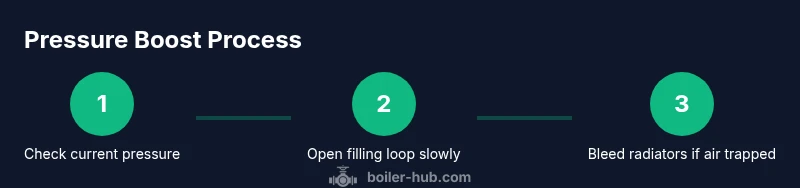
Gradually open the filling loop valve(s) and monitor the pressure gauge. Add water until the gauge reaches the lower end of the safe range when cold, typically around the manufacturer’s specification. Do not rush this step.
Tip: Stop as soon as the gauge reaches the target range; overfilling is difficult to correct quickly. - 5
Close the filling loop and check for leaks
Close the valve(s) and remove the filling hose. Re-seat all fittings and inspect for any signs of water leakage around joints and valves. If a leak is found, tighten gently and wipe dry; if it persists, stop and call a professional.
Tip: A tiny leak can escalate; if you’re unsure, stop and get a pro involved. - 6
Bleed radiators if air remains trapped
If some radiators feel cold at the top or you hear gurgling, bleed them to remove trapped air. Use the bleed key or screwdriver to open the valve a small amount until water flows, then close the valve.
Tip: Close the bleed valve promptly once water begins to run; over-bleeding can lower system pressure. - 7
Restart the boiler and re-check pressure
Turn the boiler back on and let it run for 10-15 minutes. Check the pressure again when the system is hot, then when it cools. If it returns to the safe range, you’re done; if not, you may need to repeat or call a professional.
Tip: Record the final pressure for future reference and monitor for stability over the next few days. - 8
If pressure won’t hold, seek professional help
Repeated loss of pressure could indicate a faulty expansion vessel, leaking joint, or worn pressure relief valve. If repressurizing doesn’t hold, do not continue DIY attempts.
Tip: Professional service can diagnose expansion tank integrity and systemic leaks safely.
Questions & Answers
What is the normal boiler pressure range?
Most domestic boilers aim for about 1 bar when cold and may rise to around 1.5-2 bar when hot. Always verify your model’s recommended range in the manual. If pressures are consistently outside that range, consult a professional.
Most boilers run around 1 bar when cold and up to about 1.5 to 2 bar when hot. Check your manual and avoid pushing beyond the recommended range.
Can I repressurize without bleeding radiators?
Yes, you can repressurize using the filling loop without bleeding radiators if the system pressure is low. Bleeding is only needed if air is trapped in the radiators or if you notice banging noises.
You can repressurize without bleeding, but bleed radiators if you hear air pockets or feel cold spots in the radiators.
Why does pressure drop again after refilling?
A repeated pressure drop can indicate a leak, a faulty expansion vessel, or an improperly sealed filling loop. Inspect joints and connections, and consider professional testing of the expansion tank.
If pressure keeps dropping after refilling, check for leaks or a faulty expansion tank and get a pro to test the system if needed.
What safety steps should I take before working on the boiler?
Turn off power, let the system cool, wear protective gloves and eye protection, and keep children away. Have towels or a bucket ready and consult the manual for model-specific safety notes.
Power off, let it cool, wear protection, and keep kids away. Check the manual for your model’s safety notes.
When should I call a professional?
If repressurizing fails to hold, if you hear leaks, frequent pressure drops, or suspect a faulty expansion vessel, contact a qualified technician. Do not force repairs beyond your comfort level.
Call a professional if the pressure won’t stabilize or you hear leaks or unusual noises.
What if the expansion tank is faulty?
A faulty expansion tank can cause unstable pressure. A professional can test the air charge, recharge or replace the tank, and inspect the system for related issues.
If the expansion tank is bad, a pro will test and fix or replace it to stabilize pressure.
Watch Video
Key Points
- Know your target pressure before starting.
- Open the filling loop slowly to avoid water hammer.
- Bleed radiators to eliminate air pockets after repressurizing.
- Check for leaks and only use DIY steps within safe ranges.
- If pressure cannot be stabilized, call a professional.