How to Check Boiler Water Pressure: A Practical Guide
Master the basics of checking boiler water pressure with a clear, step-by-step approach. Learn readings, safety tips, and when to call a pro to keep your system efficient and reliable. Boiler Hub.


According to Boiler Hub, checking boiler water pressure is a quick, essential maintenance task. Locate the pressure gauge and compare the current reading to your boiler’s labeled range (typically about 1–1.5 bar when cold). If the pressure is low, use the filling loop to restore it; if it’s high, bleed radiators or consult a pro.
Understanding boiler pressure basics
Boiler pressure is a measure of how hard the water inside the system is pushed to circulate through radiators and heat exchangers. Maintaining the correct pressure helps ensure efficient heat transfer, stable operation, and long-term durability. Too-low pressure can prevent radiators from heating evenly; too-high pressure can strain seals and joints. When you manage boiler pressure properly, you reduce cycling losses and improve overall comfort. According to Boiler Hub, regular checks are a simple, proactive habit that saves time and money over the life of a home heating system. Read the gauge when the system is cold for baseline accuracy and consult the manual for your model’s target range.
Locating the pressure gauge and identifying the range
Begin by inspecting the boiler’s front panel or service access point for a circular dial with a numbered scale. The range is usually marked as a band, often between 1 and 2 bar for residential combi boilers. If your system uses metric units, you may see the gauge labeled in bar; some older boilers display psi. Note the reading and confirm it matches the manufacturer’s stated target. If you don’t have the manual handy, you can often find the model number on the front plate and search the exact range online. Keep the boiler off and cool during this check to avoid thermal burns or accidental valve movement. Boiler Hub analysis shows that regular pressure checks help prevent premature wear and avoid service interruptions.
How to read the gauge correctly and account for temperature
Gauge readings can vary slightly with temperature. A cold boiler typically reads lower than when the system has heated water; many manufacturers specify a cold range of around 1 bar. When the boiler is warmed up, the pressure can rise by about 0.5 bar. The critical point is to compare your current reading to the cold-range target listed in the manual, or the label on the boiler. If you’re consistently seeing readings outside the recommended range, it’s a sign that you may need to adjust. In all cases, work with steady hands and avoid rapid pressure changes that can disturb seals.
What to do if the pressure is below the recommended range
If the gauge shows a value below the target, you’ll need to add water into the system. Most modern boilers have a filling loop, a pair of hoses connected to a valve that lets you introduce water until the pressure reaches the correct level. Before you start, ensure the shutoff valves are closed, slowly open the filling valve, and watch the pressure gauge as it climbs. Stop as soon as you reach the target range; closing the valve promptly prevents overfilling. If you don’t see a rise in pressure after several breaths of the loop, there may be a leak, an air lock, or a faulty gauge.
How to safely raise pressure using the filling loop
To safely increase pressure, attach the filling loop to the designated feed valves if it’s not already connected. Open the valve gradually, pause briefly to allow the system to balance, and monitor the gauge closely. When the needle reaches the target, close the filling valve and remove the loop if required by your boiler model. Bleed a radiator only if you notice air pockets that cause cold spots. After the loop is shut, restart the boiler and check the pressure again after a few minutes of operation.
What to do if the pressure is above the recommended range
High pressure can stress components and trigger safety valves. If you observe readings above the recommended range, avoid forcing the pressure down with rapid valve adjustments. Instead, shut down the boiler, allow the system to cool, and consider venting a radiator to release some air and water—though this should be done with caution. If the pressure remains high after cooling and venting, you should contact a qualified technician. Persistent overpressure may indicate a fault such as a stuck pressure relief valve or a circulation issue.
After adjusting pressure: testing, bleeding radiators, and checks
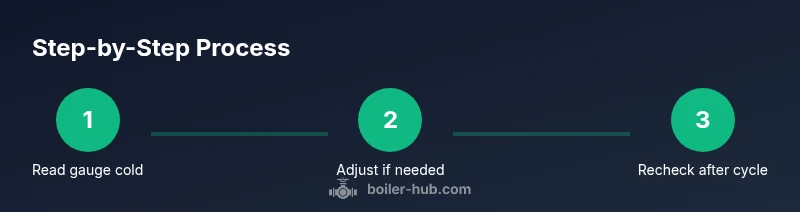
With the pressure set, turn the boiler back on and let it run through a full heat cycle. Recheck the gauge after the system returns to steady state. If you have radiators that feel cooler at the top or bottom, bleed them to remove trapped air and restore even heating. A quick refresh of the pressure reading after a heat cycle confirms stability. Logging the reading in a maintenance notebook helps you spot trends over time and plan service before a problem escalates.
Common mistakes and safety reminders
Avoid rushing adjustments or opening multiple valves at once. Opening the filling loop too quickly can overshoot the target. Never work on live electrical components without gloves and, if in doubt, shut off power first. If you overhear hissing noises, smell gas, or see pooling water near the boiler, stop immediately and call a professional. The goal is steady, not dramatic, pressure changes that could cause leaks or equipment damage.
Troubleshooting edge cases and seasonal checks
Some boilers show pressure readings that drift with seasonal temperature changes. If you only see drift after the heating season begins, check for leaks around joints or a faulty pressure relief valve. In combi systems, a rapid drop in pressure after heating may indicate a leak in the coil or a faulty seal. For complex symptoms, it’s prudent to schedule a professional check, especially before winter demand peaks. For ongoing guidance, The Boiler Hub team recommends monthly checks as part of seasonal boiler maintenance.
Tools & Materials
- Boiler manual(Contains the target pressure range and service instructions)
- Filling loop (if not built-in)(Used to add water to low-pressure systems safely)
- Gloves and eye protection(Protect hands and eyes during checks and adjustments)
- Soft cloth(Wipe away drips and keep the area clean)
- Rag or towel(Prepare for spills and to dry gauges)
Steps
Estimated time: 20-40 minutes
- 1
Turn off boiler and allow it to cool
Power down the boiler and let it cool for about 10-15 minutes to avoid scalding and to ensure safe gauge readings.
Tip: Cooling helps stabilize readings and reduces sudden pressure changes. - 2
Locate the pressure gauge
Find the round gauge on the boiler’s front panel or near the control knob. Note whether it’s labeled in bar or psi.
Tip: If you can’t locate it, consult the manual or model number online. - 3
Read the current pressure
Read the gauge with the system cold for an accurate baseline. Record the value and compare to the manual’s target range.
Tip: Take another reading after the boiler heats up to see how pressure swings. - 4
Compare to the recommended range
Identify whether the current reading is within the manufacturer’s target range (typically 1–1.5 bar cold).
Tip: If the gauge sits near the edge, plan a small adjustment rather than a full fill. - 5
If pressure is low, prepare to fill
Ensure the filling valves are accessible and the shutoffs are ready. Keep an eye on the gauge while opening slowly.
Tip: Open slowly to avoid overfilling. - 6
Open the filling valve and add water
Turn the valve gradually until the gauge reads within the target band. Stop immediately when you reach the target.
Tip: Close the valve promptly after reaching target to prevent overfill. - 7
Close the filling valve and remove the loop
Return any fittings to their original position. If you used a detachable loop, remove it safely and store.
Tip: Check for leaks around the valves after removal. - 8
Check for air in radiators and bleed if needed
Air can cause cold spots and inconsistent heating. Bleed only if you notice gurgling or feel cold drafts.
Tip: Use a radiator key and have a cloth handy for drips. - 9
Restart boiler and test the system
Turn the boiler back on and allow it to cycle through a heating and hot water demand.
Tip: Observe pressure change during the first heat cycle. - 10
Re-check pressure after stabilization
Once the system stabilizes, read the gauge again to confirm you’ve maintained target pressure.
Tip: Keep a maintenance log with the date and reading.
Questions & Answers
Why does boiler pressure change after heating up?
Boiler pressure often rises as water expands when heated. Most systems are designed to compensate for this by allowing a small pressure increase within the target range.
Pressure tends to rise as the water heats; it’s normal to see a higher reading when the boiler is hot.
What is a normal boiler pressure range?
For most residential boilers, the cold pressure target is about 1 bar, rising to around 1.5 bar when hot. Always check your manual for your model’s exact range.
Commonly, cold is about 1 bar and hot can be up to 1.5 bar, but check your model.
Can I adjust pressure without a filling loop?
Adjusting pressure without the proper filling loop can be dangerous and may damage components. Use the loop as directed by your boiler’s manual.
No—use the correct filling loop as described in your manual to avoid damage.
What should I do if pressure keeps dropping?
If pressure drops repeatedly, there may be a leak, air in the system, or a faulty valve. Contact a qualified technician to diagnose and repair.
If it keeps dropping, there may be a leak or air in the system; call a pro.
Is it safe to bleed radiators myself?
Bleeding radiators is generally safe if you follow steps and wear protection. Turn off the boiler first and keep a cloth handy for drips.
Bleeding is usually safe if you follow steps and turn the boiler off first.
Watch Video
Key Points
- Check boiler pressure when the system is cold for accuracy.
- Maintain readings within the manufacturer’s target range to ensure efficiency.
- Use the filling loop cautiously to raise low pressure and bleed radiators if needed.
- If readings remain unstable, consult a professional before continuing.