How to Tell Boiler Pressure: A Practical Home Guide
Learn how to tell boiler pressure, read gauges accurately, compare readings to the manual, and safely adjust your system. This step-by-step guide helps homeowners and facility managers keep boilers safe and efficient.


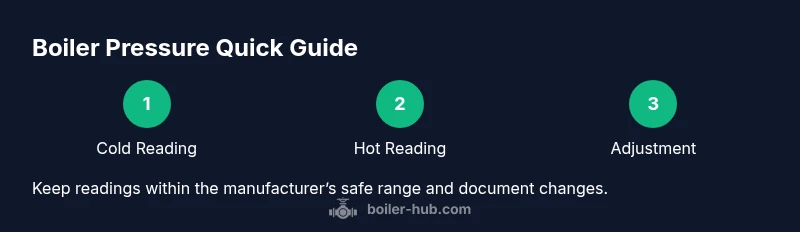
To tell boiler pressure, start by reading the pressure gauge when the boiler is cold, then recheck after it warms up. Compare the reading to the safe operating range listed in your manual or on the boiler label. If pressure is too low, use the filling loop to restore it; if it's too high, bleed air and vent excess. This is a basic, safety-critical check.
Understanding boiler pressure and why it matters
Boiler pressure is the force that pushes hot water through your heating system. When the pressure is correct, radiators warm evenly and your boiler cycles predictably. If pressure is too low, the system may struggle to heat, leading to cold spots and increased cycling. If pressure runs high, safety devices may vent water or trigger protection features, and components can wear prematurely. According to Boiler Hub, a clear understanding of boiler pressure is essential for safe operation and efficient heating. Most residential boilers include a pressure gauge on the front or side of the unit; reading this gauge gives you a quick snapshot of system health. The gauge shows units such as bars or psi, and its dial or digital readout should align with the manufacturer’s stated safe range. You don’t need to be an expert to interpret it: with calm, methodical checks you can catch problems early. Keep a simple log of readings over time to distinguish a normal drift from a fault. In this article we’ll expand on how to tell boiler pressure, what readings to tolerate, and how to respond when readings are out of range.
How to read the pressure gauge correctly
Reading the gauge accurately starts with locating it on your boiler. Most systems display a dial with a pointer or a digital readout. For many units, readings are shown in bars (some older models use psi). Check the scale and locate the safe range printed on the unit, the front panel, or in the manual. When cold, the reading should be lower; as the boiler heats, the value will rise. Do not rely on a single measurement—check both cold and operating conditions to understand system behavior. If you must remove the front panel to inspect the gauge, ensure the boiler is cooled, power is off, and you follow safety precautions. If readings are inconsistent—jumping or sticking—record them and proceed with caution. A steady reading is more informative than a temporary spike: a fluctuating value can signal air in the system, a leak, or a faulty valve. Wipe the gauge window clean with a cloth for a clear read.
Safe operating range: cold vs hot readings
A boiler’s safe operating pressure depends on design and ambient conditions. In most homes, the cold reading is at the lower end of the scale and the hot reading is higher when the system is at normal temperature. The exact target range should be confirmed in the boiler’s manual or on a label near the gauge. If your cold reading is well below the recommended threshold, you may have an air pocket or a small leak; if the hot reading is above the maximum, there could be expansion issues or a faulty relief mechanism. Do not force readings outside the manufacturer’s guidance; persistent deviations can damage heat exchangers, seals, and pumps. Regular checks help you catch slow leaks, air pockets, and balancing issues. When in doubt, rely on the manufacturer’s guidance and contact a qualified technician for adjustments beyond basic topping up.
Common symptoms of incorrect boiler pressure
Low pressure can lead to insufficient heating, longer boiler cycles, and cold spots in radiators. High pressure can trigger water discharge from pressure relief valves, hissing sounds, or pump noise. You may notice radiators taking longer to warm or irregular flame behavior on some boilers. In rare cases, a pressure warning light may illuminate on the control panel. If you observe these signs, don’t ignore them. A simple top-up or venting routine might restore balance, but recurring symptoms often indicate a leak, trapped air, or a faulty valve. Document symptoms and readings to assist with troubleshooting or a professional consultation. Pressure problems are safety-related, so approach them with care and caution.
How to adjust boiler pressure safely
If readings are outside the safe range, adjusting pressure is a careful, staged process. Start by turning off the boiler, letting the system cool, and locating the filling loop valve on the supply pipe. Open the valve slowly and watch the gauge as pressure rises; avoid rushing and do not over-pressurize. When the cold reading reaches the lower end of the safe band, close the filling loop and recheck after the boiler heats. If the hot reading remains high, you may need to vent air from radiators first, then check the expansion vessel or pressure-relief valve for proper operation. After any adjustment, restart the boiler and monitor for several minutes before rechecking both cold and hot readings. If readings still drift outside the safe range or you notice leaks, stop and call a professional. Always prioritize safety: dry hands, appropriate gloves, and no live electrical contact while working.
Maintenance and monitoring routine
Create a simple monthly monitoring routine to prevent pressure problems from sneaking up. Record date, cold and hot readings, and notes about any symptoms such as noises or leaks. Keep the log with the boiler manual for quick reference. If you install or service components such as a filling loop or expansion vessel, schedule a professional inspection at least once a year. Regular maintenance helps extend boiler life and reduces the risk of costly emergency repairs. In addition to gauge checks, verify that radiator bleeds are functioning and that there are no obvious signs of corrosion or leaks. A well-maintained system runs more efficiently and provides greater peace of mind for homeowners and facility managers.
Tools & Materials
- Boiler manual (owner's manual or spec plate)(Keep handy for pressure range and safety warnings)
- Pressure gauge access/tools (if applicable)(Use only if your boiler provides a test port or service tool)
- Filling loop valve key/wrench(Used to open/close filling loop to repressurize)
- Flat-head screwdriver or Phillips head(For panel screws or bleed valves)
- Radiator bleed key or small wrench(Useful for venting radiators if air is present)
- Cloth or towel(Catch drips and keep area clean)
- Container or bucket(Catch small spills)
- Heat-resistant gloves(Protect hands from hot surfaces or water)
Steps
Estimated time: 25-40 minutes
- 1
Locate cold pressure and read
Power down the boiler if accessible, wait for it to cool, then read the gauge. Note the cold reading and compare it to the manual's lower bound. This establishes a baseline before any changes.
Tip: Use the manufacturer’s target range as your guide; do not guess. - 2
Check hot pressure after heating
Turn the boiler on and allow it to reach normal operating temperature. Re-check the gauge and observe how much the reading rises. A large difference between cold and hot readings signals how your system responds to heat.
Tip: Wait at least 15 minutes for a stable hot reading. - 3
Assess low-pressure condition
If the cold reading is below the safe range, assess for air in the system or a slow leak. Plan to repressurize using the filling loop, following the subsequent steps closely.
Tip: Open the filling loop slowly and watch the gauge; avoid overshooting. - 4
Adjust when pressure is too high
If the hot reading is above safe limits, first bleed air from radiators, then inspect the expansion vessel and pressure-relief valve for proper operation. Do not vent water aggressively; it can cause scalding and system imbalance.
Tip: Vent gradually in small bursts and recheck after settling. - 5
Recheck and stabilize
Restart the boiler, allow it to run for several minutes, and re-check both cold and hot readings. Confirm that the readings remain within the manufacturer’s guidance and that there are no leaks.
Tip: Log the final readings for future reference. - 6
Finalize and safety verify
Document the final state, ensure all access panels are secured, and observe the system for a short period. If any uncertainty remains or readings drift, arrange a professional inspection.
Tip: If unsure at any point, pause and seek professional help.
Questions & Answers
What is a normal boiler pressure?
Normal boiler pressure depends on the model; always check the manual. Most systems show a lower cold reading and a higher hot reading within the safe range when operating normally.
Normal pressure depends on your model; check the manual. Readings usually rise when hot.
Why does boiler pressure rise when the boiler heats up?
Water expands as it heats, which increases pressure in a closed system. A relief valve can vent water if the pressure rises too much, protecting the boiler.
Water expands as it heats, so pressure can rise; a relief valve protects the boiler.
How do I repressurize my boiler?
Use the filling loop slowly while watching the gauge. Stop when the reading reaches the target range, then close the loop and check for leaks.
Open the filling loop slowly, watch the gauge, and close when you reach the target.
What should I do if the pressure gauge jumps?
A jump can indicate air in the system or a faulty sensor. Shut down if sudden, and consult a professional if unsure.
If the gauge jumps suddenly, it may be a fault or air issue. Seek a pro if unsure.
When should I call a professional?
If readings stay outside the safe range after adjustments, you smell gas, or you notice persistent leaks or noises, contact a technician.
Call a professional if readings stay off or you detect leaks.
Can pressure issues cause no heat in radiators?
Yes. Low pressure can prevent hot water from circulating; very high pressure may trigger safety cut-outs. Correcting the pressure typically restores heat flow.
Pressure problems can stop heat; fix by returning pressure to the safe range.
Watch Video
Key Points
- Begin with a cold reading and a clear baseline.
- Always compare readings to the manufacturer’s safe range.
- Make small, gradual adjustments to avoid over-pressurizing.
- Bleed radiators only if needed and with care.
- Log readings and call a pro if issues persist.