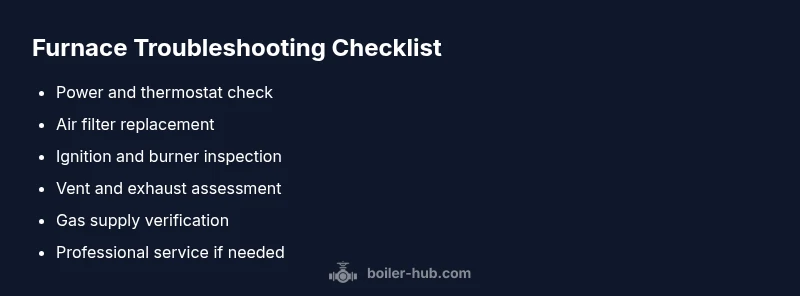
Common Problems with Furnace: Troubleshooting Guide
Urgent furnace troubleshooting guide for homeowners and facility managers. Learn how to diagnose no-heat, cycling, and efficiency problems, with a clear step-by-step flow and safety reminders from Boiler Hub.


Most furnace problems fall into three categories: no heat, short cycling, and reduced efficiency. The top fixes start with simple checks: power, thermostat settings, and a clean air filter. If the furnace still won’t heat or the flame won’t stay lit, call a licensed professional. According to Boiler Hub, many issues begin with basic maintenance and safe troubleshooting.
Why furnaces fail
Furnace failures are rarely mysterious. Most issues stem from neglecting basic maintenance, incorrect thermostat settings, or simple air-flow restrictions. According to Boiler Hub Analysis, 2026, many calls for service start with homeowners missing the obvious: a blown fuse or tripped reset, a dead thermostat battery, or a clogged air filter. When these pieces are in place, heat delivery can be compromised, efficiency drops, and the system may cycle incorrectly or shut down altogether. Understanding these root causes helps you act fast and safely, preventing more expensive repairs later. This section breaks down the most common reasons furnaces stop delivering warmth and how to spot them before they escalate.
Common failure modes
Furnaces fail in several predictable ways. No heat can result from a power or thermostat issue. Short cycling occurs when the furnace starts, runs briefly, then stops before reaching temperature, often due to an overheating limit switch or restricted airflow. Reduced efficiency shows as longer runtimes, higher utility bills, or inconsistent heat, which might indicate dirty burners, a clogged nozzle, or venting problems. Odd noises—popping, banging, or squealing—signal mechanical wear or loose components. Finally, frequent ignitions or flame rollouts can point to gas pressure or venting problems. Knowing these modes helps you triage quickly, while keeping safety front and center.
Start with the basics: power, thermostat, and filter
Before you dive into complex diagnostics, verify the simplest culprits. Ensure the furnace switch is on and the circuit breaker is not tripped. Check the thermostat: correct mode (heat), setpoint higher than room temperature, and batteries or wireless connections functioning. Inspect the air filter for dust and debris; a clogged filter increases static pressure and makes the blower work harder, reducing heat delivery. Clear obstructions around the furnace and ensure there is adequate return air. Document what you observe; this helps when you call in a pro and explains the symptoms clearly. As Boiler Hub emphasizes, most early faults are low-effort fixes that restore warmth.
Inspect ignition, burners, and venting
If heat still doesn’t arrive, inspect the ignition or pilot light. A dirty flame sensor or a worn igniter can prevent flame establishment, leaving the furnace effectively non-operational. For gas furnaces, ensure gas valve is open and listen for a steady flame once ignition occurs. Burners should glow evenly; a yellow flame or soot indicates poor combustion and a need for cleaning or service. Venting problems trap exhaust and can trigger safety shutoffs. Remove any obstructions from the vent cap and ensure outdoor exhaust is clear. If you smell gas, evacuate immediately and call emergency services.
Common error codes and noises
Modern furnaces communicate problems via error codes on the control board. Consult the owner’s manual or look up the code online for a precise diagnosis. Relative to noises, a ticking or banging sound can indicate gas ignition delay or loose blower components. Rattling or squealing usually points to worn bearings or belt issues. A humming noise with no heat may indicate a motor issue or electrical fault. Record any codes or sounds, then cross-check with the service guide to determine whether simple resets help or if professional intervention is required.
Safety and professional help
Safety is non-negotiable when dealing with furnaces. If you suspect a gas leak, a blocked vent, or if you smell rotten egg odor, evacuate and call your gas utility or emergency services. Do not attempt risky repairs yourself on gas-fired equipment. When problems persist after basic checks, or if you hear any abnormal operation (lots of smoke, unusual smells, frequent cycling, or no combustion), contact a licensed HVAC technician promptly. Regular maintenance by a certified pro reduces unexpected failures and extends system life.
Steps
Estimated time: 40-60 minutes
- 1
Power and thermostat check
Turn off the furnace at the power switch, then reset the circuit breaker. Reconnect power and confirm the thermostat is set to heat with a setpoint above room temperature. If there is a programmable thermostat, verify schedule settings and confirm the thermostat wires are properly connected.
Tip: Label wires if you disconnect them and take a quick photo for reference. - 2
Air filter and airflow
Remove and inspect the air filter. If it is dirty or wet, replace it with a filter of the correct size and MERV rating. Ensure the return air path is clear and vents are open to maximize airflow.
Tip: Purchase a spare filter to rotate monthly during peak heating season. - 3
Ignition and flame check
For gas furnaces, observe the ignition sequence. A clean flame sensor and igniter are essential for reliable ignition. If the flame is yellow or inconsistent, do not attempt major repairs; this indicates a service need.
Tip: Never touch burner components with bare hands—electrostatic discharge can damage parts. - 4
Vent and exhaust inspection
Look for obstructions at the exterior vent cap and ensure finished flue pipes are intact. A blocked vent can cause poor combustion and trigger fault codes. Keep the area around the furnace clear.
Tip: If you see soot or a strong odor, stop and call a pro. - 5
Reset, test cycle
Turn the power off and back on after completing the checks, then run a test cycle to observe heat delivery and cycling behavior. Listen for unusual noises or delays in ignition.
Tip: Document any codes or abnormal sounds to share with the technician. - 6
Assess the results
If heat appears but duration is short or inconsistent, focus on airflow or control issues; if there is no heat after resets, the issue may be ignition, gas supply, or a safety switch.
Tip: If unsure, stop and contact a pro rather than forcing continued operation.
Diagnosis: Furnace won't heat or cycles irregularly
Possible Causes
- highPower issue or thermostat wiring problem
- mediumDirty air filter causing restriction and overheating
- mediumIgnition failure or flame sensor dirty
- lowVentilation or exhaust blockage
Fixes
- easyVerify power at switch and circuit breaker; test/replace thermostat batteries; ensure thermostat is set to heat
- easyReplace dirty air filter and ensure proper airflow around furnace; check for closed vents and blower operation
- mediumClean or replace flame sensor/igniter; inspect burner for proper flame color; consider professional ignition service if needed
- mediumInspect and clear vent or chimney blockages; verify proper venting and combustion air supply
- easyIf issues persist, schedule professional service; a licensed HVAC technician may test gas pressure, heat exchanger integrity, and controls
Questions & Answers
What are the most common furnace problems homeowners face?
No heat, short cycling, and poor efficiency top the list. Often the culprits are simple—thermostat settings, dirty filters, or a tripped breaker. When basic checks don’t restore warmth, professional service is advised to avoid safety risks.
Most homeowners see no heat, short cycling, or reduced efficiency. Start with thermostat and filter checks, and call a pro if it persists.
Why won’t my furnace turn on at all?
Power supply or thermostat wiring issues are typical. Check the switch, circuit breaker, and thermostat battery. If the problem isn’t resolved, there may be a gas or ignition problem requiring a pro.
If the furnace won’t turn on, check power and thermostat first; if that doesn’t fix it, call a pro.
What does short cycling indicate?
Short cycling usually means overheating protection is tripping or there’s restricted airflow. Inspect air intake paths, clean or replace filters, and ensure the blower isn’t blocked. If unresolved, a technician should check the blower and controls.
Short cycling means the furnace keeps starting and stopping. Check filters and airflow, then call a pro if it continues.
Is it safe to reset a furnace?
Resetting can clear minor faults but isn’t a substitute for professional diagnosis. If resets don’t fix the issue, avoid repeated cycling and call a technician to inspect gas, ignition, and flame sensors.
Resetting can help briefly, but if the problem persists, get a pro to check gas, ignition, and flame sensors.
When should I replace instead of repair a furnace?
If the system is old, inefficient, or requires frequent repairs, replacement may be more cost-effective in the long run. A pro can run a cost-benefit analysis and help choose an efficient model.
If repairs pile up and efficiency drops, replacement may save money in the long run.
How often should filters be changed?
In general, check monthly and replace every 1-3 months depending on usage, household size, and filter type. Regular changes improve airflow and reduce wear on the furnace.
Check monthly and replace every 1-3 months based on use and filter type.
Watch Video
Key Points
- Check basics first: power, thermostat, and filter.
- Keep airflow unobstructed to maintain heat delivery.
- Call a licensed pro for ignition, gas, or venting concerns.
- Regular maintenance prevents most common furnace problems.