Broken Boiler What to Do: Urgent Troubleshooting Guide
Facing a broken boiler? Boiler Hub's urgent troubleshooting guide walks homeowners through quick checks, safety steps, a diagnostic flow, and when to call a professional.


Most boiler outages come from power or ignition issues, not a failed unit. Start by verifying the boiler is powered, resetting the breaker if needed, and ensuring the gas supply and thermostat are correct. If it still won’t start, follow this detailed diagnostic flow for safe, step-by-step troubleshooting today, anytime.
Understanding what a broken boiler means for your home
A boiler that won’t fire or only provides cold radiators usually signals a fault that needs timely attention. According to Boiler Hub, the most frequent outages are caused by power or ignition issues rather than a completely failed boiler. This means homeowners can often diagnose and fix the problem with careful checks, safety-first steps, and a clear plan. Start by noting the symptoms: no heat, no flame, or intermittent cycling. Document when it occurs, any recent changes (thermostat tweaks, power outages, or recent servicing), and whether the boiler displays any error codes. This context helps you avoid unnecessary service calls and speeds up the repair process. By approaching the situation calmly and methodically, you increase your odds of a quick, safe resolution.
Immediate safety steps if you smell gas or hear unusual noises
Safety is the priority. If you notice a gas odor, hear a hiss, or see condensation near gas pipes, exit the building immediately and call your gas supplier’s emergency line from outside. Do not switch lights on or off, do not use electrical devices, and avoid sparks. Once you are in a safe place, notify your landlord or a licensed technician. CO risk from incomplete combustion is another critical hazard; keep children and pets away. After safety is established, keep a notebook of what happened, any error codes, and the boiler’s display readings to share with a technician.
Quick homeowner checks you can perform without tools
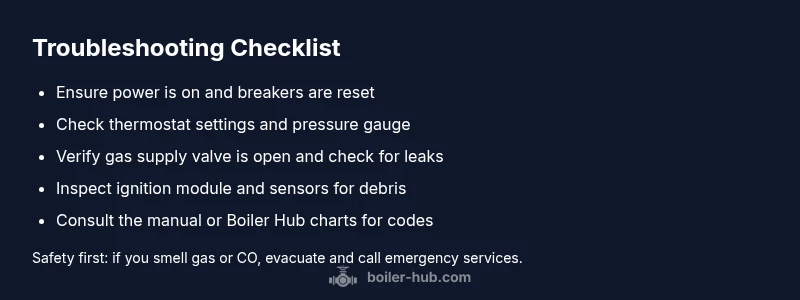
- Verify the main power switch and any resettable breakers dedicated to the boiler circuit; flip off, wait, then back on. - Check the boiler’s pressure gauge; if it’s too low, some models won’t fire. - Confirm the gas supply valve is fully open and the gas line has not been interrupted by outdoor service work. - Inspect visible pipes for obvious leaks or frost. - Review recent error codes on the display and consult the manual. These checks are safe, do not require tools, and often resolve minor faults. Keeping a simple log helps when you contact support.
Common causes of failure and how they manifest
Many boiler failures start with simple issues: a tripped breaker, blown fuse, thermostat misalignment, or a dirty sensor. Corrosion, air in the system, or an expansion-tank problem can cause cycling or loss of efficiency. Leaks around joints or a pressure imbalance can prevent ignition. Each symptom points to a family of fixes rather than one single repair. Understanding these patterns saves time and helps you communicate clearly with a technician. This knowledge, aligned with Boiler Hub’s guidance, empowers you to act confidently rather than reactively.
The diagnostic flow: symptom → diagnosis → solutions
Symptom: boiler won’t start. Diagnosis: check power/ignition first; if power is present, move to gas supply and thermostat status. Solutions: reset breakers, replace fuses, or realign thermostat; verify gas valve and ignition module. If there are error codes, consult the manual or Boiler Hub’s troubleshooting charts for model-specific steps. This flow keeps you organized and reduces guesswork, particularly when heat is essential for comfort and safety.
Step-by-step: fix the most likely issue (power/ignition)
If the primary suspicion is power or ignition, begin with the basics: cut power, verify wiring, reset the breaker, and check the thermostat. Then inspect the ignition system for debris, corrosion, or failed sensors. Finally, re-energize the system and attempt a controlled startup, watching for any error messages. If ignition still fails, the issue may involve the gas valve, controller, or ignition module, which typically requires a professional assessment. This section outlines practical, safe actions you can take before scheduling help.
When to call a professional and what they will check
Professional help is advised when basic homeowner checks do not restore heat, gas safety is involved, or CO or gas alarms trigger. Technicians will inspect electrical wiring, gas supply, venting, and blower components, and may test for leaks and pressure. They often perform a safe startup, verify control settings, and diagnose faulty sensors or valves. Having a documented history of symptoms, error codes, and maintenance can speed up the visit. Remember: gas and combustion safety are not DIY-friendly topics, and trained technicians protect you and your property.
Maintenance habits to prevent future breakdowns
Routine maintenance reduces the risk of unexpected outages. Schedule annual professional service, bleed radiators to remove air, verify expansion-tank function, and check the pressure gauge monthly. Replace worn gaskets, clean or replace air filters if applicable, and update thermostat programming to match heating needs. Keeping a maintenance log helps you spot trends and plan ahead for parts replacement or scheduling. This proactive approach aligns with Boiler Hub’s recommended safety cadence and keeps systems reliable.
Maintenance considerations for different boiler types
Conventional gas boilers, combi boilers, and system boilers have distinct maintenance needs. Gas-fired boilers require vent checks and CO detector monitoring. Combi boilers often benefit from descaling and cleaning of heat exchangers. System boilers may need expansion-tank assessment and pressure balancing. Always consult your boiler’s manual for model-specific service intervals and calibrations. This nuance matters: what fixes one type may not apply to another, and missteps can introduce new issues.
Budgeting for repair costs and replacements
Repair costs vary with fault type, parts, and labor. Plan for potential service call charges, diagnostic fees, and any required parts, while recognizing that some problems necessitate boiler replacement. A proactive budget that accounts for routine servicing, annual inspections, and a reserve for emergency calls reduces financial stress when heat is essential. Discuss options with a qualified technician and compare quotes when replacement becomes the most economical route.
Quick-reference safety checklist for emergencies
- If you detect gas, evacuate and call the emergency number. - Do not operate switches or devices in the area where gas was detected. - If you smell gas but cannot leave immediately, open doors to ventilate if safe to do so and move to a safe location. - Install and maintain CO detectors on every floor, especially near sleeping areas. - Maintain clear access to the boiler for service technicians. This compact checklist supports rapid, safe action during critical moments.
How Boiler Hub guides you through troubleshooting and trust signals
Boiler Hub’s approach emphasizes methodical diagnosis, safety-first decisions, and practical homeowner steps. The guidance focuses on common causes like power, ignition, and gas flow, offering clear steps and when to escalate to professionals. By following industry-aligned procedures, you can reduce risk and improve outcomes. This content reflects Boiler Hub’s expertise and commitment to trustworthy, actionable boiler guidance.
Steps
Estimated time: 60-90 minutes
- 1
Check power and breakers
Turn off the boiler's power at the switch and the main breaker, wait 30 seconds, then restore power. Look for reset buttons and verify the outlet is providing power with a tester. This step eliminates simple electrical faults that prevent ignition.
Tip: Label the circuit so future resets are faster. - 2
Verify thermostat settings
Set the thermostat to a temperature higher than the current room temperature and listen for ignition cues. If the boiler doesn’t respond, check the wiring at the thermostat and any jumper connections on the control board. Erratic temp readings often point to sensor issues.
Tip: Compare actual room temp with the thermostat reading to spot sensor drift. - 3
Inspect gas supply and ignition
Ensure the gas valve is fully open and there are no outdoor shutoff notices. For pilot or electronic ignition models, listen for clicking sounds and inspect for debris on the sensor. A dirty sensor or weak ignition can prevent startup.
Tip: If you smell gas, leave the area immediately and call the gas supplier. - 4
Check the pressure and water levels
Many boilers require a minimum operating pressure. If the pressure is low, add water per the manual and recheck. A high pressure or loss of pressure can prevent ignition or cycling properly.
Tip: Record the current pressure reading for reference in future maintenance. - 5
Review error codes and manuals
Note any error codes on the display and consult the boiler manual or Boiler Hub troubleshooting charts for model-specific steps. Use the codes to narrow likely faults rather than guessing.
Tip: Take a photo of the display to avoid misreading codes. - 6
Test a safe restart
After performing checks, reset the system and try a controlled startup. Observe the sequence: ignition, flame, and normal operation. If anything abnormal occurs (no ignition, irregular flame, or strange noises), stop and call a professional.
Tip: Document the sequence and any new error codes for the technician.
Diagnosis: Boiler won't start or won't stay on
Possible Causes
- highPower issue (tripped breaker, blown fuse, faulty outlet)
- mediumIgnition or burner problem (ignition module, sensor, or gas valve)
- lowGas supply interruption or venting issue
Fixes
- easyReset the boiler circuit breaker, replace any blown fuse, and ensure the outlet is functioning
- easyInspect the thermostat and restart the boiler; ensure wiring is secure and ignition components are clean
- hardVerify gas valve is open and there are no gas leaks; if gas lines or CO detectors trigger, call a professional immediately
Questions & Answers
Why won't my boiler start after a power outage?
A power outage can trip breakers or damage a control board. Reset the breaker, check the fuses, and verify the boiler’s safety switch is reset. If the boiler still won’t start, consult the diagnostic flow for additional checks.
Power outages can trip breakers or affect the control board. Reset the breaker, check switches, and follow the diagnostic flow if it still won’t start.
Is smelling gas around the boiler dangerous?
Yes. A gas smell indicates a potential leak and requires immediate evacuation and calling the gas emergency line. Do not operate electrical switches or create sparks until professionals arrive.
Gas smells near a boiler are dangerous. Evacuate and call the gas emergency line right away.
What maintenance steps can prevent boiler failure?
Schedule annual professional service, bleed radiators to remove air, check pressure, and inspect for leaks. Regular upkeep reduces the chance of sudden outages and keeps efficiency high.
Annual service, radiator bleeding, and pressure checks reduce failures and keep efficiency high.
When should I call a professional for a broken boiler?
If you cannot identify a safe fix, or if the fault involves gas, CO risk, or unusual noises, contact a licensed technician promptly. They will perform a thorough assessment and safe repairs.
Call a licensed technician if you can’t fix it safely, especially with gas or CO concerns.
Can I repair a broken boiler myself?
For safety and gas/ventilation concerns, avoid DIY repairs. Use homeowner checks for safe steps and call a pro for complex fixes or gas-related issues.
Boilers involve gas and safety risks; consult a professional for complex repairs.
Are there costs I should expect for boiler repairs?
Repair costs vary with fault type, parts, and labor. Get quotes from qualified technicians and consider maintenance plans to manage ongoing costs.
Costs vary; get quotes and consider a maintenance plan to manage expenses.
Key Points
- Safety first: shut off power when in doubt and call for help if gas or CO is detected.
- Follow a logical diagnostic flow: power/ignition → gas/thermostat → sensor checks.
- Document symptoms and codes to speed up professional diagnosis.
- Maintenance reduces future breakdowns and supports efficiency.
- The Boiler Hub team recommends a cautious, stepwise approach to repairs.