If boiler doesn t work: Quick Troubleshooting Guide
Urgent troubleshooting guide from Boiler Hub to help homeowners diagnose why a boiler won t work and fix common issues safely. Learn quick checks, diagnostic flow, and when to call a pro.


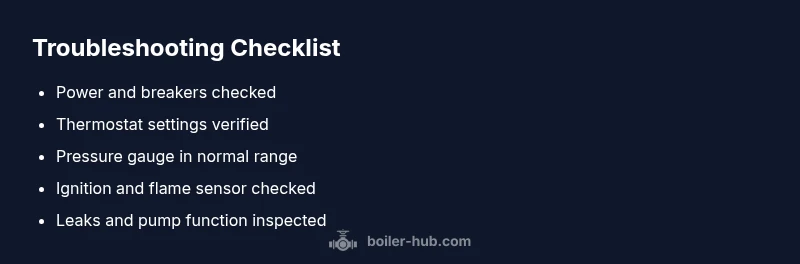
Start with the simplest fixes. Check that the boiler is powered, the circuit breaker is on, and the thermostat is set correctly. Inspect the pressure gauge and refill if needed, then reset the unit. If boiler doesn t work after these steps, move to the diagnostic flow or contact a professional. Safety first—avoid opening sealed components.
Why a Boiler Might Not Start
When your heating system fails to fire up, homeowners often worry about snowbound winters and rising fuel costs. If boiler doesn t work, the problem is usually rooted in a few repeatable causes: a lost power supply, a high-limit or safety switch tripped, incorrect thermostat settings, or very low boiler pressure. The good news is that many of these issues are safe to inspect and fix without specialized tools. In this section, we cover the common scenarios and explain why a restart often resolves the issue. The goal is to empower you to identify the most likely culprit and decide whether you can proceed safely or should call Boiler Hub’s trusted professionals. As always, work methodically and never bypass safety interlocks.
Quick Safety Checks You Can Do Safely
Before touching any boiler components, ensure your area is safe and power is isolated if you need to inspect wiring. Wear protective gloves if you handle hot surfaces and never attempt to disassemble sealed chambers or fuel lines. A quick review of basic safety can save you time and avoid injury. If you smell gas or detect a strong gas odor, evacuate immediately and call emergency services. This section outlines safe, low-risk checks you can perform to rule out obvious issues that prevent the boiler from starting.
Check the Power, Circuit Breaker, and Controls
Power issues are by far the most common reason a boiler won t start. Start by confirming the boiler is plugged in or hard-wired correctly, and the wall switch is on. Check the circuit breaker or fuse box for a tripped breaker or blown fuse related to the boiler circuit. If the power supply is fine, move to the thermostat. Misconfigurations or failed thermostats are an equally frequent fault that prevents ignition. Also verify there isn t a temporary lockout on the boiler’s control panel that needs a reset.
Reading the Pressure Gauge and Refill Procedures
Low boiler pressure prevents the system from firing or shuts it down for safety. Locate the pressure gauge on the boiler’s front panel; it should usually read between 1 and 1.5 bar when cold. If the pressure is low, you’ll need to add water through the fill loop until the gauge sits in the recommended range. Do not overfill. After adjusting pressure, reset the boiler and attempt a restart. If pressure rapidly drops, there could be a leak that needs professional assessment.
Understanding and Interpreting Boiler Codes and Status Lights
Most boilers display status indicators or error codes that tell you what’s wrong. A quick-reference guide in your manual will translate digits or letters into actionable steps. If you don t have the manual, many manufacturers publish code lists online. In general, common codes point to ignition faults, pressure problems, or pump failures. Document the code, reset the unit if instructed, and follow the prescribed steps. If the code persists after a safe reset, proceed to diagnostic flow or professional service.
Diagnostic Flow: Symptom to Diagnosis to Fix
A systematic diagnostic flow helps ensure you don t skip steps. Start with visible factors (power, pressure, controls) and move toward internal components (ignition, flame sensor, valve operation) only if the basics check out. The flow below guides you from symptom to likely diagnosis and then to practical fixes. If you encounter a safety risk at any stage, stop and call a qualified technician.
Step-by-Step Fix for the Most Common Cause (No Heat)
- Verify power and breaker status. 2) Check thermostat setting and room temperature; adjust if necessary. 3) Inspect the pressure gauge and refill if needed to the normal range. 4) Reset the boiler and observe the ignition sequence. 5) Listen for the ignition click or flame; if no flame, the ignition system or gas valve may be faulty. 6) If no improvement, escalate to professional service. Each step reduces risk and narrows the fault.
When to Call a Professional (Safety and Scope)
If you notice gas odors, persistent leaks, or if you can’t safely access the boiler components, stop troubleshooting and call a licensed heating technician. Gas-fired boilers involve fuel and combustion risks; professionals can perform a pressure test, leak check, vent inspection, and ignition system service with calibrated tools. Regular maintenance is essential for long-term reliability and safety.
Maintenance Habits to Prevent Future Breakdowns
Preventive care lowers the likelihood of sudden failures. Schedule an annual professional service, replace worn seals, bleed radiators to remove trapped air, and monitor pressure regularly. Keeping a maintenance log helps you catch a pattern of symptoms before they become a fault. Small, proactive steps save money and keep your boiler operating at peak efficiency.
Steps
Estimated time: 45-75 minutes
- 1
Check power and safety switches
Turn off the boiler, verify the wall switch and circuit breaker are on, and ensure no tripped fuses. If safe, perform a brief reset following the manufacturer’s instructions.
Tip: Document any tripped breakers; it helps the technician diagnose faster. - 2
Verify thermostat settings
Set the thermostat to a higher target temperature than current room temperature and ensure there are no fault indicators on the control panel.
Tip: If you have a smart thermostat, confirm it is connected to Wi-Fi and reporting correctly. - 3
Check boiler pressure
Locate the pressure gauge; if below 1 bar, use the fill loop to raise it to the normal range. Avoid overfilling.
Tip: Refill slowly and recheck the gauge after a brief heat cycle. - 4
Reset and test ignition
Perform a safe reset as per the manual and listen for the ignition spark or burner flame. If ignition fails, proceed with the next steps.
Tip: Never bypass safety locks; this can be dangerous. - 5
Inspect ignition components and gas valve
If you hear no ignition and there’s gas supply, inspect the igniter and flame sensor for dirt or damage. Replace or service as needed.
Tip: Gas work should be done by a licensed pro. - 6
Check for leaks and pump function
Look for wet spots, corroded pipes, or a non-operational circulating pump; leaks indicate a fault that requires repair.
Tip: Shut off power before touching any piping.
Diagnosis: Boiler won t start or fires inconsistently
Possible Causes
- highPower issue (no power, tripped breaker, faulty switch)
- highThermostat misset or faulty
- highLow air pressure / water pressure
- mediumIgnition or flame sensor fault
- mediumGas supply or valve issue (gas boilers)
- lowAir in the system or pump failure
Fixes
- easyRestore power: reset breakers and ensure wiring is intact
- easySet thermostat correctly and check for failed zones
- easyCheck and adjust boiler pressure using the fill loop
- mediumReset ignition/fault codes per manual and retest ignition
- hardInspect gas supply and valve – only if trained; call pro if unsure
- mediumBleed air, check pumps, and inspect for leaks
Questions & Answers
What should I check first if my boiler won’t start?
Begin with power, breaker status, thermostat settings, and boiler pressure. If these basic checks don’t resolve the issue, proceed through the diagnostic flow and consider professional help for ignition or gas-related faults.
Start with power, breaker, thermostat, and pressure. If it still won’t start, follow the diagnostic steps or contact a qualified technician.
Can I reset my boiler myself?
Yes, many boilers support a safe reset from the control panel. Refer to your manual for the correct sequence, and only reset after checking power and pressure. If the problem persists, avoid repeated resets as it can mask underlying faults.
You can reset via the control panel as described in your manual, but don’t keep resetting if ignition or pressure faults remain.
What does a boiler error code mean?
Error codes vary by model. Consult the manual or manufacturer’s website to interpret the code and follow the recommended steps. If codes persist after a reset, call a professional.
Error codes guide you to the fault; check the manual and then reset or call a pro if it continues.
When is it essential to call a professional?
If you smell gas, notice leaks, or cannot safely access the boiler components, stop troubleshooting and contact a licensed technician. Complex ignition, gas supply, or pressure issues require professional service.
Call a professional if you smell gas or encounter leaks, or if ignition or pressure issues persist after basic checks.
How often should a boiler be serviced?
Most manufacturers recommend an annual service by a qualified technician to maintain efficiency, safety, and reliability. Regular checks help catch issues before they fail.
Annual professional service keeps your boiler efficient and safe.
Can air in the system cause a boiler to fail to start?
Yes. Air pockets can prevent proper circulation and ignition. Bleed radiators and verify there’s no trapped air in the boiler loop.
Air in the system can stop ignition—bleed radiators and check the loop.
Is it safe to operate a boiler with a gas leak?
Absolutely not. Evacuate the building, avoid flames, and call emergency services. Do not attempt to operate or repair gas lines yourself.
If you suspect a gas leak, leave immediately and call for help.
What maintenance steps reduce future breakdowns?
Schedule annual service, check pressure, bleed radiators, replace worn seals, and monitor for unusual noises or cycling. Small fixes now prevent bigger outages later.
Regular service and checks help you avoid future boiler outages.
Watch Video
Key Points
- Identify power, pressure, and thermostat first
- Use safe reset procedures and avoid bypassing safety interlocks
- Recognize when to call a licensed pro
- Maintain the boiler regularly to prevent outages
- Document error codes to speed up service