Boiler and Machinery: A Comprehensive Comparison Guide
An objective, in-depth comparison of boiler and machinery options for homes and facilities, covering design, maintenance, efficiency, costs, and risk management to help you choose the right system.


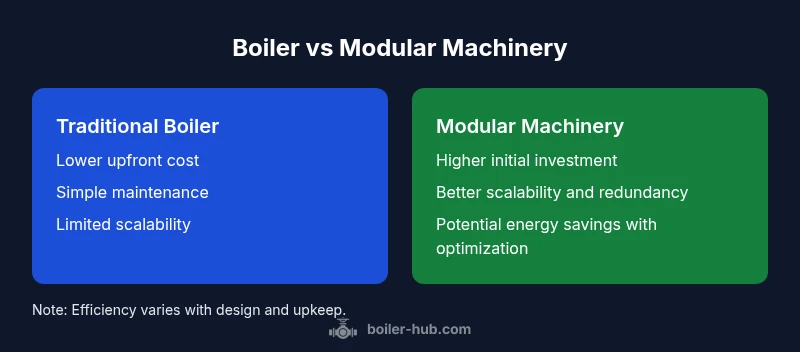
Boiler and machinery options diverge mainly on scale, maintenance, and efficiency. For small to mid-size homes, traditional boiler setups with reliable controls are typically cost-effective and straightforward to service. In larger facilities, modular boiler houses or packaged machinery offer better resilience and energy savings with proper commissioning. Overall, choose boiler systems for simplicity and cost-effectiveness; advanced machinery wins with scale and redundancy.
Overview of Boiler and Machinery Landscape
The market for boiler and machinery spans compact residential boilers to large industrial packaged systems. For homeowners and facility managers, understanding how different designs align with load profiles, fuel availability, and space constraints is essential. In this space, ancillary machinery—pumps, heat exchangers, expansion tanks, and smart controls—plays a critical role in reliability and efficiency. According to Boiler Hub, guidance emphasizes starting with a clear load assessment and a robust maintenance plan to ensure long-term performance. The Boiler Hub team found that even modest upgrades to controls and sensors can improve energy efficiency without major capital expenditure. This section outlines the core categories you will encounter and the questions you should ask when evaluating boiler and machinery options for a building’s heating needs.
Key Components and System Architecture
A typical boiler and machinery setup includes the boiler or boilers, circulation pumps, heat exchangers, expansion tanks, venting or chimney systems, and a control network. Traditional boilers focus on reliable heat generation with straightforward controls, while modern packaged machinery emphasizes modularity, fault tolerance, and advanced sensors. When evaluating systems, consider how controllers integrate with building management systems, the types of fuels supported, and the space required for equipment rooms or dedicated mechanical spaces. For both homeowners and facility managers, a clear diagram of the intended flow—from fuel source through heat generation to distribution—helps highlight potential bottlenecks and maintenance responsibilities. The emphasis across the sector is on dependable operation, predictable service intervals, and the ability to isolate faults quickly for reduced downtime, all within the broader context of system reliability and total cost of ownership.
Sizing, Efficiency, and System Integration
Proper sizing is essential for performance and efficiency. Oversized systems cycle more often, wasting energy, while undersized setups struggle to meet demand during peak loads. Efficiency gains come from better combustion control, condensing technologies where applicable, and optimized pumping and distribution strategies. Integrating boiler and machinery with a building management system enables real-time monitoring of temperatures, pressure, and fuel usage, enabling proactive maintenance and rapid fault detection. For those evaluating different approaches, the decision framework should weigh expected load, peak demand scenarios, and available energy sources. The goal is to balance upfront capital with ongoing operating costs, while ensuring the system remains adaptable to future needs. The discussion should also address regulatory compliance and emissions considerations relevant to the facility and jurisdiction.
Installation Considerations and Code Compliance
Installation quality directly impacts safety, efficiency, and longevity. Proper clearances, venting, and correct piping layout reduce the risk of backpressure, condensation, and leaks. When selecting boiler and machinery, verify compatibility with existing infrastructure, including fuel supply, electrical service, and space constraints. Compliance with local codes, ventilation requirements, and warranty terms is essential. Engage qualified professionals for design and commissioning, and request a detailed commissioning plan that covers startup testing, performance verification, and operator training. Thoughtful planning here prevents avoidable downtime and supports safer, more reliable operation over the equipment’s life.
Maintenance and Lifetime Costs
Preventive maintenance is a cornerstone of reliable boiler and machinery operation. A disciplined schedule for inspection, water treatment, component lubrication, and filter replacement reduces the risk of unexpected failures. Life-cycle costs include initial capital outlay, ongoing fuel and energy costs, routine maintenance, and eventual decommissioning or replacement. In practice, routine checks on water quality, pressure relief devices, and burner performance can yield meaningful improvements in reliability and efficiency. Given the variety of components involved, align maintenance responsibilities with the equipment type and the local service ecosystem. Boiler Hub highlights that well-planned maintenance partnerships can extend asset life and stabilize operating budgets.
Risk Management: Safety, Leaks, and Water Chemistry
Water chemistry and system pressure are central to boiler safety and longevity. Corrosion, mineral buildup, and improper venting can compromise efficiency and safety. Regular checks of boiler pressure, expansion tanks, and leak indicators are essential. Leaks pose both safety risks and potential damage to surrounding structures, so early detection and prompt repair are critical. Proper safety protocols, including lockout/tagout procedures during service and adherence to ventilation requirements, help protect personnel. Proactive risk management also involves training operators to recognize warning signs and establishing clear escalation paths for faults.
Reliability, Warranties, and Service Contracts
Reliability emerges from system redundancy, quality components, and a robust service ecosystem. Traditional boilers offer straightforward reliability but limited redundancy unless designed with parallel paths; modular machinery provides expandable redundancy that is valuable for critical facilities. Warranties and service contracts should reflect expected maintenance needs, response times, and coverage for spare parts. When negotiating service terms, specify preventive maintenance frequency, inspection routines, and documented performance benchmarks. A well-structured service plan reduces downtime and supports predictable budgets over the system’s life.
Data, Monitoring, and Optimization
Modern boiler and machinery setups benefit from data collection and analytics. Real-time monitoring of fuel usage, efficiency, and component health supports proactive maintenance and continuous improvement. Data-driven optimization can identify opportunities to adjust firing rates, pump speeds, and control setpoints to reduce energy waste. For managers, connecting the heating system to a scalable data platform enables trend analysis, alerting, and remote diagnostics. The overarching objective is to maintain reliable operation while minimizing energy costs and emissions, aligning with broader facility performance goals.
Decision Framework: Home vs Commercial Applications
For homes or small commercial spaces, a traditional boiler can offer straightforward operation, lower upfront costs, and solid reliability. In larger buildings with varying demand, modular boiler and machinery configurations deliver scalability, fault tolerance, and potential energy savings when properly designed and maintained. The choice should consider load profiles, space constraints, fuel availability, and the organization’s capability to maintain equipment. The ultimate goal is a system that meets present needs while staying adaptable for future growth, with a roadmap that includes regular maintenance and periodic reassessment.
Comparison
| Feature | Traditional Boiler System | Modular Packaged Boiler/Machinery |
|---|---|---|
| System Size & Scalability | Best for small-to-medium loads | Best for large, variable or peak loads |
| Initial Cost & Installation Time | Lower upfront for simple boilers | Higher upfront due to modules and controls |
| Efficiency & Control | Standard efficiency, straightforward controls | Higher potential efficiency with advanced controls and optimization |
| Redundancy & Reliability | Single-path reliability; simple redundancy is limited | Built-in redundancy and modular expansion |
| Maintenance & Service | Easier maintenance with fewer moving parts | Requires specialized service for modules and controls |
| Space & Footprint | Smaller footprint in many homes | Larger footprint; dedicated equipment room sometimes required |
| Fuel Type & Emissions | Gas/oil or electric with standard venting | Broader options with efficient fuel handling and emissions controls |
Advantages
- Simple, cost-effective setup for small properties
- Easier to source local service technicians
- Lower upfront investment for basic models
- Familiar maintenance routines
- Compact footprint in many homes
The Bad
- Limited scalability for growth or peak demand
- Potentially higher operating costs if outdated
- Less redundancy without separate backup systems
- Longer payback for energy savings in some cases
Modular machinery wins for larger facilities; traditional boilers remain the practical choice for smaller buildings.
For small buildings, a traditional boiler offers simplicity and cost-effectiveness. In larger facilities, modular boiler and machinery provide scalability and redundancy with the potential for energy savings when designed and maintained properly. The choice should be guided by load, budget, and maintenance capacity.
Questions & Answers
What is the main difference between a traditional boiler system and modular boiler/machinery?
A traditional boiler system provides straightforward heat generation with simple controls, suited for smaller loads. Modular boiler/machinery uses multiple modules for scalability and redundancy, enabling better handling of variable or large loads. The choice hinges on building size, expected demand, and maintenance capacity.
Traditional boilers are simple and cost-effective for small buildings, while modular systems offer scalability and redundancy for larger facilities.
How do I determine the right size of boiler and machinery for my building?
Begin with a detailed load assessment that accounts for winter and peak conditions, building envelope, and hot-water needs. Consult a specialist to perform a heat-loss and heat-demand calculation, then compare candidates for matched capacity and efficiency. Oversizing wastes energy, while undersizing risks insufficient heating.
Start with a professional load assessment to match capacity to demand and avoid waste or shortfalls.
What maintenance should I perform regularly on boiler and machinery?
Implement a preventive maintenance plan that includes water treatment, burner inspection, venting checks, pump lubrication, and control calibration. Schedule annual professional inspections for safety devices and critical components. Document all service to support warranties.
Follow a regular maintenance schedule with professional annual inspections and keep records.
Are boiler leaks dangerous and how should I address them?
Leaks can indicate pressure problems, corrosion, or failed seals and may pose scald or system damage risks. Shut down the affected section if safe, call a licensed technician, and avoid attempting repairs beyond your training. Prompt repair minimizes damage and restores safe operation.
Yes, leaks require professional assessment and prompt repair to stay safe.
What signs indicate impending boiler failure?
Watch for unusual noises, fluctuating pressure, frequent cycling, rising energy costs, and visible leaks. Sudden outages or degraded heat quality are red flags. Investigate early with a technician to determine whether repairs or replacement are warranted.
Listen for noises, watch for leaks, and monitor performance; unusual changes warrant a check.
How can I improve boiler efficiency without major capital expenditure?
Optimize controls, ensure proper insulation, and maintain clean heat exchange surfaces. Regularly check burner alignment and flame quality, and consider upgrading sensors or integrating smarter controls when budget allows. Small adjustments can yield noticeable efficiency gains over time.
Tweak controls, keep surfaces clean, and upgrade smart sensors when feasible.
Should I choose boiler maintenance contracts or pay-as-you-go service?
Maintenance contracts provide predictable costs and scheduled inspections, reducing downtime. Pay-as-you-go services can be flexible but may lead to higher emergency repair costs. Evaluate your facility’s reliability needs, budget constraints, and willingness to manage maintenance actively.
Contracts offer predictability; pay-as-you-go offers flexibility but potential risk.
Key Points
- Assess load profile before selecting system
- Prioritize controls and maintenance in planning
- Consider redundancy for critical operations
- Balance upfront cost with long-term energy savings