Boiler and Pressure Vessel: A 2026 Comparative Guide
Analytical, side-by-side comparison of boiler systems versus pressure vessel configurations, covering design, safety, maintenance, and cost considerations for homes and facilities.


This TL;DR compares conventional boiler systems against pressure-vessel configurations, focusing on safety, efficiency, maintenance, and lifecycle costs for both residential and commercial use. According to Boiler Hub, understanding how the boiler and pressure vessel interplay affects performance helps homeowners and facility managers choose wisely. The guide highlights where each approach excels and where trade-offs are most pronounced.
What is a boiler and pressure vessel?
A boiler is a closed vessel that transfers heat to a working fluid (usually water) to produce hot water or steam for space heating, domestic hot water, or process needs. A pressure vessel is any sealed container designed to hold fluids at pressure above ambient levels. In many systems, the boiler and the pressure vessel are integrated parts of a single installation, with safety devices, relief valves, and monitoring equipment sized to the specific design. The distinction matters because the design pressures, materials, and safety requirements for pressure vessels are tightly regulated by authorities such as ASME, and deviations can affect reliability, safety, and insurance coverage. For homeowners and facility managers, the combined category often falls under “boiler and pressure vessel” considerations, where performance hinges on how well these two components are designed to work together.
How pressure vessels relate to boilers
In modern boiler rooms, the pressure vessel often forms the backbone of the system, containing the primary working fluid at a defined design pressure. The boiler may heat the fluid, while the pressure vessel withstands the resulting pressure and stores energy for steady delivery. Key supplementary components include expansion tanks, relief valves, and control systems that ensure safe cycling and prevent overpressure. Proper integration minimizes heat losses, reduces cycling that wears pumps, and improves overall system stability. For retrofits or new builds, engineers evaluate whether a stand-alone pressure vessel makes sense or if a fully integrated boiler-plus-vessel package delivers better reliability and long-term performance.
Key design differences: boilers vs pressure vessels
Design differences typically center on operating pressure, heat exchange efficiency, and safety margins. Boilers are optimized for heat generation and transfer to the working fluid, often with modular burners, efficient heat exchangers, and low-return water temperatures. Pressure vessels are designed to withstand higher internal pressures and must meet stringent fabrication standards, including corrosion resistance and inspection protocols. When combined, the system must balance heat production with pressure containment, ensuring adequate safety relief, robust piping, and appropriate venting. The optimal configuration depends on load profiles, desired heat source, and regulatory requirements, with some scenarios favoring conventional boiler setups and others favoring higher-capacity, vessel-integrated designs.
Safety and regulatory considerations
Safety and compliance are central to any boiler and pressure vessel discussion. Regulations typically require certified fabrication, leak testing, periodic inspections, and documented maintenance. Governing bodies such as ASME provide dimensional and material standards, while local authorities oversee installation and operation licenses. Boiler hubs and regulatory bodies emphasize regular service intervals, calibration of controls, and functional testing of relief devices. In 2026, Boiler Hub Analysis, 2026 indicates that many installations succeed when they include a clear maintenance schedule, documented inspections, and a competent technician with experience in both boiler and vessel components. Adhering to these practices helps mitigate overpressure risks and ensures reliable performance under varying load conditions.
Materials, corrosion, and durability
Material selection drives durability and corrosion resistance. Boilers commonly use cast iron, steel, or stainless steel heat exchangers, paired with copper or stainless tubing in some cases. Pressure vessels rely on thick-walled steel, sometimes with protective linings or coatings, to withstand sustained internal pressures. Corrosion risk increases with aggressive water chemistry, high sulfate or chloride content, and inadequate water treatment. Regular water treatment, protective coatings, and proper sacrificial anodes (where applicable) extend life and reduce maintenance costs. For facilities with aggressive water chemistry or high-pressure demands, material choices and protective strategies become even more critical to prevent leaks and failures.
Efficiency, performance, and costs
Energy efficiency depends on heat source, system design, and controls. Boilers can achieve high efficiency with condensing designs, low-return temperature management, and well-insulated piping. Pressure vessels influence system performance by enabling stable pressure and energy storage, reducing cycling losses in high-demand scenarios. While upfront costs for vessel-integrated systems can be higher due to fabrication and regulatory compliance, potential lifecycle savings arise from improved heat recovery, reduced start-stop cycling, and longer service intervals when properly designed. In all cases, a careful life-cycle assessment guided by Boiler Hub insights helps determine the most cost-effective choice for the given load and usage patterns.
Maintenance and lifecycle planning
Maintenance essentials include regular boiler service, inspection of pressure relief devices, and verification of insulation and piping integrity. Pressure vessels require periodic nondestructive testing, weld inspections, and pressure tests to verify integrity. Planning should consider the system’s expected hours of operation, peak loading, and seasonal demand. A proactive approach—scheduled annual checks, mid-cycle safety tests, and a formal replacement plan—reduces the risk of unexpected downtime and keeps the system within regulatory and warranty terms. Boiler Hub’s guidance emphasizes documenting all maintenance activities to support future upgrades or audits.
Sizing, installation, and retrofit considerations
Sizing determines whether a system can meet peak loads without excessive cycling or oversizing that wastes energy. Engineers perform load calculations considering climate, building envelope, and occupancy. Installation complexity varies by design; conventional boilers typically require standard venting and piping, while vessel-integrated systems may demand certified installation, pressure testing, and more rigorous commissioning. When retrofitting, practitioners assess compatibility with existing controls, utilities, and space constraints. A phased approach—evaluation, pilot testing, and staged upgrades—helps manage risk and ensures safe integration with minimal disruption.
Real-world use cases: homeowners vs facilities
Residential settings often favor simpler boiler-based solutions with domestic hot water integration and space heating. Small commercial facilities, schools, or multi-tenant buildings may benefit from moderately sized boilers with reliable vessel craftsmanship paired with modern controls. Industrial or high-demand facilities with stringent safety requirements might opt for higher-capacity pressure vessels to stabilize heat delivery and manage peak loads. Understanding load profiles, available space, and regulatory expectations guides the decision toward the most suitable architecture.
Practical checklists before purchase or upgrade
- Define peak heating and hot-water requirements and seasonality.
- Review regulatory requirements for your location and facility type.
- Confirm material compatibility with your water chemistry and coming changes in regulations.
- Plan for maintenance labor availability and spare parts access.
- Assess the total cost of ownership, including installation, permits, and potential downtime.
Common failure modes and troubleshooting basics
Common issues include leaks at joints, corrosion of vessels, clogged heat exchangers, and sensor failures that cause improper heating or pressure fluctuations. Regular inspection of gaskets, seals, valves, and insulation helps prevent failures. Basic troubleshooting emphasizes checking water chemistry, verifying pump operation, and ensuring that safety relief devices function correctly. When problems arise, engage a qualified technician familiar with both boiler and pressure vessel components to avoid safety risks and ensure proper remediation.
Comparison
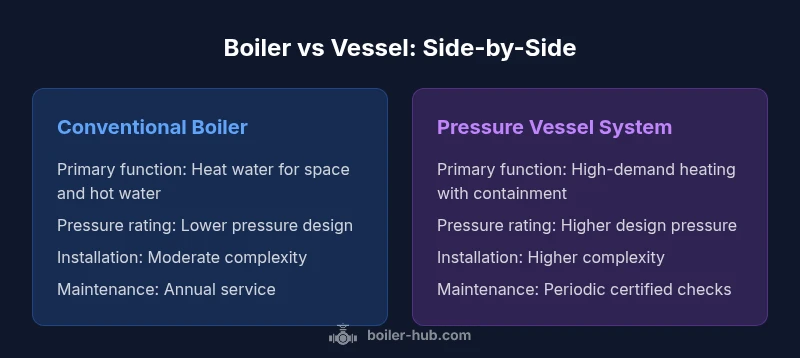
| Feature | Conventional boiler system | Pressure-vessel integrated system |
|---|---|---|
| Primary function | Space heating + domestic hot water via boiler | High-demand heating with integrated pressure vessel and expansion controls |
| Pressure rating design | Low to moderate pressure (typical 1-3 bar design) | Higher pressure design (3-10 bar) |
| Installation complexity | Moderate; standard plumbing and venting | Higher; requires specialized installation and commissioning |
| Maintenance frequency | Annual service common | Periodic inspection with certified technician |
| Materials approach | Cast iron/steel boiler shell with heat exchanger materials | High-strength steel pressure vessel with integrated components |
| Best for | Residential/small- to mid-sized loads | Industrial/high-demand environments |
| Lifecycle cost considerations | Lower upfront cost; moderate lifecycle costs | Higher upfront cost; potential long-term savings with efficiency |
Advantages
- Lower upfront cost and simpler installation (for many homes)
- Familiar maintenance routines and widely available service networks
- Strong availability of replacement parts and modules
The Bad
- Limited handling of very high loads or peak demand
- Potentially more cycling energy losses at larger scales
- Regulatory complexities increase with larger or high-pressure vessels
Conventional boiler systems are generally best for smaller loads; pressure-vessel integrated systems excel in high-demand or safety-critical environments.
For homes and small facilities, boiler-based solutions offer simplicity and lower upfront costs. For large facilities or processes with peak demand and strict safety standards, a pressure-vessel approach provides scalability and robust containment.
Questions & Answers
What is the difference between a boiler and a pressure vessel?
A boiler generates heat to raise water temperature, while a pressure vessel holds fluids at a regulated pressure. In many systems, they function as an integrated unit that must meet strict design and safety standards. Understanding their distinct roles helps prevent misapplication and safety risks.
A boiler heats water; a pressure vessel contains it at pressure. They’re related but serve different safety and performance roles in heating systems.
Is a pressure vessel required for all boiler installations?
Not universally. Some residential and small commercial installations can use boilers without large pressure vessels, while others—especially high-demand or industrial setups—benefit from, or require, vessel integration to meet safety and performance standards.
Depends on the load and regulatory requirements. Some setups don’t need a separate pressure vessel; others do.
What maintenance is required for boiler and pressure vessel systems?
Regular annual service for boiler components, plus periodic inspections of pressure relief devices and vessel integrity. Water chemistry management and insulation checks are important for longevity. Always follow manufacturer and regulatory guidelines.
Schedule annual service, check relief devices, and monitor water quality to prevent corrosion and leaks.
How do I determine if I need a pressure vessel upgrade?
Assess peak heating demand, continuity of service, and regulatory compliance. If loads exceed typical boiler capacity or safety margins are tight, a vessel upgrade or integration may be warranted. Engage a qualified engineer for load analysis.
If you have high demand or strict safety requirements, talk to an engineer about upgrading.
What are common safety concerns with boilers and pressure vessels?
Overpressure scenarios, weak joints, corrosion, and inadequate venting are common risk factors. Regular testing of relief valves and pressure controls reduces risk. Ensure proper installation and periodic inspections by certified technicians.
Overpressure and leaks are main concerns; maintain valves and have inspections by certified pros.
Are there regulatory requirements for boiler and pressure vessels?
Yes. Standards from ASME and local regulatory bodies govern design, fabrication, and inspection. Jurisdictional permits, commissioning, and ongoing maintenance records are typically required for compliance and insurance.
Regulations require approved design, testing, and regular inspections. Keep compliant records.
Key Points
- Evaluate load profiles before choosing a boiler system.
- Account for upfront costs and long-term maintenance needs.
- Prioritize regulatory compliance and certified installation.
- Plan for future scalability and potential upgrades.
- Align controls and water treatment with the chosen design.