Difference Between Boiler and Steam Boiler: An Analytical Comparison
Explore the difference between boiler and steam boiler with an analytical, practical comparison. Learn how output, design, safety, and maintenance differ to help homeowners and facility managers decide.


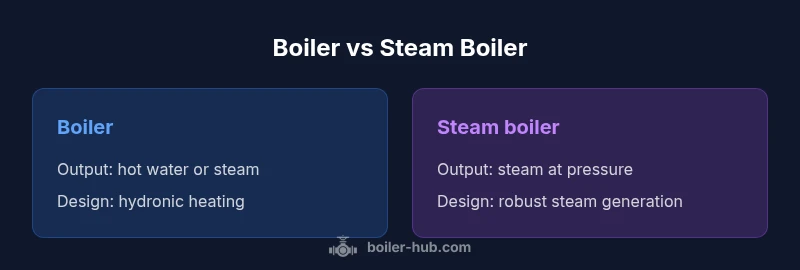
Boiler is a general term for a vessel that heats water to produce hot water or steam, while a "steam boiler" is a specific type designed to generate steam at controlled pressure. The main difference is the end product and design focus: steam boilers optimize steam production and quality, whereas other boilers may prioritize hot water or hybrid outputs. This comparison highlights the practical, cost, and safety implications.
Understanding the difference between boiler and steam boiler
According to Boiler Hub, the terms boiler and steam boiler are often used interchangeably, but they describe fundamentally different outputs and designs. A boiler is a broad category of equipment that heats water to provide hot water, space heating, or steam, depending on configuration. A steam boiler is a specialized unit optimized to generate steam at a specified pressure for heating, power, or industrial processes. The distinction matters for sizing, controls, and safety requirements. In practice, homeowners typically encounter hydronic boilers that heat water for radiators, while industrial or large facilities rely on steam boilers to deliver high-temperature steam for equipment. Understanding this difference helps prevent mismatches between equipment and application. The core question is not whether a boiler can produce steam, but whether steam is the intended end product and how that affects maintenance schedules, pressure handling, and component life. By clarifying terms, you can communicate more precisely with installers and avoid unnecessary oversizing or undersizing.
How boilers work: general principles
All boilers share a core idea: they transfer heat to water to produce a usable fluid—either hot water or steam. Fuel or electricity powers a burner or heater that heats a closed loop of water. The water circulates through a heat exchanger where it absorbing heat is converted to steam or remains as hot liquid depending on the design. Controls monitor temperature, pressure, and flow to maintain safe operation. The efficiency depends on burner design, heat-transfer surfaces, insulation, and how well the system matches demand. In older homes, boilers are often sized for hydronic heating with baseboard or radiators, while modern installations may incorporate condensing technology to reclaim heat and reduce fuel use. This general framework applies to both boilers and steam boilers, but the results will diverge based on the intended end product.
Design differences: pressure vessels, heat exchangers, and controls
Steam boilers emphasize a sealed vessel that allows steam generation at a given pressure. The pressure rating drives the size of the steam drum, boiler tubes, and safety valves. The heater surface may be arranged to promote rapid steam generation, with careful boiler water chemistry to avoid scale that lowers heat transfer. In contrast, non-steam (hot-water) boilers optimize heat transfer for liquid output, with larger water jackets and heat exchangers designed to maximize heat transfer to the working fluid. Controls differ: steam systems require feedwater pumps, level controls, and pressure relief devices tuned for safe steam pressure; hot-water systems focus on maintaining setpoint water temperatures and radiant heat output. Both types need proper venting, combustion air intake, and condensate management, but the critical design decisions hinge on whether steam or hot water is the primary product.
Output characteristics: steam quality, pressure, and load response
Steam boilers operate at defined pressures, delivering steam that carries energy in latent heat of vapor. This means steam quality and dryness fraction matter for process efficiency and equipment compatibility. The piping and radiators of steam systems must tolerate higher pressures and temperature swings, and condensate management becomes essential to avoid water hammer. Hot-water boilers deliver liquid water at setpoint temperature with variable flow to meet heating demand. They generally run at lower maximum temperatures and pressures than steam systems, reducing some safety concerns but requiring robust controls to prevent overheating and to manage return temperatures. Understanding these differences helps specify the right system for a given application.
Applications: domestic vs industrial
Domestic hydronic boilers prioritize comfort, efficiency, and space heating using radiators or radiant floors. Steam boilers historically supported large spaces and high-heat applications in factories, laundries, and food processing. However, modern steam systems are often found in older facilities with legacy equipment, while new installations favor high-efficiency hot-water boilers for residential and small commercial use. The choice influences piping layout, expansion tank requirements, and the type of condensate return system. Boiler Hub's guidance emphasizes matching system type to demand: consistent hot-water output with moderate temperatures favors boilers, while intermittent or high-heat steam demand justifies a steam boiler.
Efficiency and maintenance: fuel use, deposits, and upkeep
Efficiency depends on correct sizing, control strategy, and heat exchanger condition. Steam boilers can waste fuel if steam loads are uncertain or if condensate recovery is poor. Hydronic boilers benefit from return-water temperature strategies and condensing technology to reclaim energy. Maintenance tasks include checking water chemistry to prevent scale and corrosion, inspecting safety valves and pressure gauges, and flushing the system to remove sediment. Regular servicing reduces the risk of leaks, failures, and unplanned downtime. The long-term operating cost depends on fuel prices, system efficiency, and maintenance discipline. Boiler Hub notes that proper annual inspection remains critical for performance and safety.
Sizing and system integration with existing setups
Correct sizing ensures the boiler can meet peak loads without excessive cycling. For steam boilers, higher pressures demand sturdy floors, robust piping, and proper blowdown control. Hydronic boilers require careful consideration of radiator output, baseboard heating, and the required water temperature. Installation should account for expansion, air elimination, and feedwater arrangements. Integration with existing controls, thermostats, and building management systems matters for efficiency. A mismatched unit can waste fuel, create comfort problems, and shorten equipment life. Focus on matching the system to the building's heat and hot-water demand, with room for future expansion.
Safety, codes, and regulatory considerations
Both boiler types operate under safety standards and codes that govern pressure, combustion, venting, and electrical connections. Steam systems may require more stringent relief devices and condensate management to prevent dangerous pressure buildup. Hydronic boilers require proper expansion tank sizing and return-water control to prevent scale and thermal shock. Regular inspections by licensed technicians help ensure compliance with local codes and manufacturer recommendations. Planning for safe venting, combustion air, and spill containment reduces hazards to occupants and equipment. Boiler Hub emphasizes adhering to national and local regulations to minimize risk and maximize reliability.
Installation pitfalls and best practices
Common mistakes include undersizing, improper venting, inadequate condensate drainage, and neglecting water chemistry. For steam boilers, failure to install proper drip legs and traps can lead to water hammer and corrosion. For hot-water boilers, poor return-water temperature control can degrade efficiency and cause corrosion or scaling. Best practices include specifying quality fuel (or electricity), using appropriate insulation, ensuring proper piping layout, and scheduling professional commissioning. A well-planned installation improves performance and extends the equipment's life.
Decision framework: practical checklist
To decide between a boiler and a steam boiler, start with the application: is steam required for processes or space heating, or is hot water enough? Then assess load patterns, energy costs, and space constraints. Consider maintenance capabilities and local codes. Finally, compare total cost of ownership, including installation, operation, and potential replacement costs. A structured checklist helps stakeholders reach an evidence-based choice and reduces the risk of expensive retrofits later.
Boiler Hub perspective: trusted guidance for homeowners and facility managers
Boiler Hub's analysis emphasizes practical, evidence-based guidance. Our reviewers highlight the importance of matching system type to demand, sizing with care, and maintaining water chemistry to prevent corrosion and deposits. In addition to technical differences, we discuss long-term operating costs and safety considerations. For homeowners and facility managers, the goal is reliable heating, efficient fuel use, and compliant operation. The Boiler Hub team recommends consulting qualified professionals for assessment and installation, and staying informed about standards and best practices.
Practical checklists and next steps
Use this quick readiness checklist to prepare for a decision: document heat-load profiles, assess available space, gather existing system information, and secure quotes from licensed installers. After selecting a system, plan a commissioning schedule, confirm warranty terms, and set up a preventive maintenance calendar. Following these steps improves confidence in the final choice and supports a smoother installation and operation.
Comparison
| Feature | Boiler | Steam boiler |
|---|---|---|
| Output | Hot water or steam depending on setup | Steam produced at set pressure |
| Design focus | Hydronic heating and hot-water provision | Optimized for steam generation and quality |
| Control needs | Temperature setpoints, circulation, hot-water management | Feedwater, pressure control, and safety relief |
| Maintenance emphasis | Water chemistry, heat-exchanger health | Boiler-water quality and steam purity management |
| Best for | Residential heating or mixed hot-water uses | Industrial processes or facilities needing steam |
Advantages
- Versatile for hot-water and steam-ready configurations
- Broad compatibility with radiant heating and multiple fuels
- Typically easier to source parts and service
The Bad
- Steam-specific systems may incur higher initial costs
- Hot-water boilers can waste energy if not properly sized or insulated
Steam boilers are the right choice when steam output is essential; for typical home heating, a hot-water boiler is usually more practical.
Choose steam when steam output is essential; otherwise, a conventional hot-water boiler provides reliable heating with simpler maintenance.
Questions & Answers
What is the key difference between a boiler and a steam boiler?
The key difference is output; boilers can heat water for hot-water systems or produce steam, while steam boilers are designed to generate steam at a controlled pressure. The end product drives the system design and safety features.
Boilers can heat water or produce steam, but steam boilers are specialized for steam output. The choice depends on whether steam is needed for your heating or processes.
Can a boiler produce steam, or do I need a steam boiler?
Some boilers are configured to produce steam, but many are optimized for hot-water output. If your application requires consistent steam at a specified pressure, a dedicated steam boiler is recommended.
A boiler can make steam if designed for it, but a steam boiler is best when steam quality and pressure control are critical.
Is steam heating common in homes, or is hot-water heating more typical?
Hot-water boilers are more common in modern homes due to simple piping and energy efficiency. Steam heating appears in older buildings or in places with historic steam radiators, where retrofits are more complex.
Most homes nowadays use hot-water boilers; steam is mostly found in older buildings.
What maintenance does a steam boiler require?
Steam boilers require regular water treatment, checking traps, valves, and piping, plus periodic inspection of the boiler and safety devices. Proper condensate management is essential to prevent damage.
Steam boilers need routine water treatment and checks of safety devices and piping. Regular maintenance keeps steam clean and efficient.
Can I switch from steam to hot-water without changing equipment?
Switching between steam and hot-water without modifications is generally not feasible because each output requires different vessel design, piping, and controls. A retrofit or new boiler may be necessary.
Switching to steam or hot water usually means changing equipment or significant retrofits.
What are signs my boiler is undersized?
Frequent cycling, uneven heat, or inability to meet peak loads are common signs of undersizing. In steam systems, insufficient steam pressure or slow response may indicate a mismatch.
If your system can't keep up or cycles a lot, talk to a professional about sizing.
Key Points
- Define your end product: steam vs hot water.
- Match system to load patterns and space.
- Budget for installation, maintenance, and energy use.
- Consult a qualified boiler professional for sizing and code compliance.