What is a boiler vs water heater: An analytical comparison for homeowners
An analytical comparison of boilers and water heaters—how they work, costs, installation, efficiency, maintenance, and scenarios for choosing one.


TL;DR: A boiler heats water for home heating and often domestic hot water, while a water heater focuses on supplying hot water for taps. In many homes, the choice hinges on whether you also need space heating and how you value efficiency, upfront costs, and maintenance. This comparison breaks down the key differences to help you decide.
What is the core difference between boiler systems and water heaters
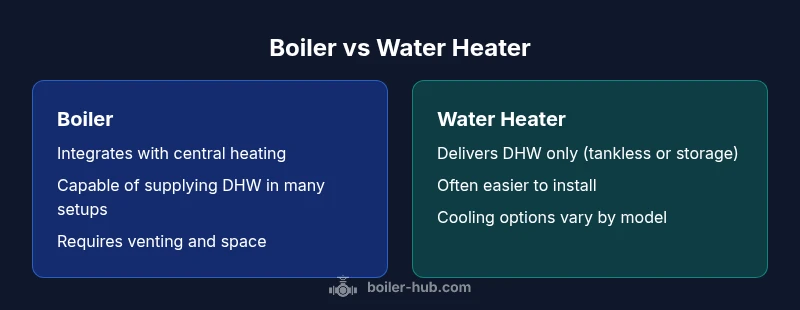
What is the real distinction between a boiler and a water heater? At a high level, a boiler is a central heating unit that can heat water for radiators or radiant floors and, in many configurations, also supplies domestic hot water. A water heater, by contrast, is dedicated to producing hot water for taps, showers, and appliances. According to Boiler Hub, the practical difference is in how the hot water is produced, distributed, and integrated with the home’s heating needs. If your home already relies on a hydronic heating system, a boiler often becomes the backbone of both space heating and hot water. If your home only requires hot water with no central heating loop, a water heater is typically the simpler path. The reader should note that both devices share a common goal—reliable hot water—but they optimize for different end uses and system layouts. This guide uses a clear, side-by-side framework to help you assess options for your climate, footprint, and budget.
In this article, we’ll stay focused on what each device does, how they operate, and what that means for installation, efficiency, and long‑term costs. The goal is to empower homeowners and facility managers to make an informed choice that aligns with their needs and constraints. Throughout, we’ll reference trusted guidance from Boiler Hub to frame practical decisions.
bold:null},{
How a boiler works
Boilers consume a fuel source (gas, oil, or electricity) to heat a fluid, most commonly water, which then travels through a closed loop of pipes to a heat exchanger. In radiant and baseboard heating systems, that hot fluid returns to the boiler after releasing heat into living spaces. When the domestic hot water tap is opened, a portion of the system’s heated water is diverted to the domestic side. The most common modern variants are condensing boilers, which recover latent heat from exhaust gases to improve efficiency. For new homes or remodels, “combi” or system boilers are popular because they can deliver both space heating and hot water, reducing clunkiness in the mechanical room. It’s important to size the boiler correctly to avoid short cycling or excessive standby losses. In short, the boiler is a central, multi-purpose heater built to integrate with a home’s entire heating strategy, not just a single hot-water demand.
Sizing and installation quality can greatly influence performance and long-term operating costs. A well-designed boiler system works in harmony with radiators or underfloor heating, balances temperatures across zones, and minimizes heat loss through well-insulated piping. Practically, this means assessing your home’s heating load, insulation level, and hot water demand before selecting a configuration. The Boiler Hub team emphasizes that an appropriately designed boiler setup reduces energy waste and improves comfort across seasons.
bold:null},{
How a water heater works
Water heaters focus specifically on hot water delivery. Storage-tank models keep a reservoir of hot water heated by a burner or electric element, while tankless models heat on demand as water flows through a heat exchanger. Gas and electric options cover most residential needs, with gas typically providing faster recovery and tankless units offering space savings. Heat pump water heaters are a different category, extracting ambient heat from the surrounding air to heat water more efficiently in moderate climates. Solar-assisted water heaters add another layer of renewable potential but require southern exposure and additional storage and balance. The key takeaway is that traditional water heaters prioritize domestic hot water (DHW) reliability, with size and recovery rate driving performance. When deciding between storage, tankless, or heat pump variants, evaluate your peak hot-water usage patterns, number of simultaneous draws, and the physical space available for equipment and venting.
From a homeowner’s perspective, a stand-alone water heater remains simpler to install, service, and replace than a full boiler-based hydronic system. It is often the most economical choice for smaller homes or apartments that do not require space heating. That said, if you anticipate upgrading to a complete hydronic system in the future, a tankless or hybrid approach might offer better long-term flexibility.
bold:null},{
Types and configurations
Boilers come in several configurations that influence how they pair with home heating and hot-water needs:
- Conventional boilers: paired with a radiator-based system; require a separate water heater for DHW in many setups.
- System boilers: include a built-in buffer or storage components; good for multi-zone heating.
- Combi boilers: provide DHW on demand and space heating from a single appliance; efficient in well-insulated homes.
- Condensing boilers: maximize efficiency by reclaiming heat from exhaust gases.
Water heaters include:
- Storage-tank heaters: store hot water in a tank; simple, reliable, and widely used.
- Tankless (on-demand) heaters: heat water as it flows, delivering continuous hot water with potentially lower standby losses.
- Heat pump water heaters: operate by moving heat rather than generating it; best in homes with moderate climate and adequate space.
- Solar-assisted heaters: supplement conventional heating with solar energy for DHW.
Each configuration has trade-offs in upfront cost, maintenance, and space requirements. The choice should reflect your climate, hot-water usage profile, and whether you also need space heating. Modern designs emphasize high efficiency, easier service, and better control options to optimize performance.
bold:null},{
Efficiency and cost considerations
Efficiency is a major driver of long-term operating costs. Boilers—especially condensing models—offer potential energy savings when paired with well-insulated radiators and thermostat zoning. For DHW, close attention to storage tank insulation, pipe insulation, and heat exchanger efficiency matters. Water heaters show similar efficiency considerations: well-insulated storage tanks, high-efficiency electric elements, and tankless on-demand systems can significantly reduce waste heat. Boiler Hub analysis, 2026, notes that effective efficiency gains come from proper sizing, system design, and routine maintenance rather than relying on any single device type alone. This means even a high-efficiency water heater can underperform if the home’s insulation is poor or if hot-water draws occur in rapid succession without adequate recovery.
Cost considerations blend upfront, maintenance, and energy use. Boilers typically demand higher initial investment because of the broader heating system they support and the necessary venting, controls, and space. Water heaters, especially stand-alone tanks, usually cost less to install initially but may incur higher operating costs if hot-water usage peaks are frequent and recovery is slow. The key is to forecast your annual hot-water demand and heating needs; a careful estimate helps you choose a solution with the best long-run value. The Boiler Hub team emphasizes balancing upfront costs with expected energy savings and system durability to arrive at a sound decision.
bold:null},{
Installation and space considerations
Installation complexity is a critical differentiator. A boiler system requires careful ducting or pipe routing, venting for gas appliances, and often a dedicated mechanical room or closet space. Piping must be well insulated to minimize heat loss, and zoning components allow comfortable temperature distribution across rooms. In contrast, a stand-alone water heater has a smaller footprint and simpler venting or electrical requirements, particularly in retrofit projects. If you have limited space, a compact combi boiler or a tankless water heater might be preferable, but you must evaluate voltage capacity, gas line availability, and venting constraints for either option. In some homes, upgrading to a high-efficiency boiler invites a broader upgrade in insulation, radiant heating design, or thermostat controls to maximize the return on investment. From a safety standpoint, make sure all installations meet local codes and require proper permits. The cost and disruption of installation are often the deciding factors when choosing between a boiler-centered system and a DHW-focused water heater.
The decision should weigh your home’s current infrastructure, future expansion plans, and access to licensed professionals for installation and service. Proper sizing, venting, and zoning can dramatically improve comfort and energy performance, while poor installation undermines even the most efficient equipment. Boiler Hub’s guidance highlights that a well-planned installation reduces long-term headaches and supports consistent hot-water delivery and stable indoor temperatures.
bold:null},{
Choosing based on use case: best for households
Your decision should reflect real-world usage patterns and the structure of your home. In a large home with multiple bathrooms, radiant heating, and a requirement for reliable DHW, a boiler-based system—especially a combi or system boiler—is often the better long-term investment. It provides integrated space heating and hot water management, supports zoning, and can scale as occupancy changes. In smaller homes or apartments where space is tight and there is no hydronic heating load, a dedicated water heater or a compact tankless unit tends to offer the simplest, most cost-effective path. If you anticipate future growth—e.g., adding radiant floors or upgrading to a full hydronic system—consider a modular boiler design that can be expanded.
Another practical factor is climate. In regions with cold winters and high hot-water demand, boilers can leverage efficient condensers and heat reclamation to cut energy use, while northern climates with mild summers might lean toward water heaters with improved insulation. Always size systems to avoid unnecessary cycling and heat loss. Your plan should include a professional load calculation and an evaluation of future needs, such as potential expansions, renovations, or the addition of new fixtures. The Boilers Hub team recommends starting with a detailed home assessment to determine whether a boiler-centric approach or a stand-alone water-heating path is best for your situation.
bold:null},{
Maintenance and common issues
Maintenance plays a pivotal role in sustaining efficiency and reliability. Boilers require annual professional inspections to check burner operation, heat exchanger integrity, venting, and circulating pumps. Regular servicing helps prevent corrosion, scale buildup, and energy waste. Water heaters also benefit from periodic checks: inspecting anode rods in tanks, flushing to remove sediment, and verifying thermostat settings can extend service life and improve efficiency. Tankless water heaters require periodic descaling in areas with hard water to prevent mineral buildup that reduces flow and efficiency. In both cases, leaks are a common warning sign of worn seals, fittings, or pressure valves; addressing leaks quickly is essential to avoid water damage and energy loss. A well-maintained system will deliver more consistent temperatures, fewer outages, and longer life. The Boiler Hub approach emphasizes routine inspection, timely part replacement, and keeping equipment compatible with your home’s insulation and heating strategy for best outcomes.
bold:null},{
Safety, codes, and long‑term planning
Safety considerations relate to fuel type, combustion byproducts, venting, and carbon monoxide risks. Gas-fired boilers and water heaters require proper venting and CO detectors, along with adherence to local building codes. Electric options reduce combustion risks but still require proper electrical connections and overload protection. For long‑term planning, consider the total cost of ownership, potential upgrades (e.g., switching to condensing technology or integrating solar or heat pumps), and the structural capacity of your home for the chosen system. Boiler Hub guidance highlights the importance of clear code compliance, manufacturer recommendations, and professional installation to ensure safety and reliability over decades. A thoughtful approach to future needs—such as adding radiant heating or upgrading to higher efficiency equipment—will help you avoid costly replacements early in a system’s life cycle.
bold:null},{
Brand and warranty considerations
Warranty terms matter for peace of mind. Boilers often come with longer coverage for major components when installed with approved maintenance plans, while water heaters may offer longer warranties on tanks or on-demand elements depending on the brand and model. When evaluating options, review venting requirements, local code acceptance, service accessibility, and the availability of qualified technicians in your area. A strong warranty alongside a solid service agreement can reduce the financial impact of unexpected repairs. If you plan to upgrade as part of a home retrofit, ask about compatibility with future heating upgrades, smart controls, and zoning capabilities. The more you align your choice with the home’s anticipated use, the stronger your long‑term value proposition will be for either boiler or water heater configurations.
bold:null},{
Real-world decision flow and next steps
To move from analysis to action, follow a simple decision flow:
- Clarify your heating needs: do you require space heating in addition to DHW?
- Assess space and venting constraints to determine fit and compliance.
- Estimate usage patterns: peak hot-water demand, number of bathrooms, and occupant behavior.
- Compare operating costs with current energy prices and insulation quality.
- Consult a licensed professional to perform a load calculation and provide a written proposal.
If your goal is to upgrade or replace, start with a professional assessment, then ask for a dual proposal (boiler-based system vs standalone water heater) to compare not just prices but long-term energy usage and maintenance needs. The Boiler Hub team recommends a structured evaluation that balances upfront cost with expected energy savings, system compatibility, and future plans for the home. This approach yields a defensible choice that aligns with your climate, footprint, and budget.
bold:null}],
comparisonTable
prosCons
verdictBox
keyTakeaways
faqSection
mainTopicQuery
Comparison
| Feature | Boiler | Water Heater |
|---|---|---|
| Primary purpose | Provide central heating and domestic hot water (if configured) | Provide domestic hot water for taps and appliances only |
| Heat source options | Gas/oil/electric (boilers) | Gas/oil/ electric (water heaters) |
| Hot water delivery method | Central hot water loop with radiators/underfloor heating | Stored or on-demand DHW (tank or tankless) |
| Space requirements | Requires boiler room or mechanical space; piping and venting | Can fit in utility closet or small space depending on tank or unit type |
| Initial cost impression | Higher upfront due to system complexity and installation | |
| Energy efficiency options | High efficiency condensing/combination options | High efficiency electric or gas tankless/storage options |
| Lifespan and durability | Durable with regular maintenance, longer lifecycle when well maintained | Lifespan depends on tank and components; can be long with proper care |
| Maintenance needs | Annual professional service and system balancing | Regular maintenance and periodic flushing or descaling as needed |
| Best use case | Homes needing space heating and DHW; multi-zone comfort | Homes focused on DHW with limited space usage |
| Typical running costs | Economical when sized and maintained well; potential for lower standby losses | Variable costs depending on model, insulation, and usage patterns |
Advantages
- Potential for integrated space heating with a boiler system
- High-efficiency options (condensing, combi) can lower long-term energy use
- Clear upgrade path when space heating is required
- Water heaters offer simpler installation and often lower upfront costs
- More options for retrofits and scalable configurations
The Bad
- Higher upfront installation costs for boiler-based systems
- Maintenance and service complexity can be higher
- Space requirements and venting can complicate installations
- Tank-style water heaters may incur standby heat losses if not well insulated
Boiler-based systems win for homes needing space heating integration; water heaters win for simple DHW delivery and lower upfront costs
Choose a boiler when you need central heating in addition to hot water and are prepared for a more involved installation. Choose a water heater when your priority is a straightforward hot-water supply with lower initial costs and easier service. The Boiler Hub team emphasizes aligning system choice with climate, space, and long-term energy goals to maximize value.
Questions & Answers
What is the main difference between a boiler and a water heater?
A boiler heats water for space heating and can supply domestic hot water in some configurations, while a water heater provides hot water for taps and appliances only. The choice depends on whether you also need heating and how you want to manage space and energy use.
A boiler often handles heating plus hot water; a water heater focuses on hot water only.
Can you convert a boiler to heat only DHW?
Yes, you can configure a system to primarily supply domestic hot water, but this usually involves reconfiguring or replacing components and ensuring compatibility with your home’s heating needs. A licensed pro should assess whether your current setup can be adapted without compromising safety or efficiency.
You may reconfigure, but get a pro to review feasibility and safety.
Are boilers more energy efficient than water heaters?
Efficiency depends on the model and how the system is used. Modern condensing boilers can be highly efficient, and tankless or high-efficiency water heaters can also be very efficient. The key is correct sizing, installation quality, and appropriate usage patterns.
Efficiency depends on the model and installation, not just the device type.
What should I consider before choosing between a boiler and a water heater?
Consider your climate, existing heating systems, space, upfront cost tolerance, and long-term energy goals. A plan that aligns with future renovations or expansions often yields the best value. Always get an in-person assessment from a licensed professional.
Think about space, climate, and future plans before choosing.
Is a heat pump water heater a good alternative?
Yes, heat pump water heaters are efficient and can be a strong option in moderate climates with adequate space. They work best where electrical capacity and ambient conditions support their operation. They are not a boiler, but they can fit into a mixed system strategy.
Heat pump water heaters are efficient and useful in the right setup.
How do installation costs compare?
Boiler systems generally have higher upfront costs due to complex installation, venting, and controls. Stand-alone water heaters tend to be cheaper to install, but long-term costs depend on energy prices, usage, and maintenance.
Boilers cost more upfront; consider long-term energy use and maintenance.
Key Points
- Assess whether you need space heating beyond hot water
- Prioritize proper sizing to prevent energy waste
- Factor installation space and venting into your decision
- Consider growth plans for the home (upgrades or expansions)
- Evaluate long-term energy costs alongside upfront price