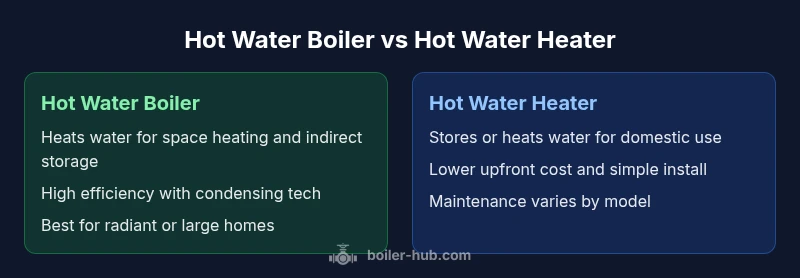
Hot Water Boiler vs Hot Water Heater: A Practical Comparison
Compare hot water boilers and hot water heaters: efficiency, cost, installation, and reliability. Learn which option fits your home or building with practical guidance from Boiler Hub.


Hot water boiler vs hot water heater: the best option depends on your home, budget, and fuel. Boilers excel in efficiency and heating reliability when paired with radiant systems or indirect storage tanks, while conventional storage water heaters offer lower upfront cost and simplicity. Boiler Hub analysis highlights where each option shines and where trade-offs occur.
What are hot water boilers and hot water heaters?
For many homeowners and facility managers, the terms hot water boiler and hot water heater are used interchangeably, but they describe different approaches to producing domestic hot water and space heating. At a high level, a hot water boiler refers to a device that heats water to circulate through a radiant or hydronic system, and may also feed a separate storage tank for domestic hot water. A hot water heater, by contrast, is typically a storage tank or tankless unit dedicated primarily to domestic hot water supply, without integral space heating. The distinction matters because it influences installation, energy efficiency, and the long-term cost of operation. According to Boiler Hub Team, understanding whether you need a boiler-based heating system or a conventional water heater can help you avoid oversizing and optimize fuel use. In many homes, a boiler installed with an indirect water heater tank can deliver reliable domestic hot water with excellent efficiency, especially when paired with a modern condensing boiler. In others, a traditional storage water heater may be the simplest, most affordable entry point, particularly in smaller homes or apartments where space is limited and radiant heating is not used. The choice influences your plumbing layout, electrical or gas supply, and maintenance plan.
How they work: boiler systems vs storage water heaters
A boiler system heats water in a central loop that can distribute heat to radiators, underfloor heating, or indirect hot water storage. The boiler chills water to the required temperature and then circulates it through a closed loop. Domestic hot water may be produced by extracting heat from the boiler loop or by an adjacent storage tank linked to the boiler. A traditional hot water heater, by contrast, stores a supply of hot water in a tank and keeps it at the set temperature until a faucet is opened. Tankless water heaters heat water on demand but are still considered hot water heaters when discussed in this context. The distinction matters for flow rates, recovery times, and how your home uses hot water. According to Boiler Hub Team, the system design should reflect the daily hot water load and whether radiant heating is part of the plan. In homes with high heat demand or integrated radiant systems, boilers with indirect storage are often the most efficient route, while for small households with modest hot water needs, a standard storage heater can be adequate and straightforward to install.
Key differences in practice
- Energy path: boilers transfer heat to a separate loop or indirect storage, while storage water heaters heat and store water for direct use.
- Space: boilers require a mechanical room or utility area; storage heaters need space for a tank.
- Upfront cost: boilers plus installation tend to be higher; storage heaters are usually cheaper to purchase and install.
- Maintenance: boilers require annual service and may need specialized parts, while storage heaters often have simpler maintenance tasks.
- Reliability and supply: with proper sizing, boilers can offer a more constant supply when paired with an indirect tank; storage heaters can run out of hot water if the tank is not adequately sized.
- Fuel and emissions: system choice may affect fuel type (gas, oil, electric) and associated emissions, depending on local utilities and efficiency standards.
Efficiency and operating costs explained
Efficiency is a central factor when comparing hot water boiler vs hot water heater. A boiler installation that uses condensing technology and an indirect water heater can achieve high use of the available energy, lowering operating costs over time, especially in homes with significant hot water and heating loads. Storage water heaters’ efficiency varies by model and insulation. Even with good insulation, a storage tank loses heat to the surroundings, which increases standby losses. In practice, the most economical option depends on your hot water demand pattern, climate, and fuel costs. Boiler Hub’s perspective emphasizes sizing accuracy and choosing modern, well-maintained equipment to minimize waste and maximize energy use. The long-term value is often about balancing upfront investment with expected energy savings and system life. If you regularly use hot water for radiant heating or domestic indirect water heating, a boiler with an indirect tank can deliver cost savings through higher efficiency per gallon of hot water produced, compared with a legacy storage heater.
Sizing, installation, and maintenance considerations
Appropriate sizing is critical for both options. Oversized equipment wastes energy and money, while undersized systems struggle to meet demand during peak periods. A boiler installation for radiant heating typically requires careful load calculations that account for space heat and domestic hot water combined or separately. Storage water heaters should be sized by the peak hourly rate and daily hot water usage; tank size should align with family size and shower usage. Installation quality matters: venting, piping, and controls all influence performance and safety. Maintenance for boilers includes annual burner or heat exchanger service, pressure checks, and system flushing; for storage heaters, periodic anode rod inspections and thermostat checks are common. Regular maintenance reduces risk of leaks, thermostat failure, and corrosion, extending the life of the system. Boiler Hub’s guidance highlights the importance of professional sizing and an informed choice based on your climate and occupancy patterns.
Real-world scenarios and decision guide
In a cold climate with frequent heating needs and a large daily hot water draw, a boiler with indirect storage often yields better energy efficiency and comfort. In a small apartment with modest hot water demand and no radiant heating, a traditional storage water heater might be the most cost-effective, easiest to install option. For homes with space constraints, wall-mounted boilers and compact indirect tanks can save room compared with large storage tanks. If you anticipate potential future expansion to radiant floor heating, starting with a boiler-based system can simplify upgrades later. Boiler Hub emphasizes a careful assessment of household patterns, peak usage, and the feasibility of upgrades to a boiler-based solution.
Safety, codes, and reliability considerations
Both boiler-based and storage-based systems require proper venting, gas line sizing, water quality management, and adherence to local codes. Faulty venting or improper clearance can create safety hazards, while improper sizing can lead to temperature swings or insufficient hot water. Reliability hinges on quality components, skilled installation, and regular maintenance. To maximize safety and longevity, consult qualified professionals, ensure proper water treatment if your water is high in minerals, and follow manufacturer service intervals. The Boiler Hub Team notes that safety is non-negotiable and that investing in proper commissioning and periodic maintenance pays off in reliability and comfort.
Decision checklist and next steps
Use this quick checklist to decide between a hot water boiler vs hot water heater: 1) assess your heating load and hot water demand; 2) evaluate space, venting, and fuel options; 3) consider future plans for radiant heating; 4) compare lifecycle costs rather than upfront price alone; 5) get a professional load calculation and install plan. If you already know you have radiant heating or you anticipate it, a boiler with indirect storage is often the smarter long-term choice; otherwise, a traditional storage heater can be a pragmatic and cost-effective option. This approach aligns with Boiler Hub’s emphasis on practical, data-informed decisions that balance performance and cost over time.
Comparison
| Feature | Hot water boiler with indirect storage | Conventional storage water heater |
|---|---|---|
| Energy efficiency | High efficiency with boiler/indirect storage | Moderate to high efficiency depending on model |
| Space requirements | Compact boiler unit; needs mechanical room | Requires space for a storage tank, often in utility room |
| Initial cost | Higher upfront (equipment + installation) | Lower upfront (equipment + installation) |
| Maintenance needs | Annual service; potential for specialized parts | Generally simpler maintenance |
| Hot water supply reliability | Strong with properly sized indirect tank | Direct tank supply; may run out if undersized |
| Fuel options | Gas, oil, or electric (dependent on setup) | Typically gas or electric; fuel varies by model |
Advantages
- Higher long-term energy efficiency with boilers
- Better compatibility with radiant heating and indirect storage
- Flexible fuel options depending on installation
- Potential for longer system life with proper maintenance
The Bad
- Higher upfront cost and more complex installation
- More expensive repairs and parts when service is needed
- Longer payback period in some homes without radiant heating
Boiler generally offers better long-term efficiency and reliability for homes with radiant heat; storage water heaters are simpler and cheaper upfront.
In homes with radiant heating or high hot water demand, a boiler-based system with indirect storage is typically the smarter choice for efficiency and comfort. For small spaces or simpler needs, a conventional storage heater remains a viable, cost-effective option.
Questions & Answers
What is the main difference between a hot water boiler and a hot water heater?
The main difference is that a boiler heats water for space heating and can feed indirect domestic hot water, while a traditional hot water heater focuses on storing or delivering domestic hot water. The choice affects installation, efficiency, and overall lifecycle costs.
The boiler handles space heating and may feed indirect hot water, whereas the heater focuses on domestic hot water alone.
Which option is more energy efficient?
Boiler systems with condensing technology and indirect storage are typically more energy efficient in homes with radiant heating or high hot water demands. Traditional storage heaters vary by model and insulation, and their efficiency depends on standby losses and usage patterns.
Boilers with indirect storage tend to be more energy efficient, especially in larger or colder homes.
Is a boiler better for homes with radiant heating?
Yes, boilers are generally better suited for homes with radiant floor or baseboard heating because they can efficiently provide both space heating and domestic hot water, especially when paired with an indirect tank.
If you have radiant heating, a boiler plus indirect storage is usually the smarter choice.
What maintenance is required for each system?
Boilers require annual servicing, including burner checks, pressure tests, and possible descaling. Storage water heaters need thermostat checks and periodic inspection of the anode rod or tank components, depending on the model.
Boilers need yearly service; storage heaters need periodic thermostat and component checks.
How should I size a system?
Sizing should be based on peak hot water demand and space heating load. For boilers, a professional load calculation is essential; for storage heaters, match tank size to household water usage patterns.
Get a pro to calculate loads, then choose equipment sized to your peak needs.
Key Points
- Assess your heating and hot water load first
- Balance upfront costs with long-term operating savings
- Consider space, venting, and fuel options
- Prioritize proper sizing to avoid oversizing or undersizing
- Plan for future upgrades to radiant heating when useful