Difference Between Boiler and Hot Water Heater: A Practical Comparison
Explore the difference between boiler and hot water heater, how each works, and which is best for your home. This Boiler Hub comparison covers efficiency, installation, costs, and practical guidance.


According to Boiler Hub, the difference between boiler and hot water heater centers on function: boilers heat for space heating and may feed indirect DHW; hot water heaters store and deliver DHW directly. If you want centralized heating plus hot water, a boiler is usually better; for DHW-only needs, a storage heater may suffice.
What is the difference between boiler and hot water heater?
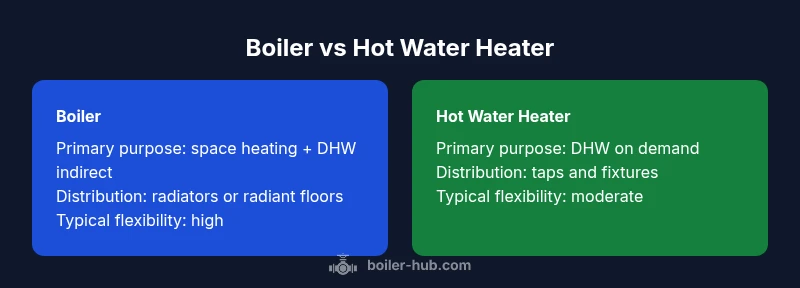
At its core, the difference between boiler and hot water heater is about purpose and how water is heated and used in your home. A boiler is part of a broader heating system; it heats water (or creates steam) to circulate through radiators or radiant panels for space heating and may provide indirect domestic hot water via a heat exchanger. A hot water heater, by contrast, is a dedicated appliance designed to store and deliver heated water directly to taps and showers. In practice, most homes choose a boiler when space heating is a priority, and a storage water heater when DHW is the main goal. This distinction matters for efficiency, control strategies, and service requirements.
How they heat and distribute hot water
Boilers heat water in a closed loop that serves either a hydronic heating system or both heating and domestic hot water through indirect means. When used for DHW, an indirect tank or heat exchanger draws heat from the boiler to warm potable water. Hot water heaters heat water in an internal tank and distribute it directly to faucets and appliances. They do not typically participate in space heating unless paired with a separate boiler or a combi system. The distribution networks differ: boilers rely on radiators or radiant floors, while water heaters feed standard plumbing fixtures.
Heating capacity and output characteristics
A boiler’s strength lies in its ability to supply heat for entire zones of a home and to offer DHW via a heat exchanger or indirect coil. This makes boilers suited for multi-room setups and homes with radiators, especially when you want consistent ambient comfort alongside hot water. A hot water heater focuses on delivering a steady supply of domestic hot water but does not by itself provide space heating. If your home relies on forced-hot-air or radiant heating, a boiler-based system can deliver a more integrated solution.
Efficiency, energy use, and costs
Efficiency considerations hinge on system design rather than the appliance alone. Modern condensing boilers can achieve high efficiency, particularly when paired with zone controls and proper insulation. Storage water heaters have standby losses associated with keeping a tank of hot water hot, which can reduce overall efficiency in some configurations. Electric storage heaters may offer simpler operation but can carry higher electricity costs in certain markets. Boiler Hub analysis shows that efficiency gains are often tied to how well the system is sized, installed, and maintained, rather than the appliance type alone.
Installation, space requirements, and venting
Boilers require space for the boiler unit itself, along with associated piping, expansion tank, and venting (gas or oil) or electrical connections for electric variants. They also need appropriate clearance and sometimes a dedicated mechanical room. Hot water heaters are typically more compact and can fit in closets or utility rooms, but their venting and electrical requirements remain critical. In both cases, proper clearance, accessibility for service, and adherence to local codes matter for safe and reliable operation.
Lifespan, reliability, and maintenance
Boilers, when properly maintained, tend to offer robust long-term reliability, especially if they are modern, high-efficiency models. Hot water heaters can be reliable as well, but tank-based systems incur standby losses and may require regular tank maintenance, anode rod checks, and occasional flushing to remove sediment. Routine service, yearly inspections, and timely replacements when components wear out are essential in both setups. Planning for service availability in your region helps reduce downtime and unexpected repair costs.
Use-case scenarios and decision guide
For homes that require steady space heating plus hot water, a boiler-based system with an indirect DHW option often delivers the best balance of comfort and efficiency. If your primary objective is a simple, economical supply of domestic hot water with limited or no space heating needs, a conventional storage hot water heater may be the most straightforward choice. In homes with rising electric rates, a boiler linked to a heat pump or solar aiding DHW could be attractive. Understanding your climate, fuel options, existing infrastructure, and future plans is key to selecting the right path.
What to ask your contractor
When comparing boiler vs hot water heater options, ask about system compatibility with your current heating layout, fuel type, and local codes. Request detailed efficiency data, potential indirect DHW configurations, estimated installation costs, and maintenance requirements. Inquire about space constraints, venting needs, and the impact on future upgrades or expansions. A qualified contractor can translate your priorities into a clear plan with a feasible timeline.
Comparison
| Feature | Boiler | Hot Water Heater (storage) |
|---|---|---|
| Primary purpose | Heats water for space heating and can provide indirect DHW | Heats and stores water for DHW only (taps, showers) |
| Heating method | Heats water in a closed loop for radiators or radiant floors; may heat DHW via indirect coil | Stores heated water in a tank; delivers DHW directly to fixtures |
| Typical installation context | Integrated with space-heating system; often in mechanical room or basement | Utility closet or basement with direct venting and plumbing connections |
| Output type | Provides heating for living space and can supply DHW indirectly | Provides domestic hot water on demand from stored supply |
| Efficiency considerations | High efficiency with modern condensing boilers and zoning | Efficiency affected by standby losses from tank; temperature control matters |
| Best use case | Homes needing centralized heating and DHW via indirect path | DHW-focused setups with simpler plumbing and potentially lower upfront cost |
| Cost considerations | Higher upfront and installation complexity; ongoing fuel costs depend on fuel type | Lower upfront cost for basic DHW; potential ongoing tank maintenance |
Advantages
- Boilers can provide integrated space heating and DHW, improving comfort
- High efficiency with modern condensing designs and zoning
- Flexible fuel options (gas, oil, electricity) and scalable configurations
- Centralized control can simplify household energy management
The Bad
- Higher upfront installation cost and more complex setup
- Ventilation, space, and maintenance requirements are stricter
- DHW capacity depends on indirect configurations or additional components
Boiler systems are typically preferable for homes needing space heating plus DHW; storage water heaters are simpler and cheaper when DHW is the sole requirement.
If central heating is part of your plan, a boiler offers better integration and long-term efficiency. For DHW-only needs with tighter budgets or simpler plumbing, a storage heater can be sufficient and cost-effective.
Questions & Answers
What is the main difference between a boiler and a hot water heater?
The main difference is function: a boiler primarily heats water to support space heating and may provide indirect hot water, while a hot water heater stores and delivers heated water directly to taps. This affects installation, efficiency, and maintenance needs.
Boilers heat space and may supply hot water indirectly; water heaters supply hot water directly to taps.
Can a boiler provide domestic hot water?
Yes. A boiler can supply domestic hot water through indirect heating or a dedicated DHW coil inside a storage tank. The specific configuration depends on your system design and local codes.
Yes, often via indirect heating or a DHW coil.
Which is more energy-efficient for a multi-story home?
Efficiency depends on system design and usage. Boilers with condensing technology and zoning can be highly efficient for multi-story homes; traditional storage water heaters may incur standby losses that reduce efficiency.
Efficiency depends on design and usage; boilers with modern tech are often efficient.
What maintenance is required for boilers vs water heaters?
Boilers typically require annual servicing, filter checks, and venting inspections. Hot water heaters need periodic flushing to remove sediment and occasional checks of the anode rod (for tank types).
Annual boiler service and periodic water heater maintenance are recommended.
Is conversion or replacement needed when switching from a water heater to a boiler?
Often yes. Switching involves adapting venting, fuel supply, and control wiring to support space heating. A professional assessment helps determine the exact scope and cost.
Usually requires venting and control adjustments by a pro.
Key Points
- Identify primary need: space heating vs DHW only
- Boilers excel with centralized heating; storage heaters suit DHW-only setups
- Consider efficiency drivers: condensing tech, zoning, standby losses
- Account for installation space, venting, and local codes
- Plan maintenance and potential future upgrades with your contractor