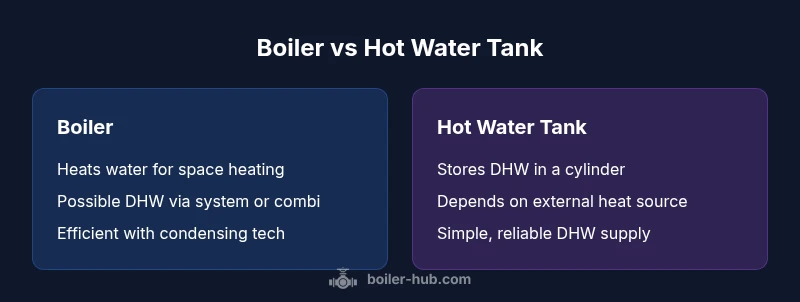
Difference Between a Boiler and a Hot Water Tank: A Practical Guide
A thorough, analytical comparison of boiler vs hot water tank, covering heating methods, storage, efficiency, costs, and installation to help homeowners decide which system best fits their home and goals.


When deciding between a boiler and a hot water tank, consider what you need most: space heating and DHW supply or DHW storage with a simpler setup. A boiler heats water for space heating (and can provide DHW in many configurations), while a hot water tank stores heated water for domestic use. The choice hinges on your home layout, usage patterns, and long-term maintenance expectations.
Understanding the difference between a boiler and a hot water tank
In residential heating, the distinction between a boiler and a hot water tank is fundamental for planning energy use and system design. A boiler is a heat source that can warm water for space heating and, with the right configuration, supply domestic hot water (DHW). A hot water tank, by contrast, is a storage vessel that holds heated water for DHW delivery. This difference matters because it shapes installation requirements, operating costs, and the long-term flexibility of your home’s heating strategy. According to Boiler Hub, recognizing the difference between these two approaches helps homeowners pick the right configuration for their climate, family size, and future plans. The Boiler Hub team emphasizes that the decision should align with how you live in the home and how you expect to evolve your heating system over time.
From a practical standpoint, you can view the boiler as the central engine for heating, while the hot water tank is a reservoir that ensures hot water availability. This framing makes it easier to compare how each option fits your space, budget, and daily routines.
How boilers heat water and provide space heating
A central boiler heats water that is circulated through radiators or underfloor piping to provide space heating. There are three common configurations: combi (on-demand DHW and space heating from a single unit), system boilers that work with a separate hot water cylinder, and conventional or heat-only boilers paired with a storage tank. Each approach has distinct advantages. Combi boilers save space and can deliver DHW quickly, but may struggle to meet high DHW demand in larger households if multiple taps run simultaneously. System boilers paired with a DHW cylinder offer robust hot water supply and strong peak performance, at the cost of extra space and plumbing. Conventional boilers provide reliable heating for older homes but rely on a separate DHW tank, which increases hardware and maintenance requirements. Efficiency gains come from modern condensing designs and smart controls; the real question is how you balance space, demand, and future upgrades.
How a hot water tank stores and delivers DHW
A hot water tank stores heated water in an insulated cylinder, ready for immediate DHW use. Tank size, insulation quality, and recovery rate determine how much hot water you can draw before the supply runs cold. Superior insulation minimizes standby heat loss, keeping operating costs lower. Some systems use indirect heating, where a boiler heats a coil inside the tank rather than circulating water through the primary loop. This arrangement preserves DHW reliability while centralizing the heating load. In many homes, a DHW tank works alongside a boiler to produce hot water efficiently when space heating is necessary, though this setup requires careful sizing and control strategies to avoid unnecessary energy use.
Key technical distinctions: heat source, control, and durability
The core technical differences revolve around heat source, control architecture, and durability. Boilers run on fuels like natural gas, oil, or electricity and can be highly efficient, especially in condensing designs with modern modulating controls. Hot water tanks depend on an external heat source (boiler, heat pump, or electric element) to reheat stored water. Control logic—thermostats, outdoor reset controls, and smart zoned heating—determines when heat is produced and when hot water is drawn. Durability varies by component quality, water quality, and maintenance habits. Boilers typically demand venting and space planning, while tanks require access for replacement and periodic anode checks. Understanding these distinctions helps you pick a system that matches your home’s climate, insulation, and occupancy patterns.
Energy efficiency, operating costs, and payback
Efficiency and operating costs hinge on system design and usage patterns. Condensing boilers capture additional heat from exhaust gases, delivering high thermal efficiency when paired with well-insulated radiators and precise controls. Hot water tanks incur standby losses—heat that leaks away while the water sits in storage—which can increase yearly energy usage if the tank is oversized or poorly insulated. Boiler Hub Analysis, 2026 notes that the biggest determinant of long-term costs is how often space heating runs and how that load overlaps with DHW demand. In homes with substantial space heating needs, a well-designed boiler-based system—even with a DHW cylinder—can outpace a DHW-focused tank for total energy costs. The takeaway is to align system type with load patterns and invest in modern controls.
Space, installation, and maintenance considerations
Installation logistics for boilers involve space planning, venting, and ensuring a safe gas or electrical supply. Proper clearances and combustion air are essential for safety and efficiency. Routine maintenance—annual servicing, vent checking, and pressure calibration—ensures reliable operation and longer life. Hot water tanks require a suitable location that minimizes freeze risk and allows straightforward replacement. Insulation and tank design influence standby losses, so selecting a well-insulated cylinder matters even if you already have a boiler. In both scenarios, professional installation is critical to meet local codes and optimize performance. When upgrading, evaluate existing piping, radiator layout, and insulation to maximize the benefits of either option.
Choosing based on use-case: families vs single occupants
Daily water use patterns guide the decision. Large families with simultaneous showers and dishwashing benefit from a DHW storage system or a boiler with a robust DHW cylinder that can handle peak demand. Single occupants or small households with predictable hot water use may prefer a compact combi boiler to save space and simplify the system. If space heating is a priority, boilers offer better integration with radiators and zoning controls. Tanks excel when DHW reliability matters more than rapid, simultaneous taps. Hybrid configurations—combining a boiler with a heat pump or solar thermal—offer a path to higher efficiency and lower emissions, especially in climate zones with long heating seasons.
Common myths and misconceptions
Many homeowners assume boilers always consume more energy than storage tanks; actual energy use depends on equipment quality, efficiency ratings, and usage patterns. Some people think hot water tanks cannot be efficient; modern designs with good insulation can minimize standby losses. Others assume tankless systems are always cheaper; upfront costs and ongoing maintenance can offset savings in some homes. A common misunderstanding is that all boilers are equivalent; newer condensing models with advanced controls provide substantial efficiency gains compared with older units. Finally, some believe DHW capacity is tied exclusively to tank size; in many configurations, capacity can be influenced by system design and indirect heating strategies.
Modern options and hybrids
The market now features a range of modern boiler configurations, including combi, system, and heat-only designs, many with smart controls and zoning. Hybrid installations pair boilers with heat pumps or solar thermal to reduce energy use and emissions. When space is tight, compact wall-mounted boilers with a high-efficiency DHW cylinder can provide both space heating and DHW efficiently. For renovations or new builds, evaluate efficiency ratings, warranty terms, and compatibility with future upgrades. Hybrid options may offer a better long-term return by reducing energy costs alongside emissions.
Replacement and upgrades: what to plan for
Planning a replacement or upgrade requires a systematic approach. Begin with a professional assessment of current radiator layout, piping, insulation, and climate conditions to determine the most suitable system. Budget for equipment, permits, venting, and any necessary upgrades to gas lines or electrical circuits. If you anticipate future improvements—such as a heat pump or solar integration—choose a boiler with high efficiency ratings and compatibility with smart controls. For DHW upgrades, size the storage tank based on peak daily demand and consider indirect heating if you already operate a boiler. A careful plan minimizes downtime and balances upfront costs with long-term savings.
Comparison
| Feature | Boiler | Hot water tank |
|---|---|---|
| Primary function | Heats water for space heating; can provide DHW with the right configuration | Stores heated water solely for domestic hot water |
| Heating method | On-demand or system-based heat delivery with potential storage cylinder | Stores DHW in an insulated cylinder; heating source external to the stored water |
| Energy efficiency | High efficiency with condensing designs and proper controls | Efficiency depends on tank insulation and heating source used to reheat |
| Space requirements | Requires space for boiler unit, venting, and piping | Requires space for the DHW tank; size scales with usage |
| Cost range (installation) | $3,000–$8,000 for boiler installation or replacement | $1,500–$5,000 for tank-based DHW installation or replacement |
| Maintenance | Annual boiler service, vent checks, and system calibration | Periodic tank inspection, insulation checks, and possible anode maintenance |
| Lifecycle | Typically 15–20 years with proper maintenance | Typically 10–15 years depending on water quality and upkeep |
| Best for | Homes needing space heating with central DHW provision | DH W-focused homes or spaces where DHW is primary concern |
Advantages
- Consolidates heating and DHW capabilities for many boiler setups
- Potentially lower long-term operating costs with modern boilers
- Broad compatibility with existing radiators and control systems
- Flexible options for future upgrades or hybrid configurations
The Bad
- Higher upfront and installation costs compared with simpler tanks
- Requires space, venting, and professional servicing for boilers
- Maintenance can be more complex than a standalone DHW tank
- Tank-based DHW systems can be simpler but may miss some heating benefits
Boiler-based systems generally offer broader functionality and potential long-term savings, but a dedicated hot water tank can be simpler and cheaper for DHW-focused homes.
For homes needing space heating integration, a boiler setup is usually advantageous. If DHW demand dominates and space is tight, a storage tank can be the smarter, more economical choice. The Boiler Hub team recommends evaluating both options against your home's current and future needs to determine the best long-term solution.
Questions & Answers
What is the main difference between a boiler and a hot water tank?
The main difference is that a boiler provides heat for space heating and can supply DHW in configured setups, while a hot water tank stores heated water solely for domestic use. This affects installation, efficiency, and how you’ll meet heating and hot water demands.
A boiler heats water for space heating and sometimes DHW, while a hot water tank stores hot water for everyday use. Your decision depends on whether you need space heat, DHW, or both.
Can a boiler also provide DHW on demand?
Yes. Many boilers can provide DHW either directly (combi) or via a connected storage tank (system/conventional boiler). The suitability depends on your home’s water demand and radiator layout. A professional can confirm the best configuration.
Yes, many boilers provide hot water directly or through a cylinder. A pro can confirm the best setup for your home.
Which is more energy efficient, a boiler or a tank system?
Efficiency depends on design and usage. Condensing boilers with good controls tend to be highly efficient, especially when paired with well-insulated radiators. Tanks lose standby heat, but modern insulation reduces losses; the better choice depends on your load profile and maintenance.
Efficiency depends on the system design and usage patterns; boilers with condensing technology are often very efficient, but tank insulation matters too.
What maintenance do these systems require?
Boilers require annual servicing, vent checks, and pressure calibration. Hot water tanks need periodic inspection, insulation checks, and sometimes anode rod replacement. Both benefit from professional checks to prevent leaks and ensure efficiency.
Boilers need yearly service and vent checks; tanks need inspection and insulation upkeep. Both should be serviced by a professional.
How much space do I need for each system?
Boilers require space for the unit and venting (in many cases). Tanks need room for the cylinder and access. The exact footprint varies with model, but boilers often fit in utility closets, while tanks require a dedicated DHW storage area.
Boilers need space for the unit and venting; tanks need storage space for the cylinder. Size varies by model.
Which setup is best for homes with radiators?
Boiler-based systems generally pair well with radiators and allow zoning, making them ideal for homes with significant space heating needs. Tanks can work, but the DHW priority is a more critical constraint if space heating dominates.
Boilers pair well with radiators and zoning for effective space heating; tanks are DHW-focused and may be less ideal for radiator-driven homes.
Key Points
- Assess your DHW demand and space heating needs before deciding
- Evaluate efficiency options and potential control upgrades
- Consider installation costs and long-term maintenance
- Explore hybrid options for future energy savings